Get Full Government Meeting Transcripts, Videos, & Alerts Forever!
Get email alerts on the Public Safety Tech topic
No spam. Unsubscribe anytime.
New Castle County police pitch Axon tech package and 24‑unit drone rollout; council presses on cost and oversight
Summary
Police officials presented a proposal to contract with Axon for a Real Time Information Center, refreshed body‑worn cameras and a six‑year Drone First Responder rollout to 24 units; council members praised the potential and pressed for clarity on long‑term costs, jurisdiction and live‑streaming policies.
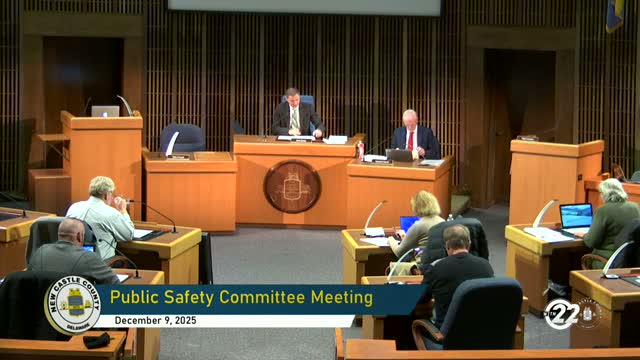
Councilman Kaneko, co‑chair of the New Castle County Public Safety Committee, opened a Dec. 9 meeting where police leaders outlined a proposed technology package with Axon Enterprises that would add a Real Time Information Center (RTIC), refreshed body‑worn cameras and a phased Drone First Responder (DFR) program intended to expand incident awareness and reduce risky officer encounters.
Colonel James Leonard introduced the proposal and acknowledged its cost, saying the package before the committee is “very expensive” but arguing it would multiply officer capacity and improve safety. Lieutenant Cumberbatch, the department’s technology executive officer, described the RTIC as “a centralized hub for information, data integration and operational support,” telling council members the system links live body‑worn and dash cameras, drone video, traffic feeds and automatic alerts into “one pane of glass” for real‑time situational awareness.
Cumberbatch said the DFR concept uses keyword detection from 911 (tools the presenters called Prepared 911 and Live 911) so RTIC pilots can launch drones from pre‑established rooftop sites; in tests he cited a three‑week trial with 177 flights in which the drone arrived before officers about 90% of the time. He said thermal streams, video and remote audio capability let pilots identify suspect direction, vehicles and medical needs and can reduce unnecessary patrol responses. “When a 911 call comes in ... the RTIC is monitoring those calls,” Cumberbatch said, describing examples in which drones located missing people and helped avoid use‑of‑force incidents.
Presenters framed the program as multi‑agency and not limited to policing: Cumberbatch said drones could assist crash reconstruction, fire scene assessment, structural incident response and other emergency management operations. He also described a counter‑drone tool (referred to as D‑Drone in the presentation) that, he said, can identify a consumer drone’s make and model and help trace an operator’s location at large public events.
Council members broadly recognized potential benefits but repeatedly pressed officials on cost, staffing, jurisdiction and oversight. Councilman Smiley asked whether drones require an on‑site officer and whether callers receive follow‑up; presenters said drones can be piloted remotely from county facilities and that RTIC staff would perform callbacks on CAD‑entered incidents when appropriate. On live monitoring of body cameras, Colonel Leonard said continuous live monitoring would be “unreasonable from an FTE perspective” but that supervision and RTIC could stream footage for critical incidents and repeat‑call properties.
Several members asked about the long‑term funding plan. Officials said the vendor relationship with Axon includes auto refreshes for hardware and software updates and that the department is seeking grants and other offsets; Colonel Leonard said fleet allocations were reduced in the FY2027 budget planning to help offset early costs. A total annual figure for the package was described in the presentation as roughly $1,200,000 per year (presenters said approximately "$12,000,000 over the whole package" in the course of discussion), while the broader multi‑year contract figures presented during Q&A varied as members parsed what elements could be removed or phased.
Councilman Hollins said he would not support the proposal without clearer funding commitments, criticizing the timing and scale of the expense and noting open questions about footage release policies and past taser issues. “I’m not gonna support this till we get some more money,” Hollins said. That exchange — and other members’ queries about who would pay if other agencies used the system — framed the committee’s central concerns: operational benefit versus multi‑year financial obligation and civil‑liberty safeguards.
For the committee’s calendar, Chair Kaneko recapped that the discussion touched R‑25203, which would authorize the county executive to execute an agreement with Axon Enterprises, and noted related budget ordinances introduced during the meeting: two small grants (PSEG funding via Delaware Emergency Management and a DOJ special law enforcement assistance fund) plus an ordinance to appropriate $750,000 from the realty transfer tax reserve as a first payment toward the renegotiated Axon contract. No final vote on the Axon authorization or the appropriation was recorded during the December 9 session.
The committee did not take final action on the Axon authorization at the meeting; members asked for additional financial detail and assurances on staffing, callbacks and data‑use policies before advancing a multi‑year commitment. The meeting adjourned after a brief other‑business discussion in which the chair condemned threats made at a recent council member town hall and thanked local police departments for assistance.