Get Full Government Meeting Transcripts, Videos, & Alerts Forever!
Get email alerts on the Ems Response Policy topic
No spam. Unsubscribe anytime.
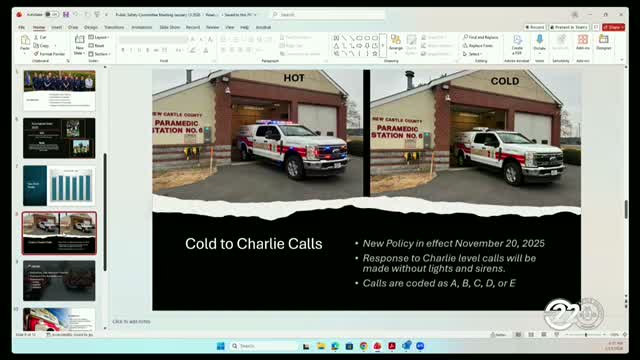
New Castle County EMS adopts 'cold' response for most Charlie calls, cites data and safety
Summary
Assistant Chief Kelly Sarleach told the Public Safety Committee that New Castle County EMS will send paramedics to Charlie-level 911 calls without lights and sirens unless upgraded by BLS crews or dispatch data; staffing, survival rates and a field whole-blood program were also detailed.
New Castle County EMS briefed the council’s Public Safety Committee on staffing, outcomes and a recent operational policy change that limits the use of lights and sirens on most Charlie-level 911 calls. "The only difference is that Charlie level calls, they're going to be responding cold or without those lights and sirens," Assistant Chief Kelly Sarleach said, describing the Nov. 20 change.
Why it matters: Sarleach said the policy is "data driven" and intended to reduce crash risk for responders and the public. County review of 2025 calls showed Charlie-level incidents accounted for about 30% of patient contacts, but "less than 2% of them required a time sensitive intervention," she said. Sarleach said switching ALS (paramedic) responses to cold for Charlie calls increased Charlie response times by about "55% (less than a minute)" and overall response times by roughly 15 seconds—outcomes she described as acceptable given improved safety for crews and drivers.
Staffing and training: Sarleach reported EMS authorized strength at 159 with current staffing at 135 (24 vacancies). The department is running overlapping paramedic academies: the DelTech accelerated academy has a 12-person capacity, and a ninth academy through Good Fellowship Academy is being planned. Councilman Carter pressed whether those academy slots would fill current vacancies; Sarleach said offers had not yet been issued but she expected to recruit and run the next class to close gaps.
Clinical outcomes and equipment: Sarleach highlighted a 40% Utstein survival rate for witnessed, shockable cardiac arrests—about 15 percentage points above the national average—and credited coordinated first-responder care. The EMS division has delivered more than 300 units of whole blood in the field since May 2023 and plans to add new coolers and warmers. Council members praised the results and asked technical questions about use of mechanical-compression (LUCAS) devices; Sarleach said supervisors carry LUCAS devices and they are used during extended compressions and transport.
Public comment and concerns: A public commenter asked about recruit probation and mental-health training; Sarleach said recruits are on probation during training and the department emphasizes mental-health and resiliency resources for staff. Later in "other" comments, Councilman Street raised community concerns about recent shootings and conditions outside a Southbridge paramedic station, urging more attention to safety in Wilmington neighborhoods.
Next step: The committee received the update for information; the paramedic staffing and response policy will be monitored and Sarleach said the department will report back with ongoing safety and outcomes data.