Get Full Government Meeting Transcripts, Videos, & Alerts Forever!
Get email alerts on the Alpr Flock topic
No spam. Unsubscribe anytime.
County police defend use of license‑plate readers, cite 30‑day retention and restricted access
Summary
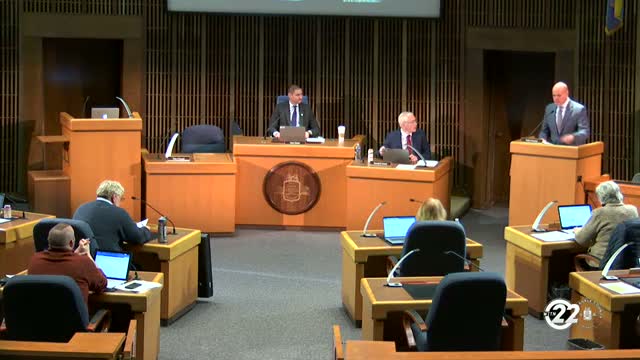
At a Feb. 10 New Castle County Public Safety Committee meeting, police briefed council on Flock automatic license‑plate readers (ALPRs), saying the devices do not use facial recognition, data are retained for 30 days, access is limited to documented investigations and sharing is confined to agencies with formal agreements.
Colonel Leonard of the New Castle County Police Department told the county Public Safety Committee on Feb. 10 that the department uses Flock automatic license‑plate readers (ALPRs) to help investigate major crimes and Amber alerts and that the system does not perform facial recognition.
"One thing is clear: it does not identify people. It doesn't do any type of facial recognition," Colonel Leonard said, describing Flock as a tool that photographs license plates and records time, location and vehicle make. He said the technology has proven most useful in stolen‑vehicle and burglary investigations.
Leonard said the department stores ALPR captures in a cloud and has tightened internal controls in the last six to eight months: searches require a documented law‑enforcement purpose (a case number or a specific investigation), a lieutenant or above must authorize queries that extend beyond Delaware, and a limited number of users can run searches. "You must justify, document, and limit your search to a single license plate," he said.
Lieutenant Cumberbatch explained how the system alerts work: officers upload a "hot list" (for example, a stolen vehicle or a homicide suspect) and the camera network reads only against that list. "Anyone else driving by that camera, we have no clue," he said. He added that captures remain available for 30 days and cannot be retrieved after that rolling window unless they were preserved in an investigation within the retention period.
Council members pressed for specifics. Councilwoman Kilpatrick asked whether searches added after the retention window could retrieve older captures; Lieutenant Cumberbatch replied that the system only retains the prior 30 days and "there's no way for me to see what cars drove by" beyond that period. Councilman Smiley queried whether the cameras are mobile; the colonel said most are fixed (two are moveable) and placements on utility poles require permitting.
The department said current formal sharing agreements exist with the Delaware State Police and Newark Police Department and that it is not aware of active federal sharing agreements, though the colonel said he would confirm and follow up with council. On cost, Leonard said the county’s 14 cameras run about $18,000–$21,000 per year in operating fees and that there is no plan in the FY27 proposal to increase the camera count.
The presentation and Q&A followed requests from privacy advocates and council members; council co‑chair Toole noted that other states have limited ALPR use or changed contracts with vendors. Leonard said the county had paused expansion amid legal questions elsewhere and adjusted policy to increase auditability and limit searches.
The committee heard no formal motion to change the ALPR policy at the meeting; council members asked for follow‑up information on any federal sharing agreements and the department committed to provide it.