Get Full Government Meeting Transcripts, Videos, & Alerts Forever!
Get email alerts on the Synthetic Turf topic
No spam. Unsubscribe anytime.
Carlsbad staff to take Poinsettia synthetic-turf replacement to council after choosing no-infill system
Summary
City staff recommended a no-infill synthetic turf (Pivot/Tenkate) for Poinsettia Community Park, citing reduced PFAS/infill concerns, improved warranties and high recyclability; the $2.2 million project is out for bid and is scheduled for city council consideration on Jan. 13, 2026.
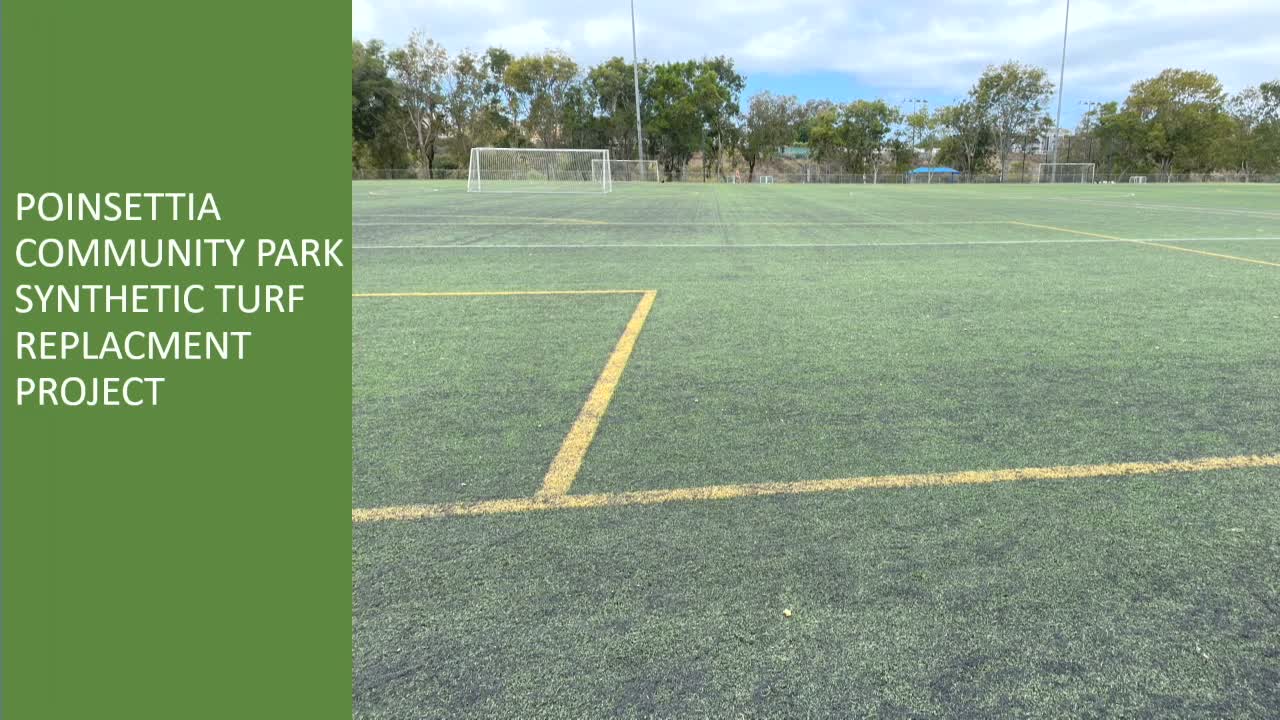
The Carlsbad Parks and Recreation Department outlined plans Nov. 17 to replace the worn synthetic turf at Poinsettia Community Park with a no-infill system intended to reduce health and environmental concerns and increase durability.
Recreation and park staff said the existing field used crumb-rubber (chrome rubber) infill and had a shorter service life. Park Services Manager Todd Reese described the specified product as the Pivot system, manufactured by Tenkate, which uses a mineral ballast rather than loose crumb rubber and a pad beneath the carpet for shock attenuation. "It is free of PFAS or added PFAS, and it has no infill in it," Reese said, adding that the new system carries a 12-year warranty for the surface and that the pad component includes a 25-year warranty.
Why it matters: staff said the design reduces concerns linked to crumb-rubber infill (health and environmental impacts), lowers maintenance needs and can be recycled. Reese told commissioners that on-site recycling currently captures about 94% of material and that manufacturer recycling can raise that to about 99%.
Cost and schedule: Reese presented a fiscal summary showing an appropriation to date of $2,200,000 and said no additional appropriation was needed for the current stage. The project had been out for bid and staff completed the report to be presented to the City Council; Reese said Director Lancaster will lead that council item at the Jan. 13, 2026 meeting, pending docket scheduling.
What staff recommended and next steps: staff recommended awarding a contract after council authorization; Reese said the work is expected to take about two months once construction begins and that paperwork (contracts, bonds, insurance) will precede mobilization. He noted the system’s design—no loose infill, a ballast layer and a long-life pad—was selected after consultant review of health, environmental, cost and performance tradeoffs.
Commissioners asked about recyclability and long-term monitoring; Reese and Director Lancaster said staff looked to comparable installations and vendor testing and would monitor performance and maintenance needs. The commission received the report and staff will present the item to the City Council for authorization to award the construction contract.