Get Full Government Meeting Transcripts, Videos, & Alerts Forever!
Get email alerts on the Grants topic
No spam. Unsubscribe anytime.
Arts Commission reviews proposed FY2026-27 community arts grant changes: eligibility limits, simplified school application and equalized school awards
Summary
Staff proposed limiting community-arts-grant eligibility for organizations that already receive other city funding, simplifying the schools application to a pass/fail model, and keeping the schools cap at $3,500 while reallocating roughly $117,000 across three categories. Commissioners pressed for outreach, presentation formats and the distribution math.
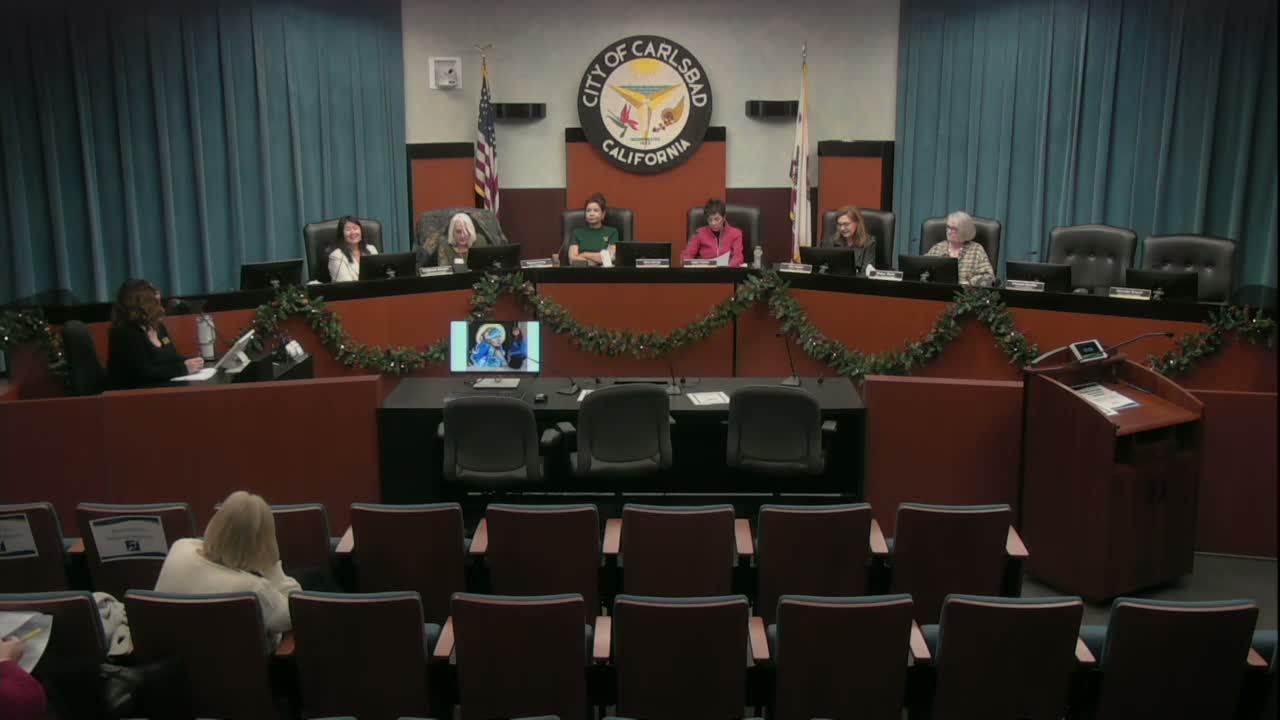
City cultural-arts staff presented proposed revisions to the fiscal year 2026-27 community arts grant guidelines at the Dec. 4 Carlsbad Arts Commission meeting, including new eligibility rules meant to broaden the applicant pool and a simplified, pass/fail awards approach for schools.
Program Manager Crystal Roa told commissioners the community arts grant pool is approximately $117,000 annually and described three applicant categories: arts organizations (maximum award $7,500), emerging arts organizations (maximum $5,000) and educational institutions (arts-in-schools category, maximum $3,500). Roa said payments would be distributed in two parts: 80% on plan/completion and 20% on the final report and budget submission.
To increase the number of distinct grantees, Roa proposed that applicants currently receiving city funds via a professional-services agreement or receiving another city grant outside the community-arts program be ineligible for this competition. "This would allow for more grantees to be able to receive more funding in different ways," she said.
Roa proposed simplifying the schools application (shorter budget questions and removing state-standards requirement) and replacing graded awards for that category with a pass/fail system so qualifying schools would each receive the same fixed amount. She announced a Jan. 15 roundtable with VAPA teachers, principals and booster-club parents to gather input and invited commissioners to attend subject to quorum rules.
Commissioners questioned the decision to hold the school award at $3,500. Roa cited available Prop 28 funds in schools and staff goals to spread funding more equitably. She presented five-year averages showing roughly $45,000 historically allocated to schools and said the commission could divide that pool among applicants; she estimated that if all 17 Carlsbad-area schools applied each would receive about $2,647, and if each applied with three disciplines the per-grantee amount would be about $882.
Commissioners also raised procedural questions about reaching emerging artists, returning to in-person presentations for some applicants, consistency and calibration of juror scoring, and building an outreach list. Roa said staff has been conducting one-on-one outreach, attending CVA meetings and compiling an email list of past and potential applicants; assistant Kim Chavez is leading the applicant-tracking effort. Roa said judges who score out of step with peers are contacted for clarification, and staff reviews scoring anomalies.
No formal guideline changes were adopted at the meeting; staff will hold the Jan. 15 roundtable and return to the commission in February with refined proposals for possible approval.