Get Full Government Meeting Transcripts, Videos, & Alerts Forever!
Get email alerts on the Affordable Housing topic
No spam. Unsubscribe anytime.
Carlsbad staff outlines how state laws and local rules shape recent affordable housing projects
Summary
City housing staff told the Housing Commission that California’s density bonus law and Carlsbad’s inclusionary ordinance are driving recent projects, reporting 143 affordable units completed in 2025 and explaining limits on transfers, waiting lists and voucher moves.
Mandy Mills, director of Housing and Homeless Services, told the Carlsbad Housing Commission on Feb. 12 that the city’s housing element and state laws are the primary drivers shaping recent affordable housing development in Carlsbad.
Mills said the housing element is a zoning plan that “does not approve any specific projects,” and she described how the regional planning body (SANDEG) and state requirements led Carlsbad to designate capacity for about 3,900 new homes through 2029 — roughly 2,100 of which must be affordable or at densities that can accommodate lower-income households. “This is called the housing element of the general plan,” Mills said.
Why it matters: Mills emphasized that zoning alone does not guarantee lower prices and outlined local tools — the city’s inclusionary housing ordinance and the housing trust fund — that have supported the creation of thousands of below‑market units. She also reviewed California’s density bonus law, noting it allows developers to increase residential density in exchange for providing a share of affordable units. Using the law’s sliding scale, Mills demonstrated how a 58‑unit project could expand substantially when the developer provides deeper affordability.
Mills gave specific recent numbers: “143 new affordable units were completed and occupied in 2025,” she said. She noted two projects — Vista Azul Apartments and Vintage at Marsha Acres — received loans from the city’s housing trust fund to support deeper levels of affordability. Mills also listed near‑term projects, including La Costa Town Square Family Apartments and Hope Apartments, and said some projects are accepting interest lists online at carlsbadca.gov.
Commissioner questions and clarifications focused on program details and resident impacts. A commissioner asked when the in‑lieu fee for small projects was last updated; Mills said the city adopted a new fee following a gap analysis in 2022 and that the fee then increases annually with the Consumer Price Index. On income definitions, Mills confirmed the city follows state AMI categories: extremely low is 30% of AMI and very low is 50% of AMI; she explained the “low” category has nuances in state law and that rent‑setting rules do not always match the maximum income thresholds.
On unit assignment, Mills said affordability follows the unit, not the household: a resident who moves into a unit designated for a particular affordability level remains in that unit even if their income later changes. She outlined financing distinctions between projects with “fixed” vs. “floating” units and said density bonuses apply to the specific project that requests them, not to other projects.
Mills also described a recent administrative change affecting voucher moves during a funding shortfall: the city may deny a requested move if the city’s subsidy portion would increase compared with what the household currently receives. She said waiting‑list rules and preference criteria are set in the initial affordable‑housing agreements and generally are not re‑ordered later.
The presentation and Q&A illustrated a shift toward smaller infill projects in Carlsbad: Mills said approvals in 2025 produced more projects but relatively fewer affordable units overall (44 affordable units spread across multiple smaller projects), which contrasts with earlier, larger stand‑alone affordable developments.
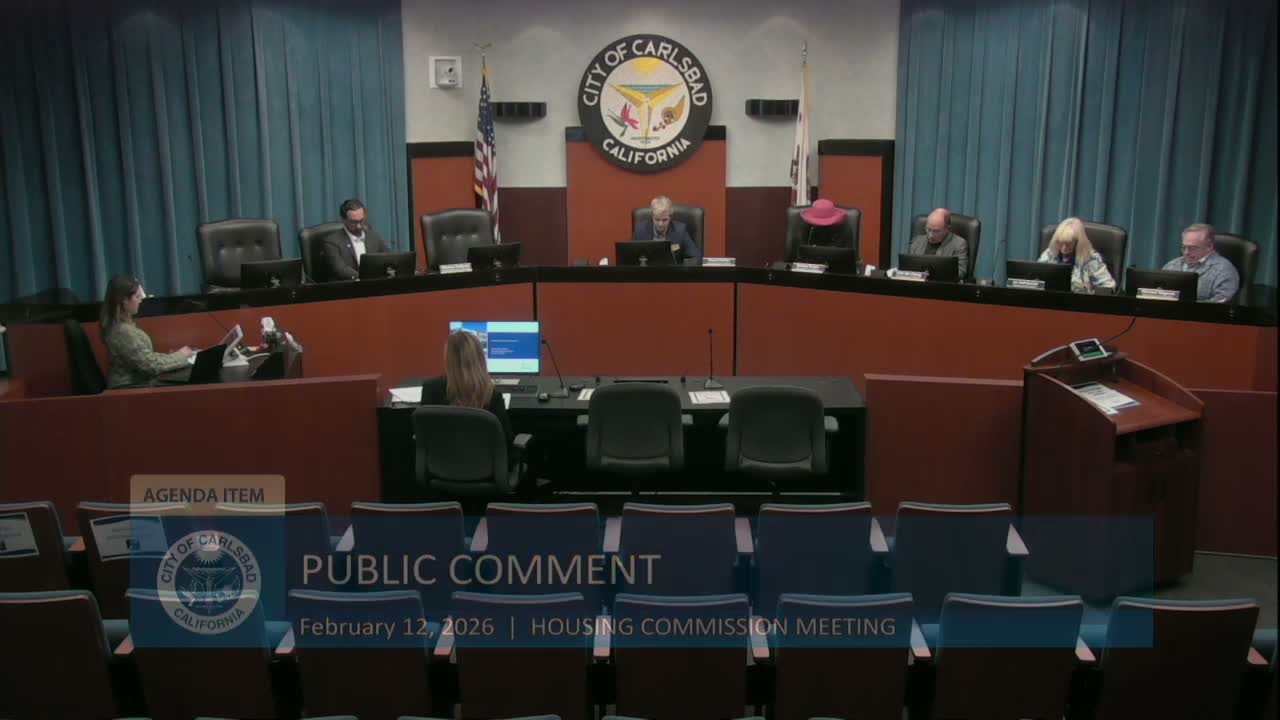
The commission had no public comments on the item. The meeting approved the minutes from Jan. 8, 2026, by a recorded motion that carried “by 5 votes, yea.” The commission adjourned at 4:43 p.m.
What’s next: Staff materials and the tables Mills referenced are included in the meeting packet and the city maintains an online list of existing and coming‑soon affordable projects at carlsbadca.gov under Housing and Homeless Services and the Planning Division.