Get Full Government Meeting Transcripts, Videos, & Alerts Forever!
Get email alerts on the Rebeach Sand Retention topic
No spam. Unsubscribe anytime.
Oceanside presents ReBeach pilot: artificial reef, sand nourishment and regional monitoring plan
Summary
Oceanside coastal zone administrator Jamie Timberlake described a pilot combining an artificial reef, sand nourishment and baseline monitoring intended to retain sand, noted physical and numerical modeling work (including testing at Oregon State), and said the project has nearly $2 million in Coastal Commission grant support and SANDAG backing.
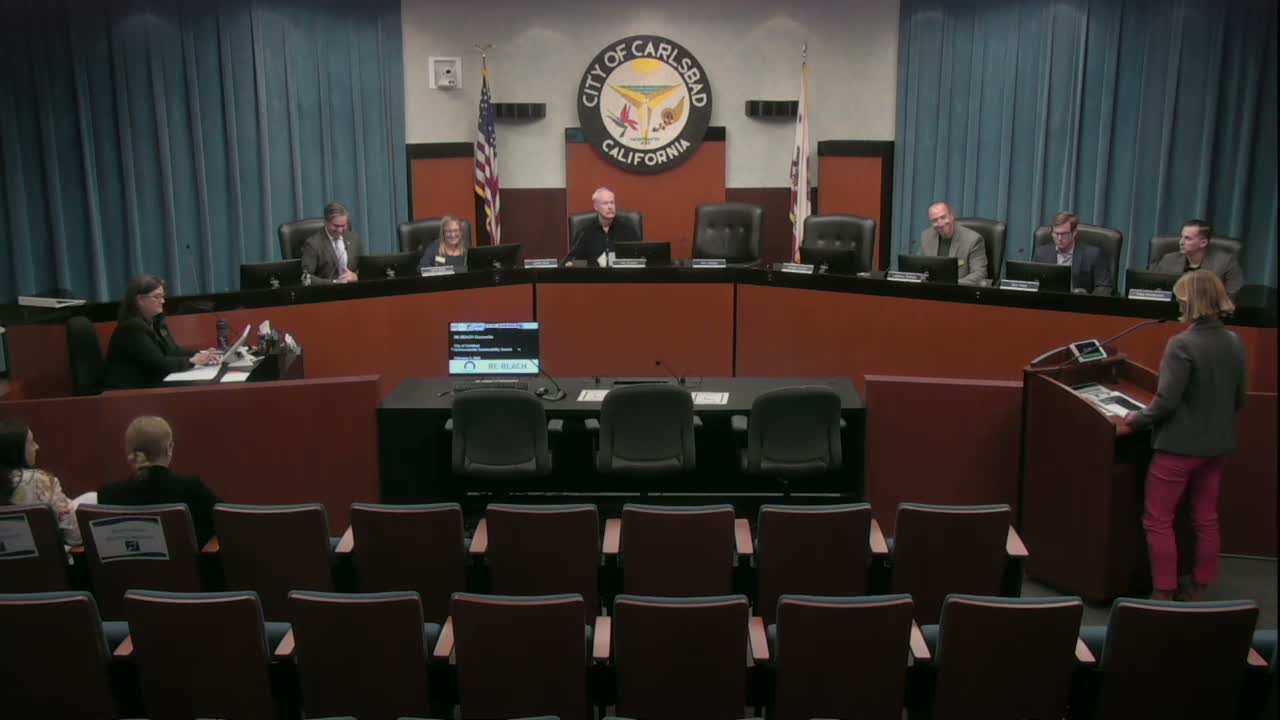
Jamie Timberlake, coastal zone administrator for the city of Oceanside, briefed commissioners on ReBeach, a pilot project that pairs an artificial reef with onshore and nearshore sand nourishment and an adaptive monitoring program intended to reverse chronic beach erosion.
Timberlake described how the city identified a parent reef design after an international design competition and more than 800 hydrodynamic simulations. The selected design is a bidirectional, wave-energy-dissipating reef to be sited in 15' to 22-foot depths between headlands, combined with headland "sand retention" features and onshore nourishment. Timberlake said the project team completed empirical analysis and hydrodynamic modeling, and has begun physical modeling in a directional wave basin at Oregon State University using a roughly 1:35 scale model.
"We're bringing that sand back into the system," Timberlake said, describing the combined reef and sand-nourishment approach. He added Oceanside has an approved local sand-borrow site just west of the project area and that the team is developing an adaptive management plan with 5-year performance monitoring benchmarks.
Timberlake told the commission Oceanside received nearly $2,000,000 in grant funding from the California Coastal Commission to augment monitoring and that the city has funded much of the project to date. He said the project is expected to be shovel-ready by 2027 and that SANDAG designated ReBeach as a regional sand-retention pilot that could be integrated into updated regional policy documents and funding strategies.
Commissioners pressed technical questions about whether the physical modeling in Oregon would capture effects in Carlsbad; Timberlake said the physical basin primarily tests the reef and that the morphological numerical model extends down through Carlsbad to the Tamarack jetties, which will help predict beach changes in adjacent jurisdictions. He also described material choices: layered cobbles and larger quarry rock (Timberlake cited Catalina Quarry as a source for heavy rock units used in the design).
Charlie Bowen, communications director for Save Oceanside Sand, told the commission his group supports the pilot and praised the project's baseline monitoring and public outreach.
Commissioners asked that Carlsbad staff continue to engage with Oceanside project staff about monitoring and adaptive management so the city has its own baseline data to evaluate potential downcoast effects. No formal action or vote was taken; staff said they will continue coordination and provide updates as modeling and permitting proceed.