Get Full Government Meeting Transcripts, Videos, & Alerts Forever!
Get email alerts on the Investment Policy topic
No spam. Unsubscribe anytime.
Carlsbad board backs investment‑policy updates to tie liquidity to six‑month cash‑flow
Summary
The Investment Review Board voted unanimously to send proposed 2026 updates to the city’s investment policy to City Council, replacing a fixed two‑thirds‑of‑budget liquidity requirement with a rolling six‑month cash‑flow measure and aligning credit rules with state law, officials said.
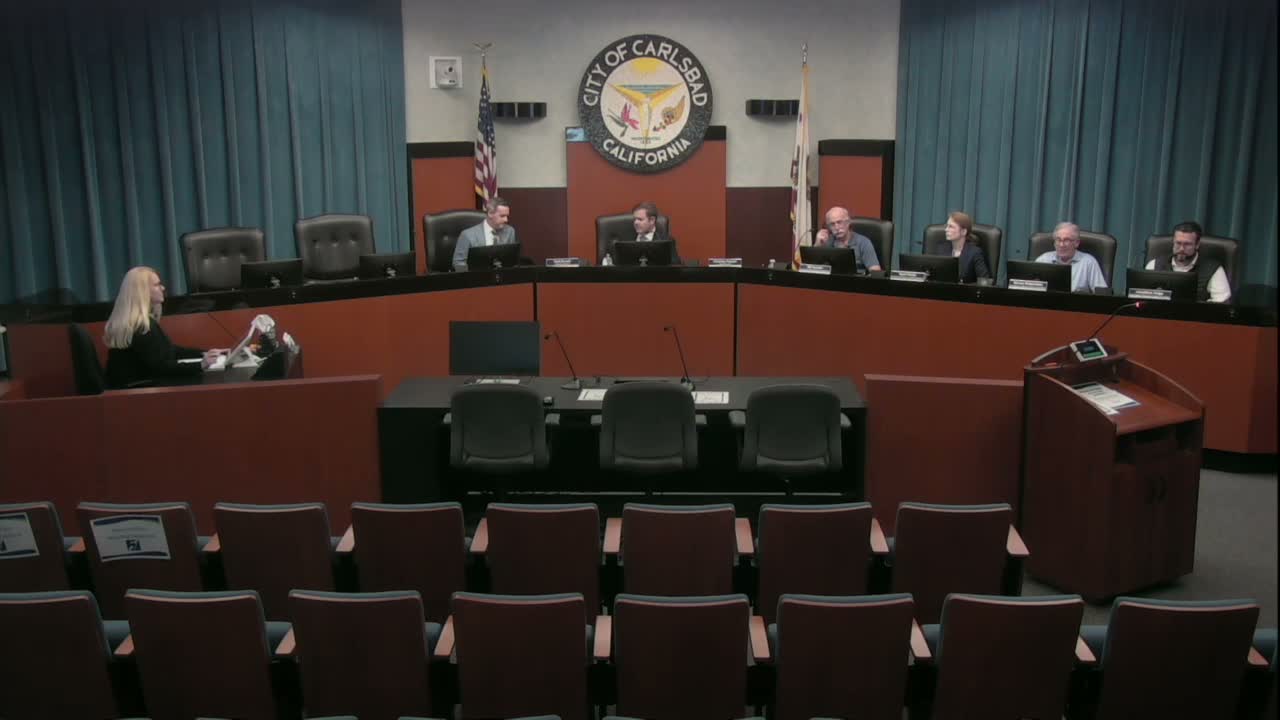
City Treasurer Christian Peacock told the City of Carlsbad Investment Review Board on Dec. 1, 2025, that staff was proposing several updates to the city’s investment policy intended to better align the policy with cash‑flow needs and state guidance.
"The prudent investor standard requires us to act under prevailing conditions," Peacock said, arguing the proposed refinements would "strengthen liquidity discipline by more directly tying the portfolio to projected expenditures" and would not loosen safety requirements.
The proposed changes that the board approved for referral to City Council include: raising allowable allocations for municipal bonds from 15% to 20% and bankers’ acceptances from 25% to 40%; permitting money‑market mutual funds and mutual funds at a combined up to 20% of the portfolio; adding placement service deposits and certificates of deposit (proposed 30% allowance); aligning corporate‑note rating requirements to a single A (as allowed by state statute); increasing the allowable commercial paper maturity in line with state law; and removing a fixed maximum on modified duration as an operational management tool.
Treasurer Peacock and staff said the most important shift is the liquidity standard. The current policy requires a fixed liquidity target—two‑thirds of the annual operating budget—while the recommended change would require that cash plus investments maturing within the next six months, together with projected base operating revenues, be sufficient to cover the city’s anticipated six‑month expenditures. Staff cited a historic worst‑case six‑month drawdown of about $36.1 million (June–November 2025) as part of the analysis informing the recommendation.
Peacock said the city carries substantial liquidity today: "As of December 2025, we had over $130 million in primary liquidity or cash plus another $200 million in investments maturing within 12 months," which he described as roughly $330 million of near‑term liquidity—nine times the largest observed six‑month drawdown.
Board members asked how the rolling six‑month requirement would be calculated and monitored. Staff said the calculation would be recomputed monthly, incorporating known operating expenditures (payroll, debt service and scheduled capital outlays) and that the city would maintain internal buffers as appropriate for contingencies such as natural disasters or major capital projects (Treasurer Peacock referenced a planned Veterans Park project of roughly $38 million). Officials emphasized that the policy language would assert the city must be able to meet the next six months of obligations, while detailed numeric buffers would be tracked internally and reported in quarterly reviews.
On credit standards, staff proposed aligning the city’s corporate‑note minimum to an A rating by a nationally recognized statistical rating organization, rather than the more restrictive split‑rating previously required. Peacock said this change preserves investment‑grade quality while expanding the universe of issuers available for opportunistic purchases.
A motion to accept the policy recommendations as presented and forward them to City Council for adoption carried unanimously. The board’s action was procedural—the board recommended the change; formal adoption rests with the City Council.
What comes next: staff will prepare formal policy language and packet materials for City Council consideration and continue monthly liquidity reporting to the board as part of the quarterly investment reviews.