Get Full Government Meeting Transcripts, Videos, & Alerts Forever!
Get email alerts on the Procurement topic
No spam. Unsubscribe anytime.
Internal audit finds procurement compliant but inefficient; council introduces purchasing-code amendments
Summary
An internal audit found Carlsbad's procurement contracts generally complied with law but identified inefficiencies and recommended raising the city manager's approval threshold (audit suggested $150,000); staff recommended raising it to $250,000, proposing code changes to reduce duplicate council approvals and a timeline for policy updates tied to a core-systems modernization project; council voted to introduce the ordinance.
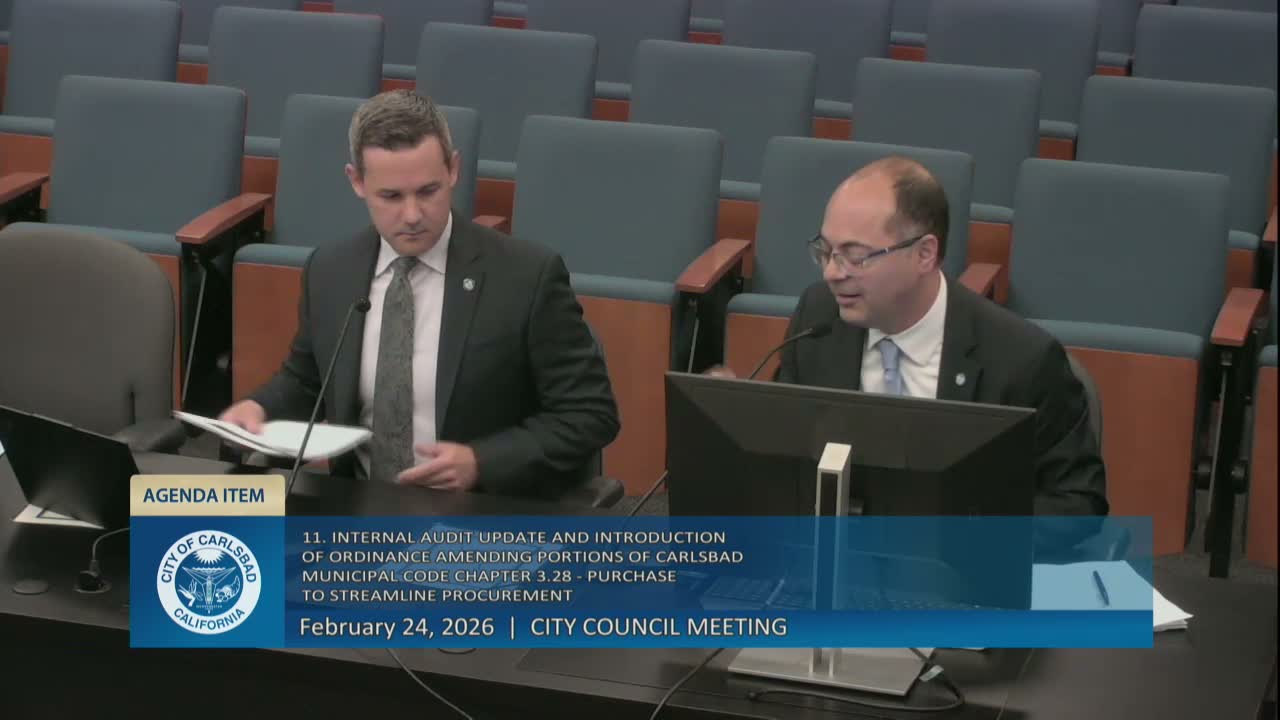
Internal Audit Manager Tufik Tafshuri presented a procurement audit that found the city's sampled contracts complied with legal requirements but noted that internal controls, while effective, are sometimes cumbersome and that procurement procedures and the purchasing manual had not been updated since 2016.
Tafshuri recommended the council consider increasing the city manager's award authority from $100,000 (set in 2008) to at least $150,000 to reflect inflation and proposed developing a more nuanced risk-based tool for counsel approval rather than a single financial threshold. He also recommended updating the purchasing manual and evaluating centralization versus decentralization of procurement duties.
Finance Director Zach Korach's management response recommended increasing the city manager's award authority to $250,000 and continuing monthly reporting of purchase orders greater than $45,000 to the council. Korach and audit staff said the city is midway through a core-systems modernization project and that purchasing-policy updates and potential structural changes (including a consultant study on centralization) would follow implementation of new systems.
Council asked clarifying questions about whether the change would require new positions (staff said it would not necessarily create a new position but could designate an existing designee), examples of why council previously reviewed plans before bidding (staff said it was rare for council to change RFPs once issued), and how comparable jurisdictions manage thresholds. On motion, the council voted to introduce an ordinance amending portions of chapter 3.28 (Purchasing) consistent with the audit recommendations.
What happens next: Staff will track implementation of audit recommendations, proceed with the core-systems modernization, update the purchasing manual, and bring the ordinance back through the introduction-to-adoption process.