
Commissioner presses need for major transmission upgrades to meet 2035 generation goals
Get AI-powered insights, summaries, and transcripts
Subscribe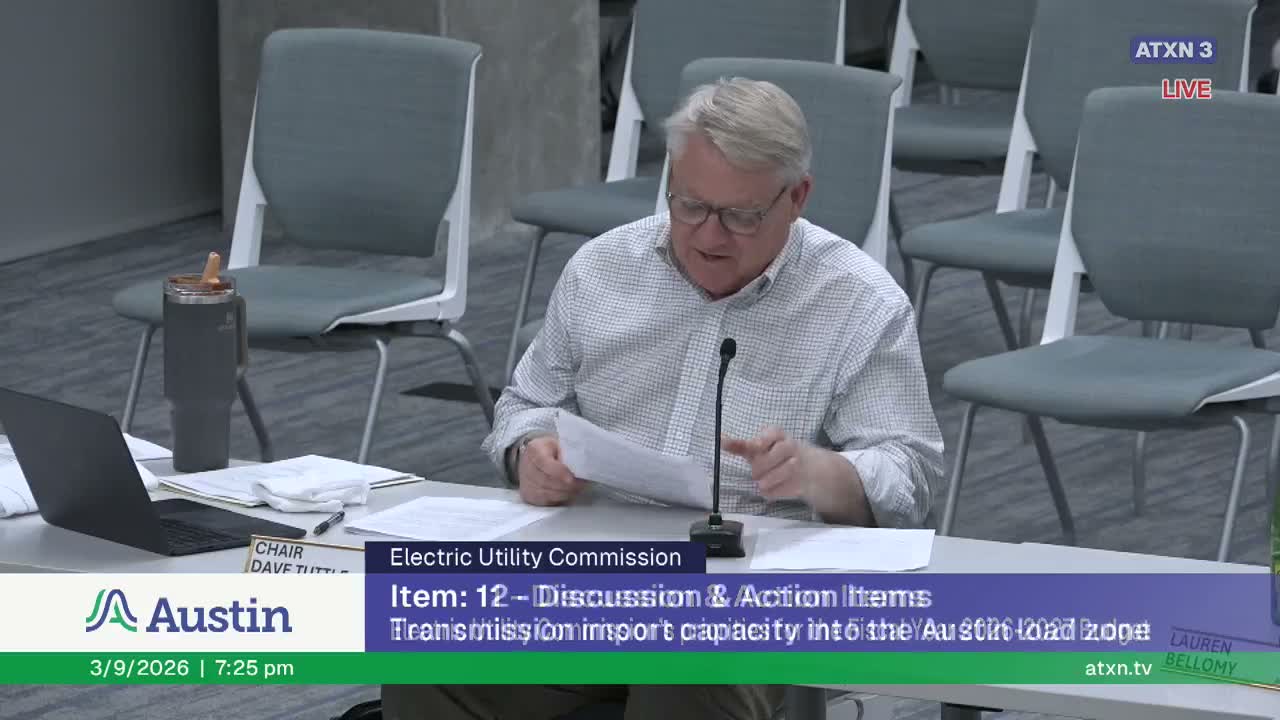
Summary
Commissioner Braden argued Austin needs substantial new high‑voltage import capacity and local grid work to meet the 2035 resource generation goals, citing Decker and peaker plant closures that left a roughly 700 MW in‑town gap and recommending staff provide a public transmission update.
Commissioner Braden used the March 9 meeting to lay out why additional high‑voltage transmission access is central to Austin Energy’s Resource Generation Plan and carbon‑reduction goals.
Braden said Austin’s historical reliance on in‑town generation and a concentrated set of east‑side interconnections leaves the city constrained when bringing in remote renewable power. He summarized recent local closures — including Decker and peaker plants — and described an estimated 700 MW in‑town gap plus the potential for larger shortfalls when other in‑town plants retire. “We’re talking about 2 gigawatts of power that we really need to be able to bring in from the outside more effectively,” Braden said, and he urged staff to return with an update on transmission planning and easement/right‑of‑way status.
Braden emphasized benefits from ERCOT’s planned high‑capacity backbone (765 kV CREZ/highway lines), which he said could break down east‑west congestion and enable more West Texas wind and solar to serve Austin customers. He described local needs for new 345 kV sources and additional reactive‑power infrastructure to manage voltages across the city as more remote renewables are integrated.
Stuart Riley and COO Lisa Martin told the commission they would prepare a public‑space update and provide information about easements and what is in the public record. Martin noted that some transmission operations details are restricted under standards of conduct, but she said staff can compile and present public materials and status updates.
Commissioners asked how existing rights‑of‑way and earlier planning work — including prior debates about a city perimeter loop — could affect build‑out costs and timing. Braden urged an early, serious look because transmission and major interconnection projects are long‑lead, generational undertakings that grow harder with delay.
Staff agreed to return with a transmission update that draws on publicly available ERCOT and project materials and to respond to specific commissioner questions about rights‑of‑way and interconnection timing.