Get Full Government Meeting Transcripts, Videos, & Alerts Forever!
Get email alerts on the State Legislation topic
No spam. Unsubscribe anytime.
Assemblymember Tasha Burner outlines 2025 wins, pushes telecom and affordability reforms
Summary
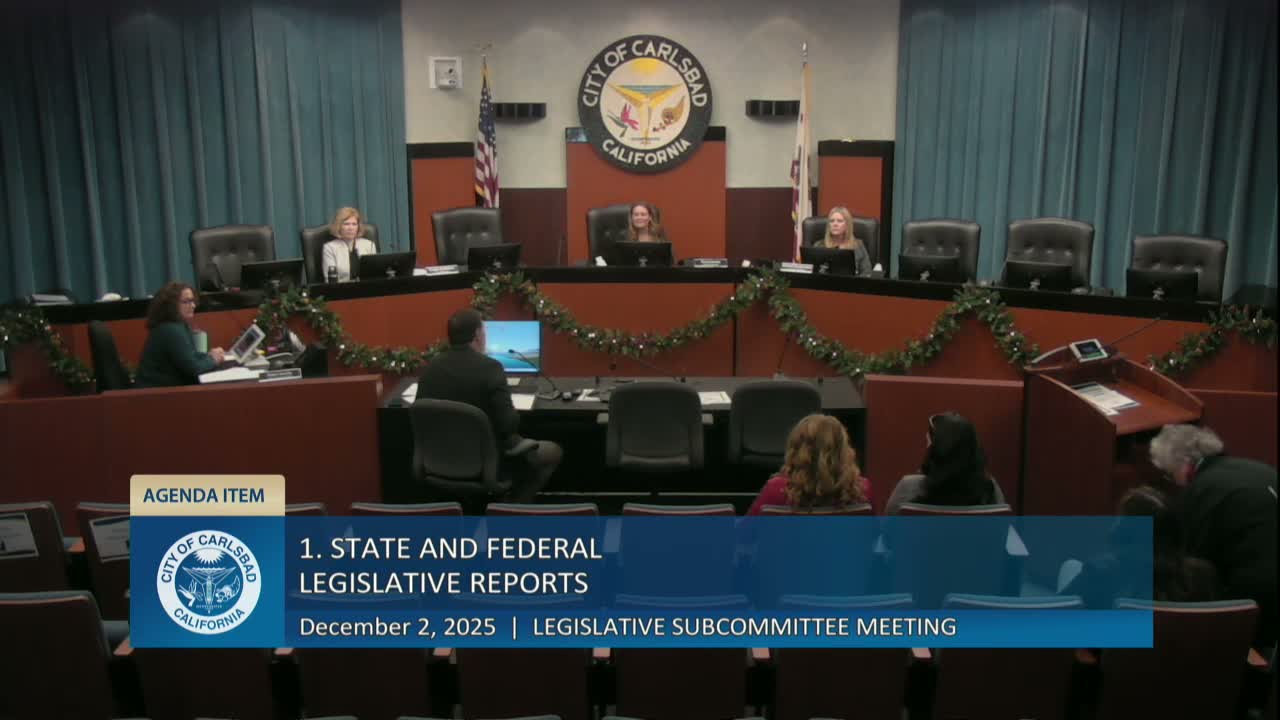
Assemblymember Tasha Burner (D-77) briefed the Carlsbad Legislative Subcommittee on 2025 legislation and priorities, highlighting bills on density-bonus misuse, utility rate transparency and a proposed ACA 9 to shift broadband governance and require affordability in CPUC rate decisions.
Assemblymember Tasha Burner (77th District) told the Carlsbad Legislative Subcommittee that the 2025 legislative year was ‘‘a tough session’’ but included several wins and a priority shift toward affordability and infrastructure.
Burner reviewed bills her office sponsored and supported, including AB 87, which she said clarifies that density bonuses cannot be applied to visitor-serving uses; AB1017-related reforms to increase transparency in utility rates; and a proposal she described as ACA 9, which would move certain broadband responsibilities out of the California Public Utilities Commission (CPUC) and ‘‘add a statutory constitutional requirement for the CPUC to look at affordability when setting rates.’’
Why it matters: Burner framed ACA 9 and the utility measures as structural fixes to address rising costs for households and to increase transparency around distribution and transmission charges. ‘‘If we're gonna have density bonus, it needs to have the affordability and applying it,’’ Burner said when explaining AB 87. On the utility measures she said the reforms will make clear ‘‘where is the money going, where is the money flowing.’’
Burner also described her work on consumer protections for e-bikes and e-motorcycles and noted two bills that were vetoed this year: one relating to ‘‘blue carbon’’ mitigation and another intended to ban plastic microbeads in rinse-off personal-care products. She said broadband access and rate transparency remain priorities: ‘‘If you do not have broadband, you are excluded from the economy and society,’’ she said.
Assemblymember Burner answered questions from council members about ACA 9 and broadband governance. She said ACA 9 would take the telecommunications piece out of the CPUC's constitutional authority and place broadband-related functions primarily in the Department of Technology (CDT) under statute, while maintaining statutory oversight for telecommunication companies. "ACA 9 will add a statutory constitutional requirement for the CPUC to look at affordability when setting rates," she said.
What comes next: Burner invited questions and said she would follow local conversations on e-bike policy and utility reforms, and would return to Sacramento to continue work on affordability and broadband access.