Get Full Government Meeting Transcripts, Videos, & Alerts Forever!
Get email alerts on the Open Space topic
No spam. Unsubscribe anytime.
Carlsbad sustainability commissioners hear calls to protect Ponto, strengthen open-space work plan
Summary
Public commenters and several commissioners urged Carlsbad’s new Environmental Sustainability Commission to prioritize acquisition and equitable distribution of open space—highlighting Ponto, a city study that projects 32 acres lost to sea-level rise, and calls to honor the city's long-standing 40% open-space goal.
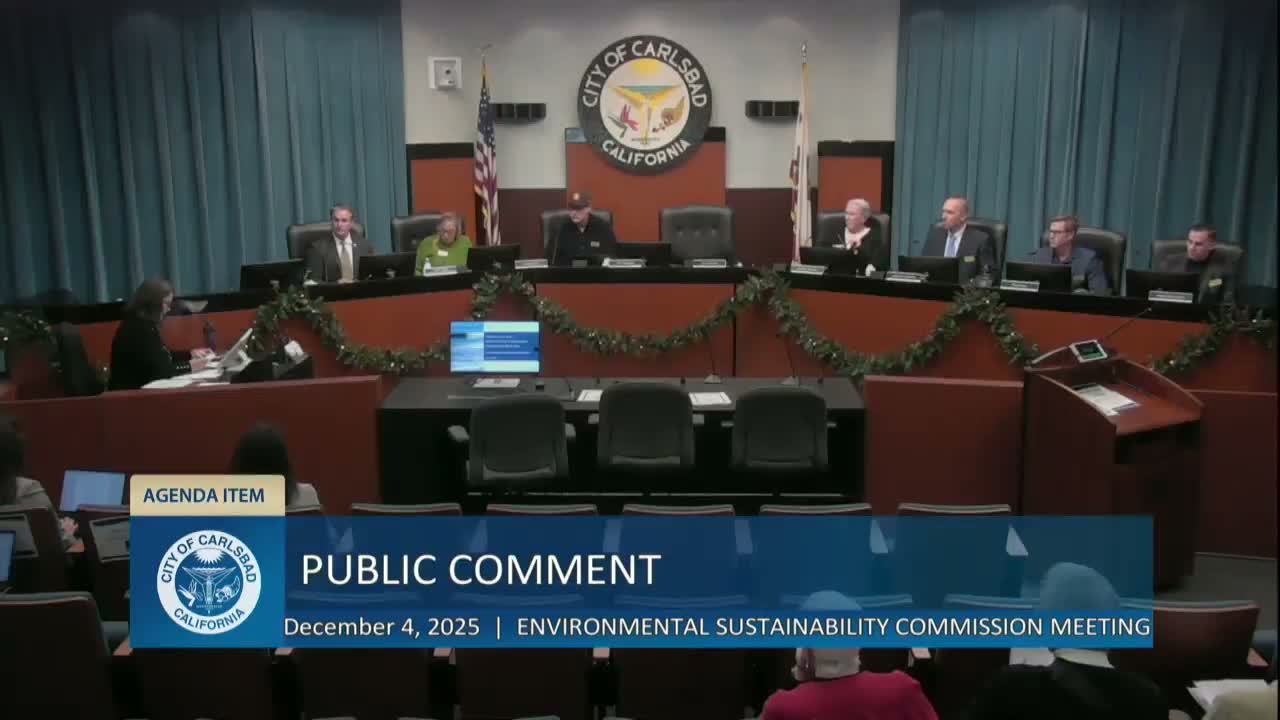
The Carlsbad Environmental Sustainability Commission spent much of its meeting reviewing a draft 2026 work plan as residents urged stronger action on open space and coastal resilience.
Residents and members of local advocacy groups told commissioners the city must do more to secure parkland and natural preserves, spotlighting Ponto as an area of urgent concern. Lance Schulte said more than 7,600 people had submitted written testimony to the city and the California Coastal Commission about the importance of open space at Ponto and alleged developers were allowed exceptions that reduced usable parkland. Schulte cited a city study he said showed Ponto could lose 32 acres of usable open space from sea-level rise and asked the commission to include protections in its work plan.
"We need to be thinking in terms of the setbacks and other issues," Schulte said, arguing the commission is "charged with protecting that resource and making sure that it's planned in the proper way to assure sustainability in the future." (Lance Schulte)
Paige Desino, speaking on behalf of the Carlsbad Sierra Club, asked the commission to back state-level climate legislation—citing bills often described as a "polluters pay" climate superfund—and connected those measures to escalating insurance costs and harms to frontline communities.
Several speakers who served on or led the Carlsbad Tomorrow Growth Management Citizens Committee urged the commission to move beyond presentations and take concrete steps: updating the open-space acquisition list, proactively pursuing parcels for preservation, and reestablishing an open-space committee to ensure equitable distribution across the city's 25 local facility-management zones.
"Open space should be distributed throughout the city, particularly mindful of areas deficient in open space," said Eric Larson, recalling committee recommendations to inventory candidate properties for acquisition.
Commissioners discussed the draft language that directs the commission to "discourage exemptions to city development standards." Staff said that phrase originated in a council minute motion and that the commission could propose alternative wording when it forwards its recommendation to the City Council. Several commissioners requested an educational presentation on the 40% open-space commitment referenced by several speakers and a breakdown showing how the city's reported roughly 38% total open space divides between developed parkland and natural preserves.
Natalie Reed and Jamie Wood of staff told the commission that the first year is intended as an education year—"receiving presentations"—but commissioners retain the option in year two or by motion to prioritize specific acquisition or policy actions sooner.
The meeting record shows the commission captured public input on several related items—growth-management recommendations, exemptions to development standards, zone-level deficits, and sea-level–rise impacts—and asked staff to fold those comments into the draft work plan before it is forwarded to the City Council for adoption and implementation.
The commission concluded that discussion by asking staff to include the requested briefings and to return with draft policy language if commissioners want to recommend changes to the council.