Get Full Government Meeting Transcripts, Videos, & Alerts Forever!
Get email alerts on the Government Transparency topic
No spam. Unsubscribe anytime.
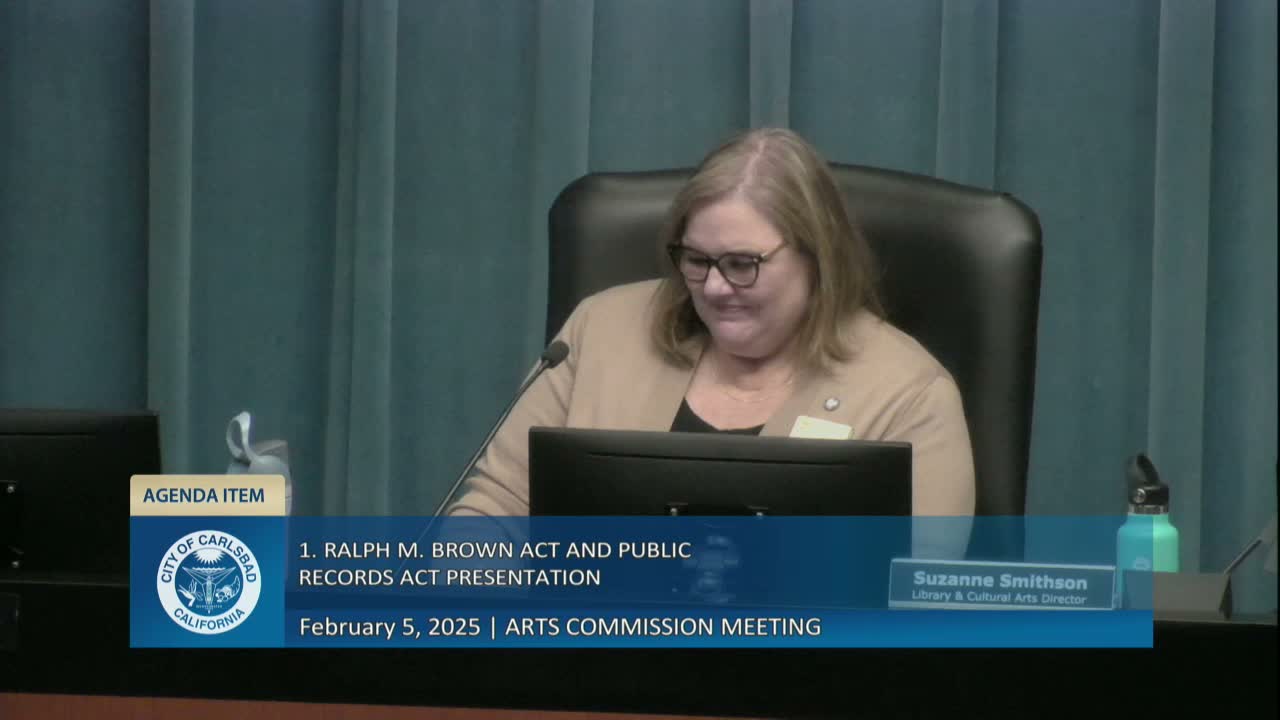
City attorney briefs Carlsbad Arts Commission on Brown Act and public‑records rules
Summary
City Attorney Cindy McMahon and Assistant City Clerk Morgan Fry gave commissioners a refresher on the Brown Act and California Public Records Act, emphasizing that many emails, texts and some social‑media interactions are public records and that serial communications can constitute a meeting.
City Attorney Cindy McMahon and Assistant City Clerk Morgan Fry told the Carlsbad Arts Commission on Feb. 5 that commissioners should assume most communications about commission business are public records and that even electronic and social‑media interactions can trigger Brown Act obligations.
"Most paper and electronic documents that are sent to or from the city are considered city records," McMahon said, adding that "this includes emails and text messages even if they are sent to or from personal devices." She told commissioners to assume records related to their official roles may be subject to public disclosure and to consult their staff liaison or the city attorney’s office with questions.
McMahon reviewed the Brown Act’s broad definition of a meeting, warning that serial conversations or intermediated exchanges among a majority of commissioners can amount to an unlawful meeting. "If Chair Chung talked to Commissioner George and then talked to Commissioner Carrillo, and then to Commissioner Ferroni — that's a majority," she said, explaining the risk of unintentional meetings that exclude public notice.
On conflicts of interest, McMahon reviewed the Political Reform Act and Government Code section 1090 (self‑dealing). She described the recusal process: when the chair calls an item, a commissioner who is disqualified should state the conflict, leave the dais and return once the matter concludes.
Assistant City Clerk Morgan Fry outlined logistical requirements: regular meeting agendas must be posted 72 hours in advance (24 hours for special meetings), the consent calendar can be handled as a single vote unless an item is pulled, and the city’s records repository and public records request portal (ten‑day response) are available resources. She described the meeting archive and a sound‑bite search tool that locates topics within recorded meetings.
Commissioners asked whether casual social encounters or likes on social media could create public‑meeting obligations. McMahon advised caution: while commissioners may post on social media, she said they should avoid responding in ways that could be viewed as communicating about commission business with a majority of members. Fry said the city clerk can research whether alternate public venues have the same streaming and recording capabilities as the commission’s usual room.
The presentation was positioned as guidance for spotting potential issues and prompting follow‑up with staff rather than a substitute for formal legal advice; both presenters directed commissioners to the clerk's manual and FPPC resources for technical questions.