Get Full Government Meeting Transcripts, Videos, & Alerts Forever!
Get email alerts on the Adu Regulations topic
No spam. Unsubscribe anytime.
Council introduces ordinances to align Carlsbad ADU rules with new state law; resolution approved unanimously
Summary
Associate Planner Shelly Glennon presented seven proposed amendments to Carlsbad’s ADU rules to align with state legislation effective January 2025; council introduced ordinances, approved a notice of exemption and will submit amendments to state reviewers, voting unanimously.
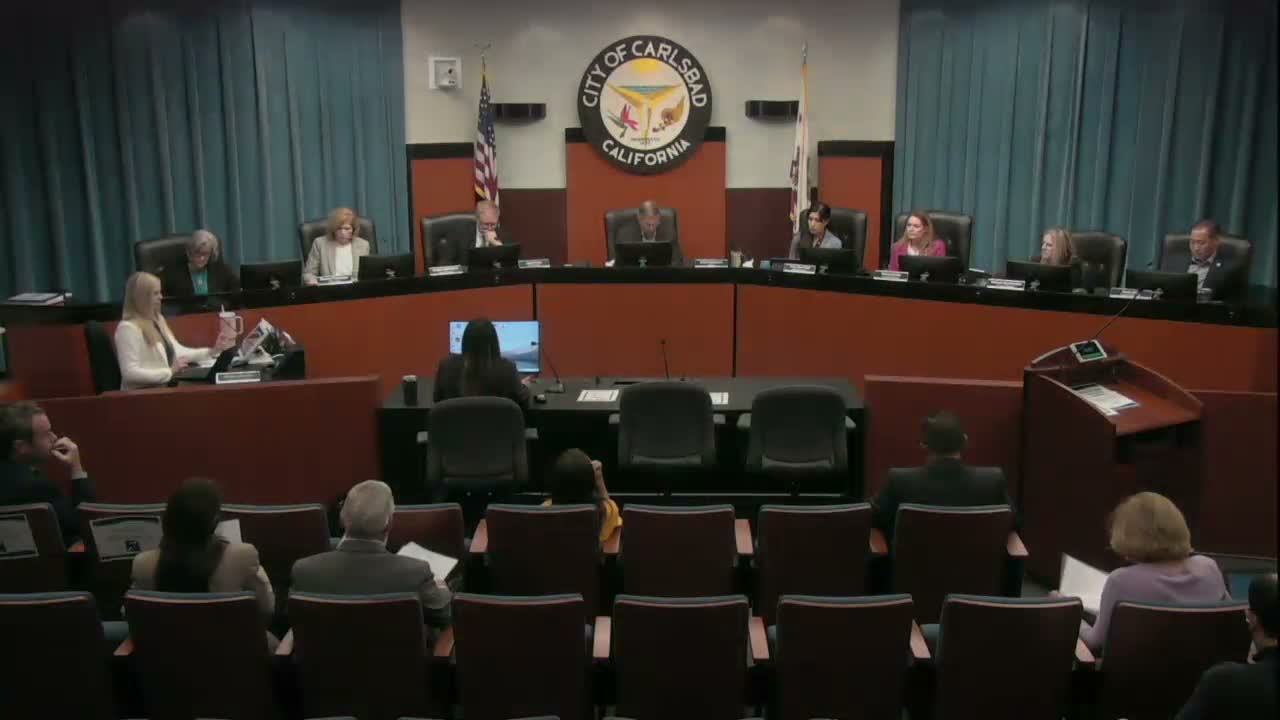
The Carlsbad City Council voted unanimously to introduce two ordinances and adopt a resolution to align the city’s accessory dwelling unit (ADU) regulations with new state law, following a staff presentation that outlined seven targeted code updates.
Associate Planner Shelly Glennon presented the 2025 ADU Amendment Project, saying the revisions were drafted in coordination with the state Department of Housing and Community Development to ensure consistency with state ADU legislation effective January 2025. She described several proposed changes including clarifying that attached ADUs must include new square footage, conversion ADUs must be contained within the dwelling or accessory structure and be subject to lot coverage requirements, and that the 1,200‑square‑foot maximum for detached ADUs applies only on single‑family lots.
Glennon said the proposed ordinance also updates allowable unit counts to reflect recent changes in the Government Code: single‑family lots may have up to three units and certain existing multifamily lots may allow more detached ADUs consistent with state limits, subject to setbacks and height rules. She described a parking replacement exemption that would apply in more situations (with coastal‑zone exceptions), a height allowance that could add 2 feet for detached ADUs within a half‑mile of a qualifying high‑quality transit corridor (which does not currently exist in the city), and an explicit recognition that state‑mandated ADUs are exempt from certain local design standards.
The draft also proposes replacing a notice of restriction with a deed restriction for JADUs where state law requires recording. Glennon said the Planning Commission unanimously recommended approval and recommended exemption from environmental review under CEQA; a draft notice of exemption was posted in November 2025.
After closing the public hearing with no speakers, Councilmember Bob Patel moved to adopt the notice of exemption, request Coastal Commission certification of the local coastal program amendment, and introduce the ordinances to amend the zone code/LCP and municipal code; the motion passed unanimously. Staff will submit the municipal code and zone code amendments to HCD and the California Coastal Commission as required. Glennon advised that zone code amendments will become effective outside the coastal zone and the municipal code will become effective citywide 30 days after adoption, while LCP amendments require Coastal Commission certification before effect in the coastal zone.
The action advances local regulations to reflect state ADU law while preserving the city’s engineering requirements for water and sewer capacity and coastal‑zone exceptions.
Next steps: staff will submit the ordinance and LCP amendment to state reviewers for final action.