Get Full Government Meeting Transcripts, Videos, & Alerts Forever!
Get email alerts on the Housing Element topic
No spam. Unsubscribe anytime.
Carlsbad council approves Coastal Commission modifications and mapping corrections for housing element rezone program
Summary
Council approved staff recommendations to accept the Coastal Commission’s suggested modifications to the housing element rezone program and to correct four mapping errors, with staff saying the changes protect coastal resources while preserving the city’s housing inventory.
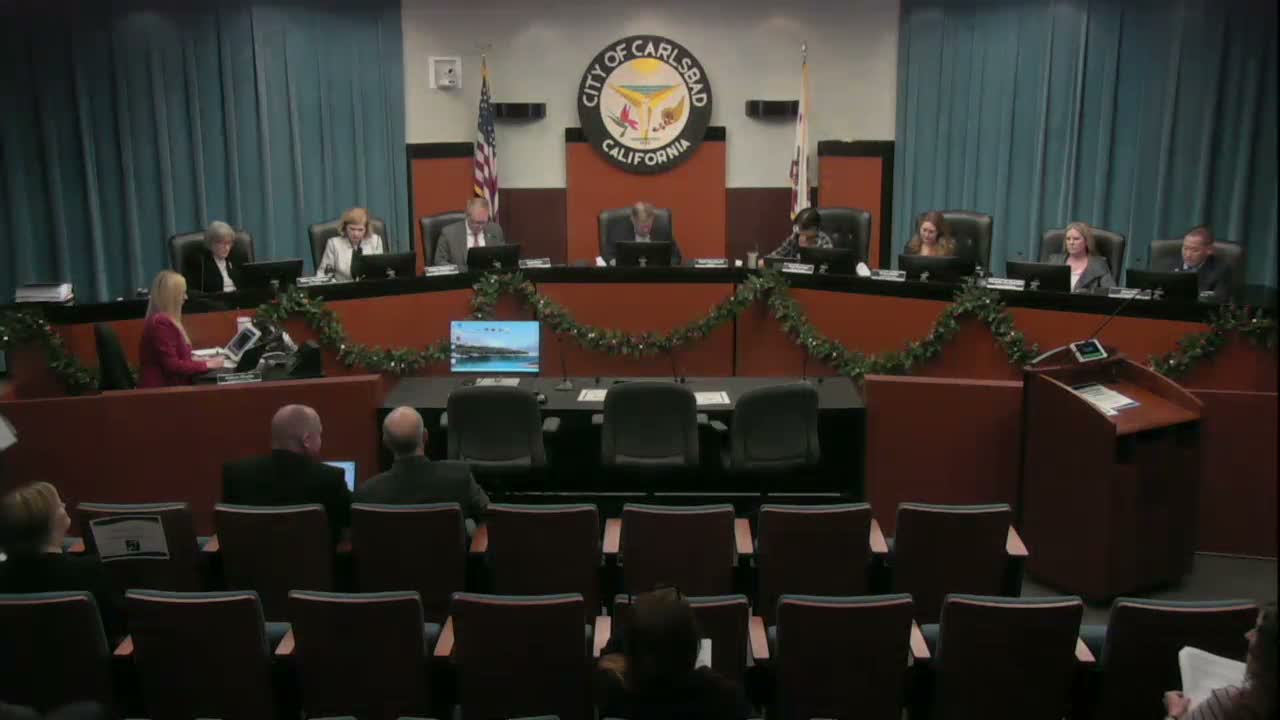
Carlsbad city staff asked the City Council to accept suggested modifications from the California Coastal Commission that refine the city’s housing element rezone program and correct mapping errors for four sites in and near the coastal zone. The council approved the two‑part action after a staff presentation and brief questions from council members.
The city manager introduced the item as a required step to obtain Coastal Commission verification for sites in the city’s coastal zone. Senior planner Scott Donnell said the action is primarily a technical set of edits intended to protect sensitive coastal resources—particularly vernal pools at the Poinsettia Coaster Station (identified as Site 17)—while retaining land use designations and development densities that support the housing element.
Donell told the council that the suggested modifications focus on two coastal sites—Site 17 (Poinsettia Coaster Station) and Site 19 (La Costa Glen Forum)—and include parcel‑specific limitations and language to preserve open space and habitat. He said Coastal Commission staff coordinated with city staff and wildlife agencies, including the California Department of Fish and Wildlife and U.S. Fish and Wildlife Service, to draft measures aimed at protecting vernal pools and other resources.
Council members asked staff to respond to a letter from the North County Transit District (NCTD) that raised seven concerns about the proposed approach. A planning staff member said the city reviewed each point and disagreed with the assessment that the amendments improperly imposed unprecedented parcel‑specific restrictions or jeopardized the sites’ inclusion in the housing element inventory. Staff noted the site’s assumed capacity of 27 units in the city’s January 2024 housing element and said changes to the local designations and densities would remain intact if the modifications are adopted.
Staff explained that adopting the suggested modifications preserves the city’s overall housing element timeline; withdrawing the package and reapplying would restart a multi‑year process and could jeopardize certification. The staff recommendation combined (1) adoption of a resolution acknowledging receipt and approval of the suggested modifications and (2) introduction of an ordinance to implement the land‑use changes and to correct mapping errors that previously blurred open‑space boundaries at four sites.
No members of the public spoke during the hearing on this item. Councilmember discussion focused on clarifying NCTD concerns and confirming that staff would include an “additional materials” memo when the implementing ordinance returns. The council moved, seconded, and adopted the staff recommendation unanimously.
The council’s action directs staff to forward the council’s concurrence to the Coastal Commission; the commission’s executive director will verify implementation at an upcoming Coastal Commission hearing, after which the local coastal zone changes will take effect.