Get Full Government Meeting Transcripts, Videos, & Alerts Forever!
Get email alerts on the Broadband topic
No spam. Unsubscribe anytime.
Charter says Southampton fiber build largely on track but costs rose after undergrounding
Summary
Charter Communications told the Southampton County Board of Supervisors the three-locality VADI fiber-to-the-premises build is advancing, with roughly 4,962 passings planned in the county, but unplanned underground construction has driven costs from about $34 million to over $60 million; Charter said it will absorb the additional cost and staff outlined mapping and ‘challenge’ steps to serve missed addresses.
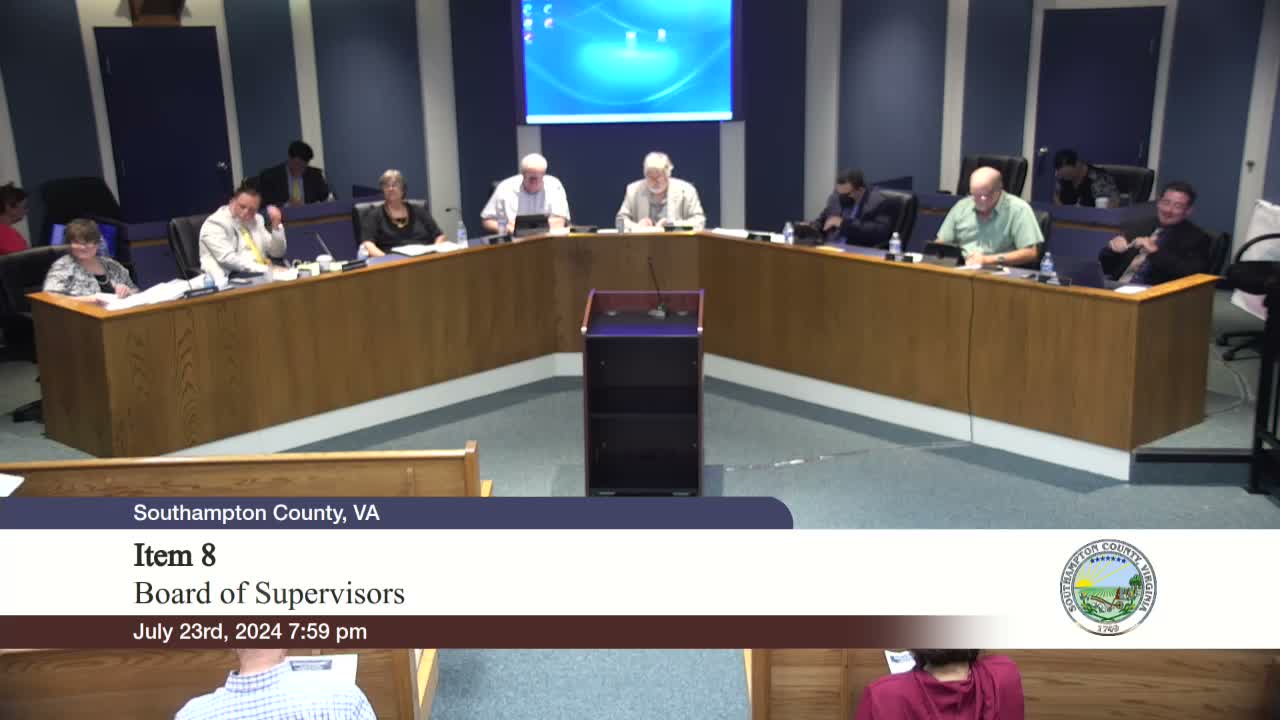
Eric Collins, director of government affairs for Charter Communications, told the Southampton County Board of Supervisors the company is progressing on a multi-jurisdictional fiber-to-the-premises build funded in part by a VADI grant signed July 8, 2022, with a 36-month completion period.
Collins said the three-locality project included about 12,223 passings total and about 4,962 passings assigned to Southampton County. He said some portions required switches from aerial to underground construction because crews could not attach to certain poles, which more than doubled the project’s estimated cost—from about $34 million to ‘‘probably looking at over $60,000,000.’’ Collins said Charter committed to absorb the additional expense so the build could continue.
Collins described mapping and data challenges that left some addresses off the original VADI lists. He explained that older FCC census-block mapping treated a block as ‘‘served’’ if one household in the block had service, which can hide unserved addresses. State and federal mapping updates and the B-program (the NTIA-funded broadband equity program) provide address-level data; Collins said Charter and local staff are rechecking shape files and address points to capture missed homes and plan extensions.
Board members pressed Collins about unresolved addresses on Delaware and Monroe roads and whether fiber runs past those houses; Collins said the project team needs the specific address points to identify and schedule extension work. He reported activation numbers and miles of fiber deployed in the county and said he expects completion within the 36-month contract window (target July 7, 2025).
Why it matters: the build is intended to deliver high-speed service to rural households that previously were treated as served by coarse mapping. Charter’s commitment to cover unanticipated construction costs reduces the immediate fiscal impact on the county, but supervisors will still monitor which addresses remain unserved and whether supplemental state B-program funding will be pursued.
What’s next: Collins said Charter will continue biweekly steering-committee coordination with county staff to identify missing addresses and to pursue extensions where needed; he said the state’s B-program process will provide an additional path to fund builds to isolated homes.