Get Full Government Meeting Transcripts, Videos, & Alerts Forever!
Get email alerts on the Mineral Mining topic
No spam. Unsubscribe anytime.
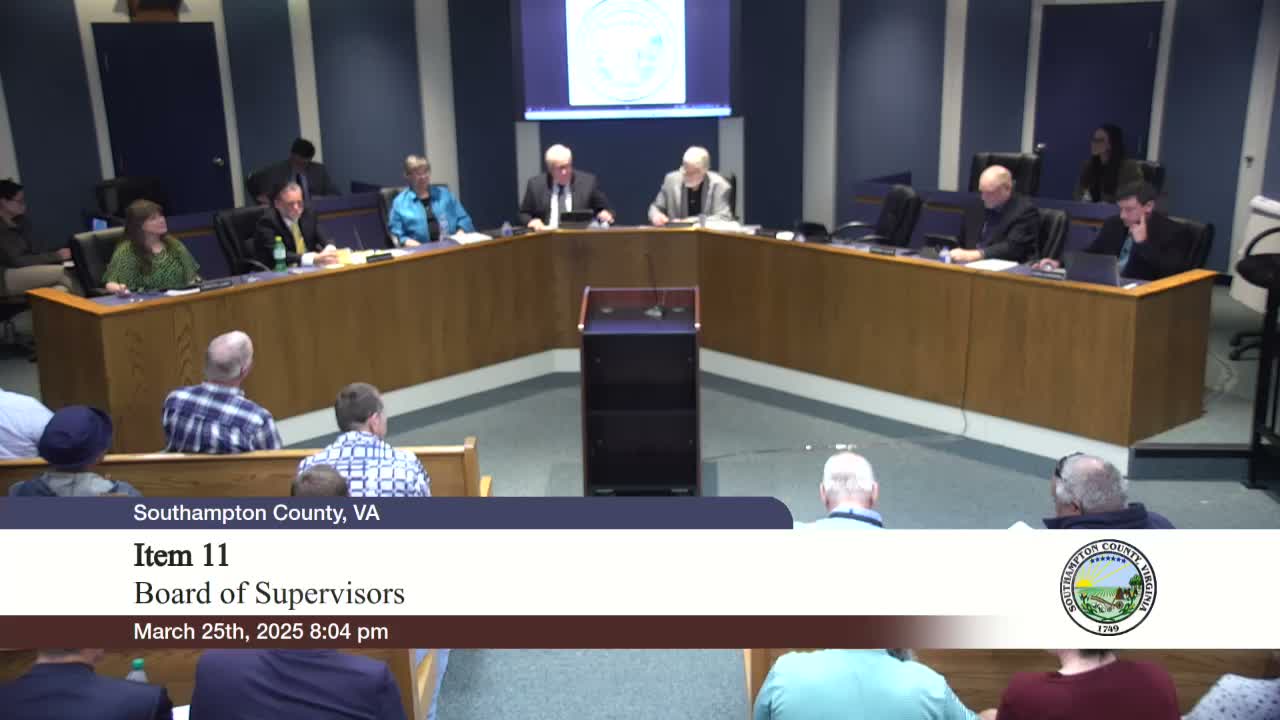
Southampton supervisors approve 65-acre sand-extraction permit after heated public hearing
Summary
After a multi-hour public hearing in which residents, tribal representatives and environmental advocates urged delay for archaeological and environmental study, the Southampton County Board of Supervisors approved a conditional use permit for a 65-acre borrow pit proposed by Gray Construction, with conditions and commitments on buffers, a paved entrance and mitigation measures.
The Southampton County Board of Supervisors voted to approve a conditional use permit for a 65-acre sand-extraction operation proposed by Gray Construction after a protracted public hearing in which dozens of residents and tribal leaders urged the board to delay action and order further studies.
The vote followed several hours of testimony that split the room: supporters emphasized local jobs, community donations and the company’s willingness to install mitigation measures; opponents warned of flooding, well-water contamination, silica dust and the loss of archaeological resources. The Planning Commission had recommended approval on a 4–3 vote.
“I would like to see them continue to grow with it,” said Alex J. Gray, who described the business as a local employer. Gray (speaker 22) told the board the company would install a paved, perpendicular entrance to meet VDOT requirements, build a 70-foot minimum paved entrance, and use surface-water ponds to circulate process water rather than pumping from local wells.
Residents and tribal advocates disputed the proposal’s safety and long-term effects. “There are graves out there,” said Vernon Darden, a lifelong hunter of the area. Ray Tucker, another resident, warned of silica dust and said, “Silica dust is one of the main resources in sand… it is a big thing with OSHA.” Raqeem Smith, whose property would sit in front of the proposed pit, said noise, air and water concerns would harm his family’s health and quality of life.
Company representatives and staff described specific mitigation steps included in the application and planning package: a dedicated construction entrance with more than 1,000 feet of line-of-sight, a minimum 70-foot paved drive, a proposed 200-foot vegetative buffer (the applicant agreed to make it a solid 200 feet where requested), dust-control measures, lower-decibel backup alarms on equipment, and a planned dry hydrant and emergency-access protocol tied to the pit’s on-site ponds.
Several tribal leaders, including Leroy Hardy Jr., urged archaeological surveys before any disturbance. Doctoral-level researchers and community members told the board they had found historical evidence and cited state consultation requirements for projects affecting potential cultural resources.
Board members debated whether to table the application for further study so that an absent member could vote and so that archaeological and environmental questions could be addressed. A motion to table was made but an objection carried 3–2; the board proceeded to debate and then passed the CUP motion by voice vote after a motion from a supervisor who cited VDOT clearance, DEQ oversight, and the applicant’s proposed mitigation.
The board recorded the motion as approved; the administrative record shows the Planning Commission’s conditions will be enforced and regular inspections will be required. The board’s action included commitments to a buffer, annual inspections, adherence to DEQ mining regulations, and the installation of a dry hydrant and gated emergency access.
Opponents said they would press for additional steps — particularly archaeological sampling and independent environmental review — as the permit moves to implementation. The board also instructed staff to re-advertise any tabling or deferred items as necessary.
The board’s action leaves open follow-up tasks: confirmatory archaeology surveys, finalization of VDOT entrance permits, and DEQ permitting. County staff and the applicant said they would continue to coordinate with neighbors on buffer planting and other mitigation.
The board took the action during its regular meeting; several agenda items were deferred or scheduled for re-advertisement as a result of the late-night hearing.