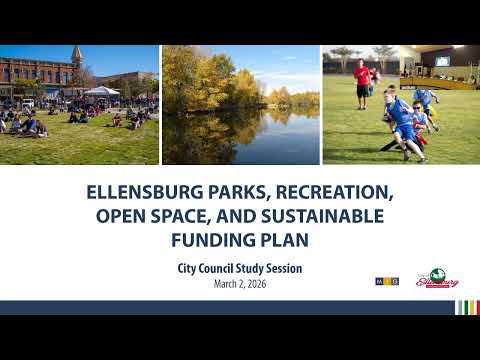
Ellensburg study session reviews $117 million parks plan and funding options
Loading...
Summary
City staff and consultants presented a draft Parks, Recreation and Open Space Plan recommending about $117 million in capital projects, a six-year prioritized Tier 1 package (~$3.6M) using existing revenues and a Tier 2 list (~$6.9M) tied to new funding such as a park/public facilities district or tax measures.
Cindy Mendoza, the MIG Consulting project lead, told the Ellensburg City study session on March 2 that the draft Parks, Recreation, Open Space and Sustainable Funding Plan lays out 136 recommendations and roughly $117 million in capital projects over the planning horizon. "If you add these all together, you will find that there's about a 117,000,000 worth of projects," Mendoza said, adding that the plan pairs that capital list with a six-year funding strategy.
Mendoza said the plan is framed as a 10-year guidance document with a six-year action plan to match capital funding cycles and meet Recreation and Conservation Office (RCO) requirements. The presentation summarized public outreach—more than 1,200 online survey responses and 147 popup-event participants—and said community priorities included an aquatic facility, repair and replacement of worn features, and expanded trail connections. "The key thing here really is on funding sustainability," Mendoza said, describing a two-tier approach: Tier 1 projects that can be matched to existing revenue (impact fees, real estate excise tax, insurance proceeds) and Tier 2 projects that depend on new revenue sources.
The plan identifies about $3.6 million in Tier 1 projects across eight sites and 13 discrete efforts—examples cited include repair and replacement work, a universal play area at Kiwanis Park and spray-ground repairs at North Alder Park. Mendoza said Tier 2 could add approximately $6.9 million in capital projects if the city pursues options such as increased impact fees, a bond measure, a park or public facilities district, or expanded grants and partnerships. She noted the field house project is advancing through a developer-led approach and would be leased to the city, shifting some costs from capital to operations.
Council members pressed staff and the consultant on operations and survey reliability. Mendoza said current maintenance and operations expenditures run on the order of $3 million to $3.5 million annually and that adding new facilities could increase O&M by roughly $2 million to $3 million per year, underscoring the need to plan for operations as well as capital. Nancy Littlequist raised concerns about the survey's statistical validity, noting the 1,200 respondents may skew toward those most interested in parks. "The question that you had in the survey about willingness to pay is encouraging," Littlequist said, adding that the result is not a randomized, statistically valid percentage. Mendoza recommended conducting a representative poll before placing a tax measure before voters.
Delano Palmer and other members asked how Ellensburg’s priorities and risk-profile comparisons line up with similar communities; Mendoza said the challenges are common regionally, particularly for large projects that require sustained public support. Council members also discussed the possibility of coordinating with Kittitas County on a countywide facilities district to fund regional items. Staff and commissioners emphasized the importance of public education about what a feasibility or operations study does—and does not—guarantee regarding design and construction.
Mendoza outlined next steps: refine impact-fee methodology as part of the comprehensive-plan update, pursue applicable grant opportunities (including RCO programs) for Tier 2 projects, and collect any final edits before returning the draft for formal consideration. The council and staff thanked MIG and city staff for the outreach and analysis; the session adjourned and reconvened at 19:00 with proclamations on the next agenda.
The presentation and discussion did not include any formal motions or votes; council members directed staff to continue refining the plan and the funding analysis before bringing an adoption item back to a future meeting.