Get Full Government Meeting Transcripts, Videos, & Alerts Forever!
Get email alerts on the Short Term Rentals topic
No spam. Unsubscribe anytime.
Kearney council postpones downtown and short-term rental code changes after public pushback
Summary
After an hour of public comment and detailed staff explanations, the Kearney City Council voted to postpone proposed downtown adaptive-reuse rules and a new short-term rental permitting system to Jan. 27, 2026, asking staff for more analysis, outreach and clarification on enforcement, occupancy and fee details.
The Kearney City Council on Monday postponed proposed amendments to downtown zoning and new short-term rental (STR) rules after residents and council members raised questions about enforcement, equity and fees.
City planner Melissa Dordio Harris walked the council through a package of code changes that would allow limited residential conversions of one-story downtown buildings (up to 40% of floor area away from street-facing facades) and create a new STR permitting regime covering definitions, annual licensing, occupancy tied to ‘‘sleeping areas’’ with two points of egress, life-safety requirements and complaint-driven enforcement.
During public comment and council questions, property owners and STR operators pressed staff on why the city would require permits without routine inspections, how anonymous noise or other complaints would be verified, how occupancy limits would be calculated, and whether Airbnb and Vrbo would remit the City’s hotel-occupation tax. Tim Sinner, a local property owner, argued the rules risked treating STRs differently from long-term rentals and hotels: “If these standards are about safety, they should be enforced consistently across all housing, not selectively,” Sinner said. Operator Tyler Wilterning said small owners have thin margins and asked how the city will identify and enforce noncompliant listings.
Planner Dordio Harris said the permit is intended primarily to provide the city with contact information for enforcement and to support collection of the hotel-occupation tax, and that the city had contacted platforms but learned large-scale tax remittance typically requires statewide or multi-city agreements. She noted a 60-day compliance period for existing listings, that inspections would be complaint-driven (or by request), and that occupancy calculations follow the International Property Maintenance Code’s square-foot rules.
Council members debated the proposed fee (first-year higher, then an annual permit), the 12-person maximum under the draft, and whether to apply different rules in the city’s extraterritorial jurisdiction. Several council members and staff recommended clearer educational outreach for operators and residents before final action.
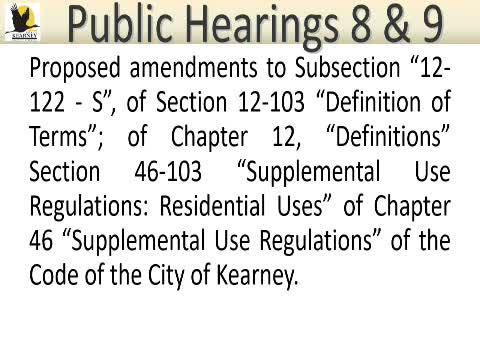
Citing the volume and substance of questions and a desire to provide additional public information, a council member moved to postpone Public Hearings 8 and 9 to the Jan. 27, 2026 meeting; the motion was seconded and adopted by roll call. Council directed staff to return with clarified fee options, enforcement procedures, examples of occupancy calculations, and an education plan ahead of the reconvened hearing.
The postponement leaves current code in place; the planner said the online permit application can go live once an ordinance is adopted, but that no immediate compliance action is required during the 60-day registration window if the ordinance is later approved.
What’s next: staff will prepare outreach materials and revised ordinance language and present them at the January 27, 2026 council meeting for further action.