Get Full Government Meeting Transcripts, Videos, & Alerts Forever!
Get email alerts on the Land Use Data Centers topic
No spam. Unsubscribe anytime.
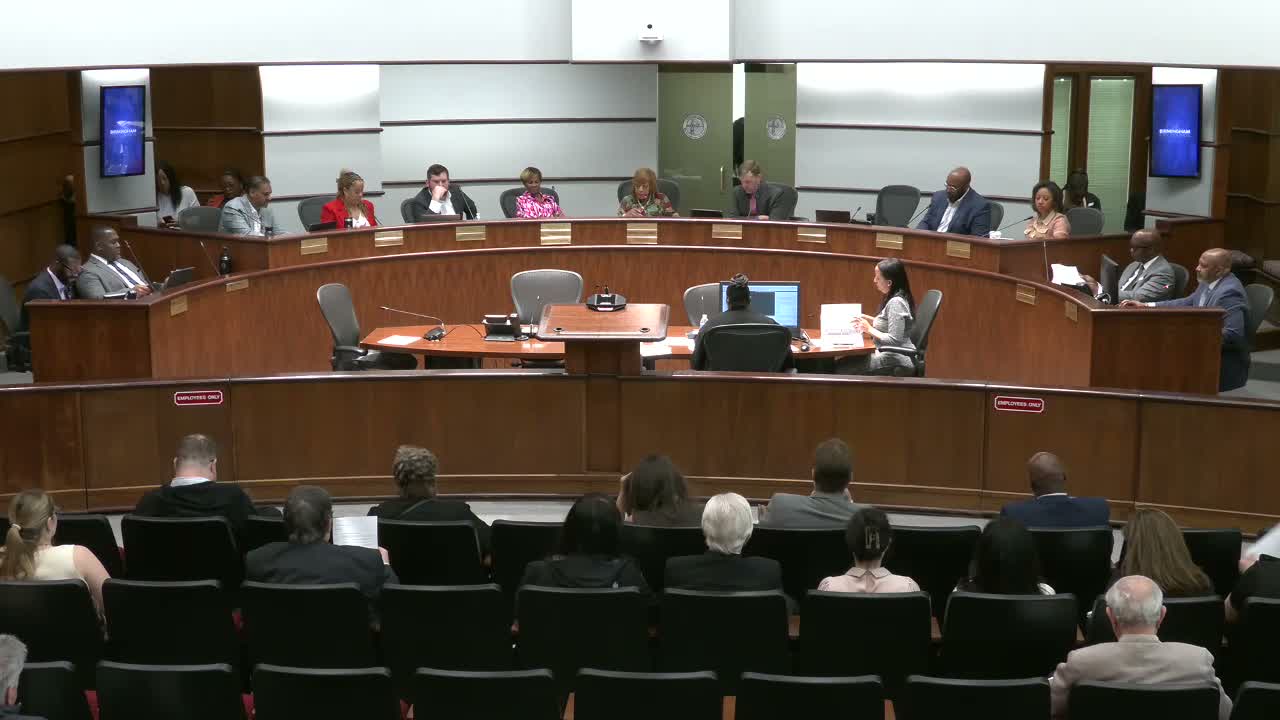
Birmingham council adopts temporary suspension on large data center permits after extended public hearing
Summary
After a lengthy public hearing and questions from council members, Birmingham’s City Council voted to adopt a temporary suspension on permitting for large (hyperscale) data centers — defined in staff drafts as projects above 20 megawatts — while staff advances permanent zoning rules. The suspension exempts applications already deemed complete.
The Birmingham City Council voted March 3 to adopt a temporary suspension on permitting for large and hyperscale data centers while city staff proceeds with draft zoning amendments and public engagement.
Katrina Thomas, director of Planning, Engineering and Permits, told the council staff has completed draft zoning amendments and that the moratorium’s purpose is to “maintain the status quo while staff researched and drafted appropriate land-use standards,” noting the draft would exclude projects under 20 megawatts and would not apply to applications already deemed complete. “There are two pending applications,” Thomas said; those applications, she said, would continue under current regulations and are not automatically subject to the moratorium.
Hunter Garrison, deputy director of the Mayor’s Office of Resilience and Sustainability, summarized technical concerns that prompted the expedited code work: energy demand and grid impacts, water consumption and cooling systems, noise and light impacts, and general land-use compatibility. Garrison described the 20-megawatt threshold as the industry guidance cited by planners: “20 megawatts and below would be exempt. Above 20 megawatts would be the suspension would apply to those.”
Staff offered an accelerated schedule for permanent code adoption: a Planning Commission hearing on March 18, a Planning and Zoning Committee recommendation the week of March 24, a council public hearing potentially set for March 31 and a final council hearing as early as April 28 if the timeline holds. Councilors discussed options ranging from shortening the suspension to referring the matter back to committee.
Residents and advocacy organizations filled the chamber for the public hearing. Dozens of speakers urged a pause while the city finalizes rules, citing concerns about noise, air emissions from backup generators, water withdrawals for cooling systems, the use of PFAS in closed-loop cooling systems, and property impacts. “By putting something there, it’s going to hurt the value of my home,” said Jennifer Gossard, an Oxmoor Valley resident. Environmental groups such as GASP and the Southern Environmental Law Center told the council that data centers’ cumulative impacts require a pause to ensure protections for nearby neighborhoods.
Several speakers also asked why projects already in the review queue would be exempt. City attorney staff and professional staff said longstanding zoning and vested-rights principles, plus the applicants’ position in the review process, limit the city’s ability to retroactively apply new standards to applications that are complete and under review. City attorneys and staff advised the council that exemptions apply only to applications that have been formally filed and deemed complete, not to informal discussions or pre-application outreach.
The ordinance the council passed directs staff to continue the accelerated regulatory process while temporarily suspending permitting for large/hyperscale data centers as defined in the draft. The council chair announced the motion passed; the transcript does not specify a roll-call tally in the chamber record for the final moratorium vote.
Next steps: staff will present the draft zoning amendments to the Birmingham Planning Commission on March 18 and pursue the adoption timeline discussed in the hearing. The public record and staff materials will be available through PEP as the rulemaking proceeds.