
Kenmore staff: permit reviews largely steady, fewer pre-apps; city met state permit-reporting deadline
Get AI-powered insights, summaries, and transcripts
Subscribe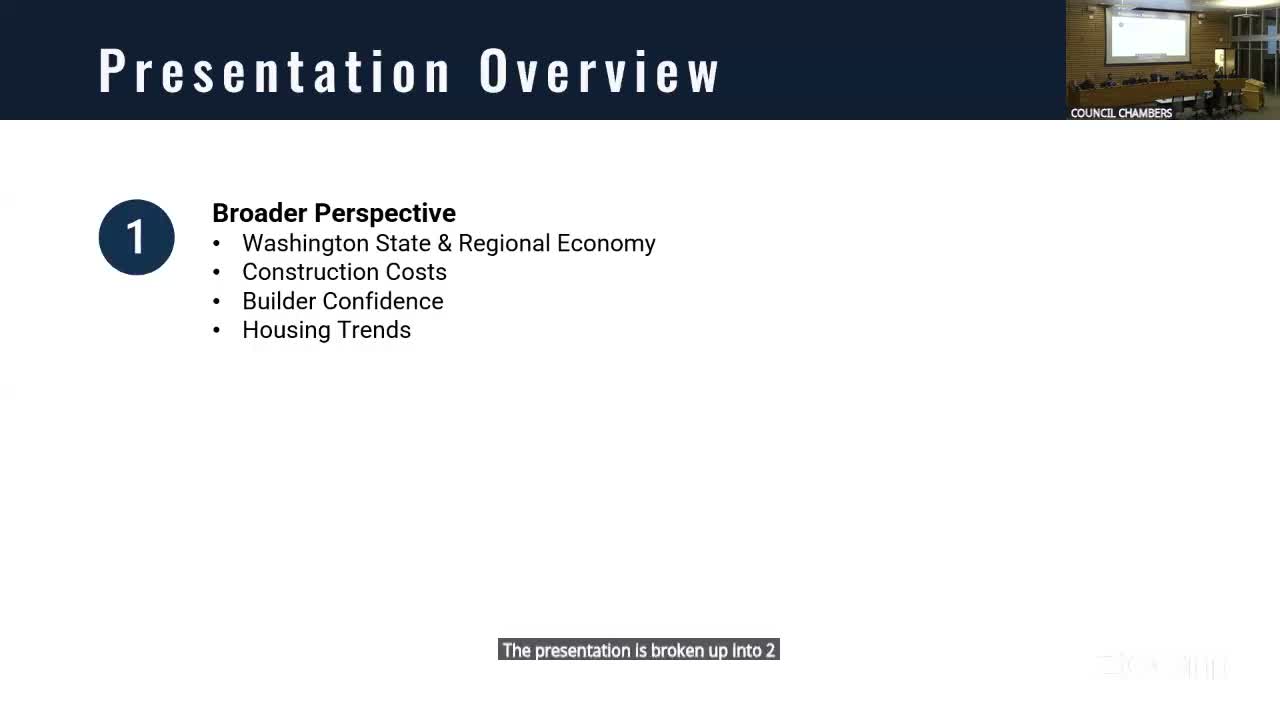
Summary
Development services director Samantha Luec told the council that while pre‑application activity has declined, overall land‑use, engineering and building permits remain steady; Kenmore reported compliance with the state permit‑streamlining report and is tracking pipelines affected by market trends and costs.
Kenmore's development services director, Sam (Samantha Luec), presented an update on local permitting and housing-market trends and told councilors the city met state reporting requirements for permit-streamlining.
Luec said statewide construction employment has softened, builder confidence (HMI) ran below 50 (nationally 39, regionally 36), and higher material costs and interest rates are limiting new construction. She cited median prices presented in the slides as roughly $649,000 for Washington state, about $850,000 for King County and about $1,000,000 for Kenmore; using a $1 million example at a 30‑year fixed 6% rate, she illustrated higher monthly carrying costs for buyers.
On permitting: Luec outlined typical timelines — pre-application meetings take about three to four weeks, the first land‑use review about six weeks (with a three‑week public comment period), engineering/site development first review six weeks, and building permits generally four to six weeks for a first review. She said Kenmore is meeting the state's reporting requirements for a 2023 law cited in the meeting as "SB 52 90," and that the city had changed some processes to expedite multifamily and large-site reviews.
Revenue and trends: Luec said permit fee revenue represents roughly 10% of the city's overall revenue and reflects cost recovery rather than profit; a 2025 fee study moved permitting to full cost recovery after the city previously undercollected (estimated shortfall about $339,000). She noted a decline in pre‑application activity that may indicate a smaller pipeline ahead, while short plats, site plans and some larger projects remain steady.
Council questions: Councilor McCulver pressed on accessory-dwelling-unit (ADU) counts versus permit applications. Luec said the slides show applications (not completed inspections), so applications can exceed units that have finished construction and final inspection. "It would say it's safe to say more than a couple dozen ADUs around the city," she told the council and offered to supply further data.
Why it matters: The update positions Kenmore to track local housing supply, fee revenue and timeline compliance with state laws and to plan for potential changes in the development pipeline.
Next steps: Staff will continue monitoring permit volumes, pipeline activity and fee revenues and will provide additional ADU data on request.