Get Full Government Meeting Transcripts, Videos, & Alerts Forever!
Get email alerts on the Water Conservation topic
No spam. Unsubscribe anytime.
Hastings board outlines two-phase water-conservation plan to meet Little Blue NRD deadline
Summary
Board heard a two-phase conservation plan after Little Blue NRD data showed multi-foot groundwater declines; Phase 1 pilots smart irrigation controllers for employees and customers, and Phase 2 would evaluate tiered residential rates with a cost-of-service study planned.
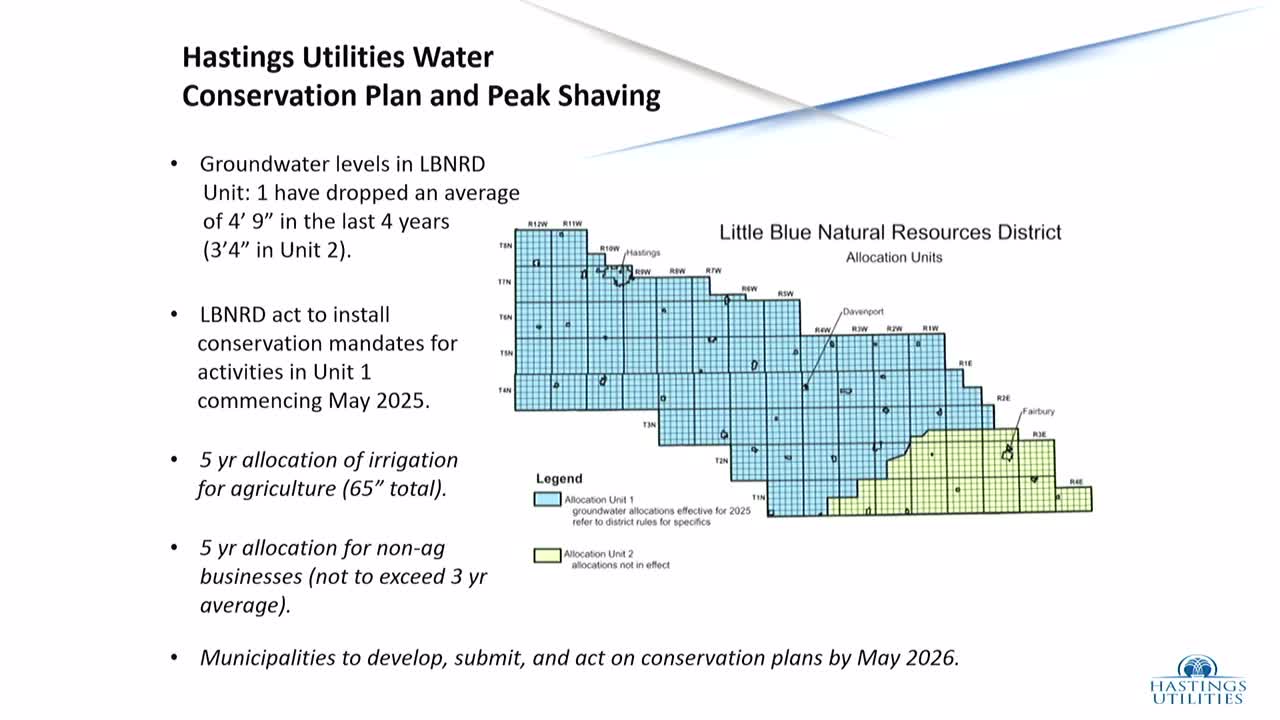
The Hastings Utility Board on Nov. 13 heard a proposed two-phase water-conservation plan intended to meet Little Blue Natural Resources District requirements that municipalities submit actionable plans by May 2026.
The presenter, who identified themself in the meeting as Jesse DeWaltz, told the board that the Little Blue NRD’s well readings show an average drop in groundwater of 4 feet 9 inches in Unit 1 and 3 feet 4 inches in Unit 2 over the last four years. "Based on this data, they decided to make a decision to install conservation mandates for Unit 1," DeWaltz said.
Phase 1 would be a near-term pilot focused on residential yard irrigation efficiency. Staff proposed supplying Rachio-brand smart irrigation controllers, managed via Aqualytics software, to city employee water customers in year one under a one-year contract and a five-year data-sharing agreement. "Year 1 goal...we're providing as an incentive a Rachio brand smart sprinkler controller per participant. They're just getting it, for free," DeWaltz said, adding the program gives the city ability to shift irrigation times to shave peaks.
DeWaltz told the board the pilot aims to deploy up to 90 controllers in subsequent years and said smart controllers can save customers "15 to 40% on their outdoor water usage," helping both individual bills and system-wide peak demand. He estimated the pilot could reduce a summer peak by about 55,000 gallons — roughly the output of one well during a peak hour — and noted that a new well costs roughly $700,000 and has about $30,000 in annual O&M.
Phase 2 would consider moving from Hastings’ current flat water rate ($2.15 per CCF) to a tiered structure where an essential-use tier is priced lower and recreational or excess use is placed in a higher tier. DeWaltz said peer cities use a variety of approaches and that tiering historically reduces residential water use by about 2.5% on average; for Hastings that would represent roughly 22.3 million gallons based on a three-year average.
Next steps flagged by staff include issuing an RFP for a cost-of-service study in December with an anticipated award in January to finalize rate design and to quantify revenue impacts. DeWaltz said final program and rate thresholds will be set after that study.
Board members asked how customers can view water use; staff said most bills display usage in CCF and that the board currently cites an average of about 6 CCF for customers; staff also stated a CCF equals 748 gallons according to the presentation.
The board did not take formal action on the plan at the meeting; staff said pilot contracts and the cost-of-service study are the near-term administrative steps.