Get Full Government Meeting Transcripts, Videos, & Alerts Forever!
Get email alerts on the Public Safety topic
No spam. Unsubscribe anytime.
Commission backs application for $900,000 to launch Office of Neighborhood Safety and Engagement
Summary
The Albany City Commission gave staff consensus to apply for congressionally directed funding to start an Office of Neighborhood Safety and Engagement, with a proposed $900,000 first-year startup and a roughly $300,000 Safe Corridors component for lighting and limited cameras; officials stressed evaluation and sustainability plans.
The Albany City Commission agreed to let city staff pursue a congressionally directed spending request to establish an Office of Neighborhood Safety and Engagement and a related Safe Corridors initiative.
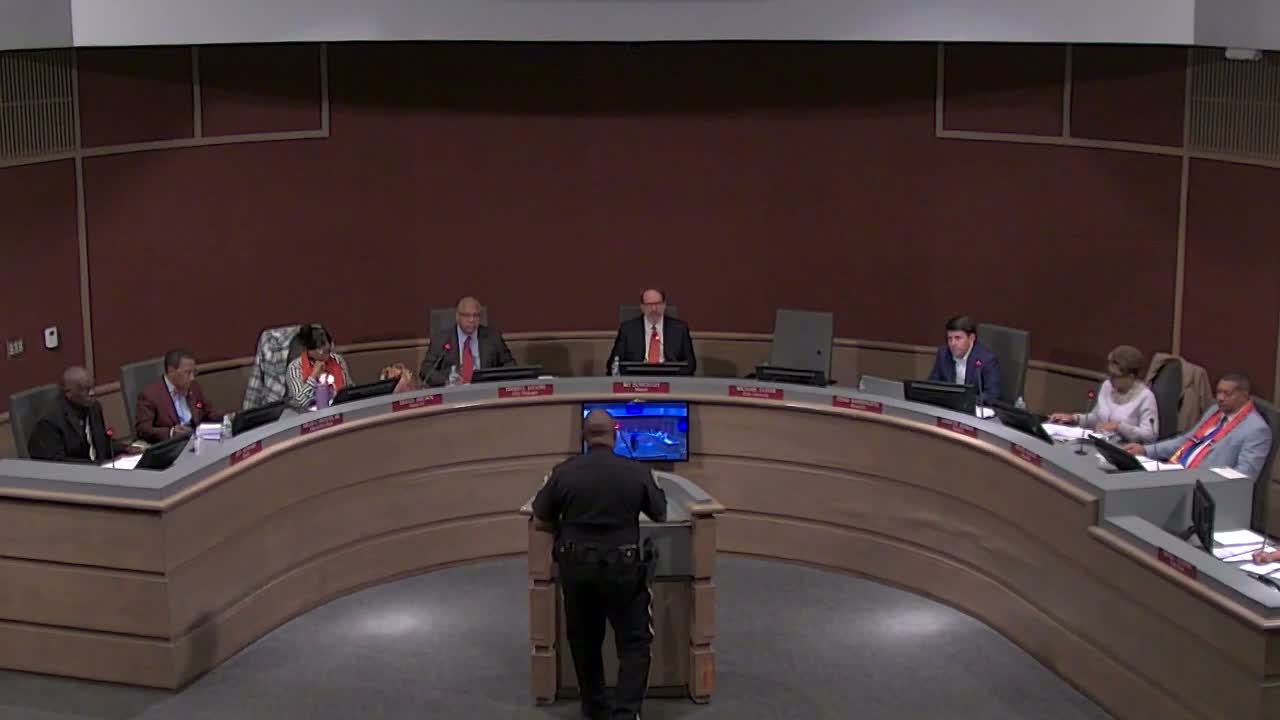
The chief, presenting the request, described the proposal as a one-year startup package totaling about $900,000 and said the Safe Corridors component would be approximately $300,000 to add lighting, a small number of cameras and an evaluation component. He said the office would employ five civilian, non-sworn staff — a director, senior program coordinator, administrative assistant, youth empowerment specialist and a program coordinator — and would partner with local hospitals and public-health entities under memoranda of understanding.
"This is built off Savannah and Washington, D.C., models," the chief said, adding the program would contract with violence-interruption or credible-messenger providers and focus on people ages 12 to 25.
Commissioners pressed staff on the grant’s time horizon and what would happen after the first year. "If the first year is over then it would be my hopes that we absorb that into our funding through the general fund," the chief said, noting the city would define key performance indicators and an evaluation plan to judge whether the program produced measurable community benefits.
Several commissioners emphasized the urgency of addressing violence and the need to get a funded program in place quickly. One commissioner said Albany cannot wait for perfect conditions before seeking resources, calling the effort "all hands on deck" for neighborhoods with high violent-crime rates.
Staff told the commission that federal deadlines required quick action: offices were coordinating with congressional staff and federal lobbyists and facing a submission window that in one instance closed on Feb. 27. Commissioners voted by roll call to authorize staff to submit the application and to send a letter of support.
Why it matters: The proposal would create a city office aimed at intervention and prevention rather than additional sworn officers, providing street-level outreach, youth services and infrastructure improvements in neighborhoods the city identifies as priorities. Commissioners said the evaluation framework and a plan to absorb ongoing costs into the general fund are essential to prevent programs from collapsing when initial federal funds end.
What’s next: Staff will finalize and submit the funding request to congressional offices and prepare evaluation metrics for the commission to review as part of any grant acceptance and budget discussions.