
Property‑vesting bill prompts lengthy debate and opposition; sponsor agrees to roll for revisions
Get AI-powered insights, summaries, and transcripts
Subscribe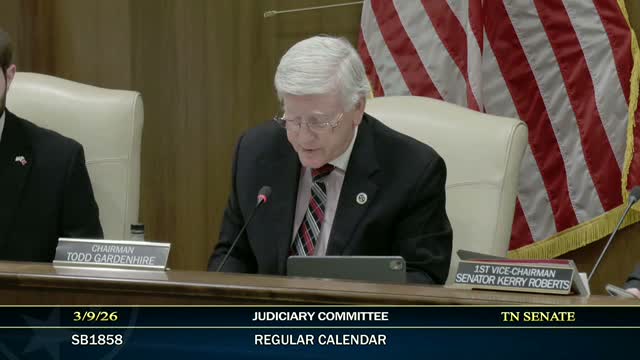
Summary
Sponsors described the Tennessee Property Vesting Rights Act (SB 19‑08) to allow property owners to seek just compensation if new land‑use regulations reduce fair‑market value; local officials and a farmer/lawyer warned it would undermine local planning and prompt costly litigation, and the committee rolled the bill for two weeks.
The Senate Judiciary Committee wrestled with SB 19‑08, described by its sponsor as the "Tennessee Property Vesting Rights Act," which would give property owners a statutory path to seek just compensation when subsequent land‑use regulations enacted after acquisition reduce fair‑market value.
Sponsor representatives said the bill would allow a property owner to submit a written demand within three years after a regulation is enacted or applied; public entities would have 90 days to resolve the complaint by paying compensation, modifying or removing the regulation, otherwise the owner could seek compensation in circuit court. The sponsor emphasized the bill does not apply to public‑health and safety regulations (fire/building codes, sanitation, pollution control, traffic and parking safety) or regulations adopted before acquisition.
Committee members asked detailed questions about triggers, examples and remedies: whether inclusion in a municipal growth plan would trigger claims, whether zoning variances count as land‑use regulations, and how courts would calculate fair‑market value (sponsor counsel said courts could rely on certified appraisals and other best available evidence). Several senators worried the bill could create an immediate cause of action against local governments, require payment of claimants’ attorney fees and expert witness costs, and encourage litigation that would hamper local planning.
George Nolan, a farmer and lawyer who testified in opposition, warned the bill would "shut down growth planning" and allow developers to bully local governments into waiving regulations by filing claims. "This legislation authorizes landowners to sue local governments anytime counties or cities enforce zoning laws that affect property values," Nolan said, arguing it would enrich lawyers and bankrupt some local governments.
Given the volume of questions and member concerns, the sponsor and committee agreed to roll SB 19‑08 for two weeks to allow adjustments and stakeholder review.
What’s next: SB 19‑08 was rolled for two weeks to allow sponsors to redraft language addressing member concerns about scope, remedies and local government impact.