Get Full Government Meeting Transcripts, Videos, & Alerts Forever!
Get email alerts on the Sustainability Roadmap topic
No spam. Unsubscribe anytime.
McKinney officials present eight-goal sustainability roadmap to cut waste, water loss and emissions
Summary
McKinney staff unveiled an eight-goal sustainability roadmap Jan. 6 that targets recycling access and contamination, water conservation and non-revenue water, stormwater operations and outreach, EV charging and fleet emissions, and energy efficiency including a tree-canopy increase; staff will develop a public dashboard and seek council feedback.
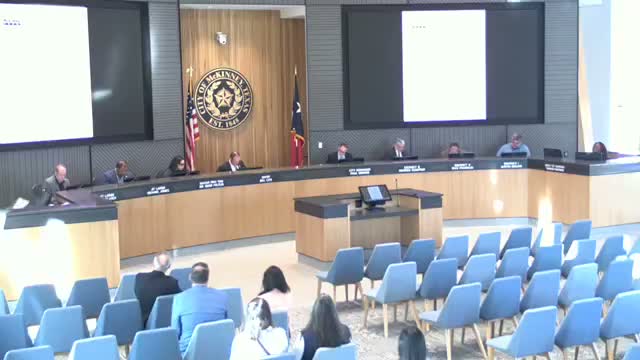
At a Jan. 6 work session, McKinney officials presented an eight-goal sustainability roadmap intended to operationalize City Council goals on quality of life and environmental stewardship.
Sustainability Manager Juhada Godum and Assistant City Manager Steve Tilton told council members the roadmap sets measurable targets across materials management, water conservation, stormwater management, air quality and energy efficiency, and outlines action items staff will pursue over roughly a five-year span.
"We want the roadmap to really center resource efficiency and fiscal responsibility," Godum said, summarizing the guiding principles staff used to develop goals and targets. The plan calls for updating city code to align with the council-approved solid waste strategy, piloting organic-diversion programs, and conducting a commercial and multifamily recycling study to identify additional diversion opportunities.
On recycling contamination, Godum said current contamination rates "hover around 41%, but we've seen up to 49%" and that the city is targeting a reduction to about 25%. She said the city recently received grant funding to pilot AI-enabled cameras on collection vehicles to identify contamination hot spots and target outreach.
For water, the roadmap sets a target to reduce per-resident water use from 96 to 90 gallons per day and proposes partnerships such as free irrigation checkups with the North Texas Municipal Water District and incentives for water-saving technologies. Godum defined "non-revenue water" as water lost before it reaches the meter and said McKinney's current rate is 8.4%; staff propose reducing that rate by about 1% per year until it reaches 4% through better leak detection, asset tracking and pipe upgrades.
On stormwater, staff proposed increasing the frequency of water-quality testing from annual to quarterly, expanding storm drain coverage and catchment systems, and doubling community cleanup events while creating "grow zones" (native-plant demonstration areas) on city property to support pollinators and reduce irrigation needs.
To address air quality and transportation, the roadmap calls for expanding EV charging infrastructure (from 23 to 33 stations), establishing baseline fleet-emissions data, and revisiting the city's 2015 clean fleet policy. For energy, staff recommended taking advantage of free preliminary energy assessments from the State Energy Conservation Office and increasing the urban tree canopy from about 15% to 30%.
Council members asked clarifying questions. Councilman Cloutier raised concerns about limited curbside space for cardboard and the need for more local drop-off options for residents in District 4, noting "a lot of cardboard gets wasted" when blue-bin space is insufficient. Godum replied that the city revenue-shares with its processor (referred to in the meeting as Balcones, now Circular Services) and that the planned recycling study should help locate additional collection structures and assess options for multifamily and commercial properties.
A council member asked about "grow zones." Godum described the McKinney Green Gardens at Gabe Nesbitt Recreation Center as a demonstration site and said staff are evaluating pocket prairies and wildflower features in parks to show residents how to implement low-water, native-plant landscaping.
Godum said next steps include leadership engagement, development of a public sustainability dashboard to track progress and data sources, continued staff prioritization of action items, and an outreach and education plan developed with the city's communications team. No formal votes on policy were taken during the work session.
The city manager's office indicated staff would distribute the presentation materials to councilmembers following the meeting.