Get Full Government Meeting Transcripts, Videos, & Alerts Forever!
Get email alerts on the Parkland Dedication topic
No spam. Unsubscribe anytime.
McKinney council reviews parkland dedication ordinance; councilors ask staff to revisit appraisal-based fee method
Summary
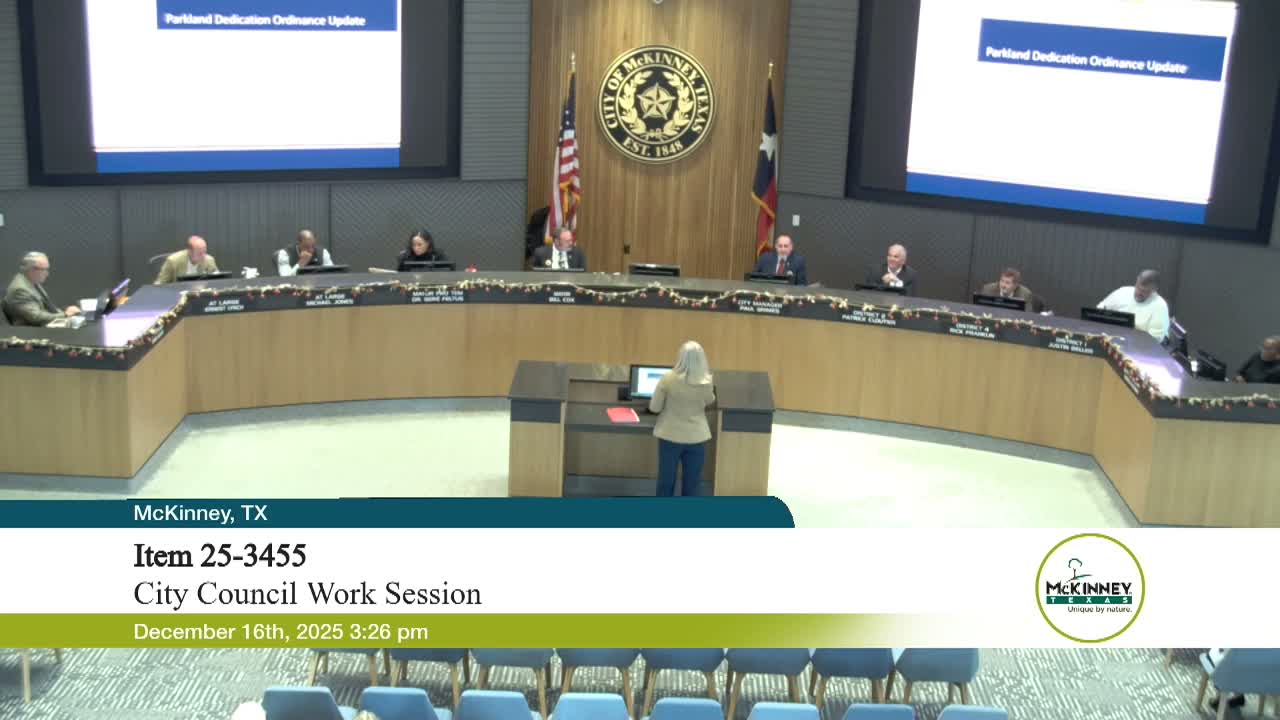
At a Dec. 16 McKinney work session, Parks Planning manager Jenny Baker outlined the city’s Parkland Dedication Ordinance (adopted 2022), including a 1-acre-per-37-unit requirement and park-development fees. Councilors pressed staff to examine Collin County Appraisal District valuations and alternative methods for infill projects and affordable housing incentives.
McKINNEY, Texas — The City of McKinney’s council on Dec. 16 reviewed its Parkland Dedication Ordinance and asked staff to return with alternative valuation methods after members warned current appraisal-based fees can inflate costs for infill and affordable projects.
Jenny Baker, Parks Planning and Development Manager, summarized the ordinance the council adopted in October 2022 and its three main components: a parkland dedication requirement of 1 acre per 37 residential units, a park-development fee ($1,400 per single-family unit; $1,600 per multifamily unit) and an increase in parkland zones from four to seven. “For all single family, multifamily, again, 1 acre is required for every 37 units,” Baker said.
Baker told council staff worked with Dr. John Crompton of Texas A&M on methodology and that the city uses Collin Central Appraisal District (CCAD) per-acre land values to calculate in-lieu dedication fees. She illustrated how the same project can face widely different per-lot fees depending on zone and CCAD values.
Several councilors said tying fees directly to CCAD valuations creates unpredictability and can yield much higher charges for infill lots than for greenfield development. One council member noted the practical problem when an applicant’s property retains a commercial valuation after a down‑zoning to residential: “Tying it to CAD is provided some headaches,” the council member said, adding that applicants have sought reassessments from CCAD to reduce fees.
Councilors urged staff to explore alternatives — such as averaged values, inflation adjustments, or overlays that treat infill and greenfield sites differently — to avoid pricing infill or deeply affordable projects out of feasibility. Baker said the ordinance allows developers to request an independent appraisal and that staff can return with additional methodologies if the council desires.
Council members also discussed fee credits and exemptions: the ordinance allows up to 50% credit for developers who construct on-site amenities (playgrounds, pavilions, trails) and provides reduced dedication requirements for senior and affordable housing (50% reduction). Baker said park development fees are assessed in addition to dedication, and that some developments vested under the old ordinance remain subject to previous rules.
The council did not take formal action on the ordinance at the work session. Staff was asked to investigate alternative valuation approaches and report back with options at a future meeting.
What’s next: Staff will return with proposed methodologies and potential overlays for council review.