Get Full Government Meeting Transcripts, Videos, & Alerts Forever!
Get email alerts on the Affordable Housing topic
No spam. Unsubscribe anytime.
Study: Thousands of McKinney households are cost-burdened; researchers recommend housing trust fund and other steps
Summary
Root Policy Research told the council that about 12,400 renter households and 9,700 owner households in McKinney were cost-burdened in 2023; the study estimates a multifamily/rental gap of roughly 4,400 units for low-to-moderate AMI households and presents tiered recommendations, including a housing trust fund and continued tenant-based assistance.
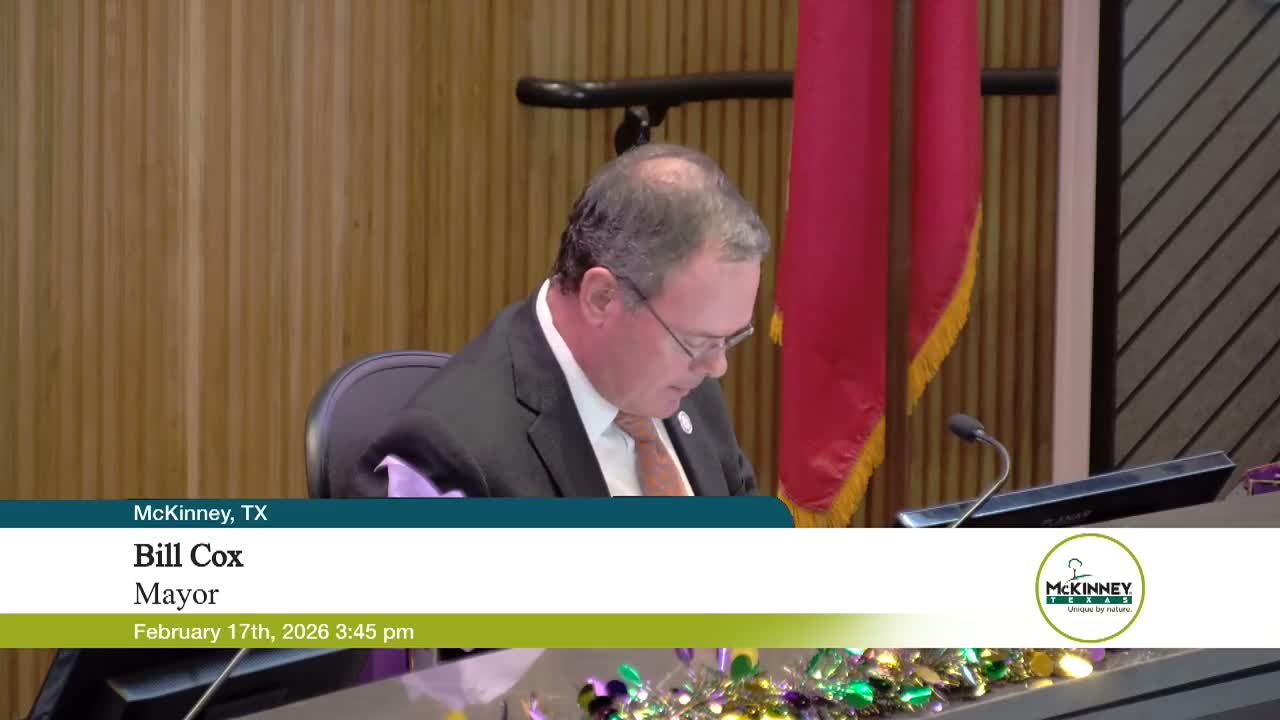
A presentation at the Feb. 17 McKinney work session laid out updated affordable-housing needs and a menu of policy recommendations to address those needs.
Margaret Lee, the city's Housing and Community Development director, introduced Avelia Bueno of Root Policy Research, who summarized the updated needs assessment. Bueno reported that, as of 2023, approximately 12,400 renter households and about 9,700 owner households were spending more than 30% of their income on housing costs (the report's definition of cost burden). She told the council that the city has an existing gap of about 4,400 rental units affordable to households in lower AMI brackets and that projected needs across scenarios total roughly 7,500 units for certain income bands, with an overall planning figure of about 12,000 units cited in the analysis.
"A total of 12,400 renter households were spending more than 30% of their household income on housing," Bueno said in the presentation, and she explained that market production alone is unlikely to meet the needs of households at 0'to'60% AMI without subsidies.
Root Policy's recommendations were presented as a three-tier menu: Tier 1 strengthens existing programs; Tier 2 focuses on sustaining and optimizing them (for example, continued support for tenant-based rental assistance); and Tier 3 includes targeted expansions such as creating a housing trust fund, establishing a land bank, and acquiring underutilized land for affordable development. Margaret Lee told council the recommendations should be considered together as a coordinated strategy rather than standalone actions.
Council members asked about the availability of the full report; Lee confirmed the report is attached to the agenda. Lee also highlighted city actions since the previous strategy: setting an affordable-housing goal, allocating public land, implementing foreclosure/eviction-prevention programs, and improving permitting and tax-exemption tools to advance affordable units.
The presentation closed with an ask to develop clear priorities, implementation steps and measurable performance metrics to move the strategy forward.