Get Full Government Meeting Transcripts, Videos, & Alerts Forever!
Get email alerts on the Agenda Votes topic
No spam. Unsubscribe anytime.
Historic Preservation Board approves marker, two rehab exemptions and three demolitions
Summary
McKinney’s Historic Preservation Board unanimously approved a historic-marker request, two Level 2 rehabilitation tax exemptions and three demolition certificates, and heard staff estimate about $299,914 in cumulative ad valorem revenue foregone under the exemption program.
The McKinney Historic Preservation Board on a unanimous vote approved a historic-marker application, two Level 2 rehabilitation tax-exemption requests and three certificates of appropriateness to demolish accessory structures.
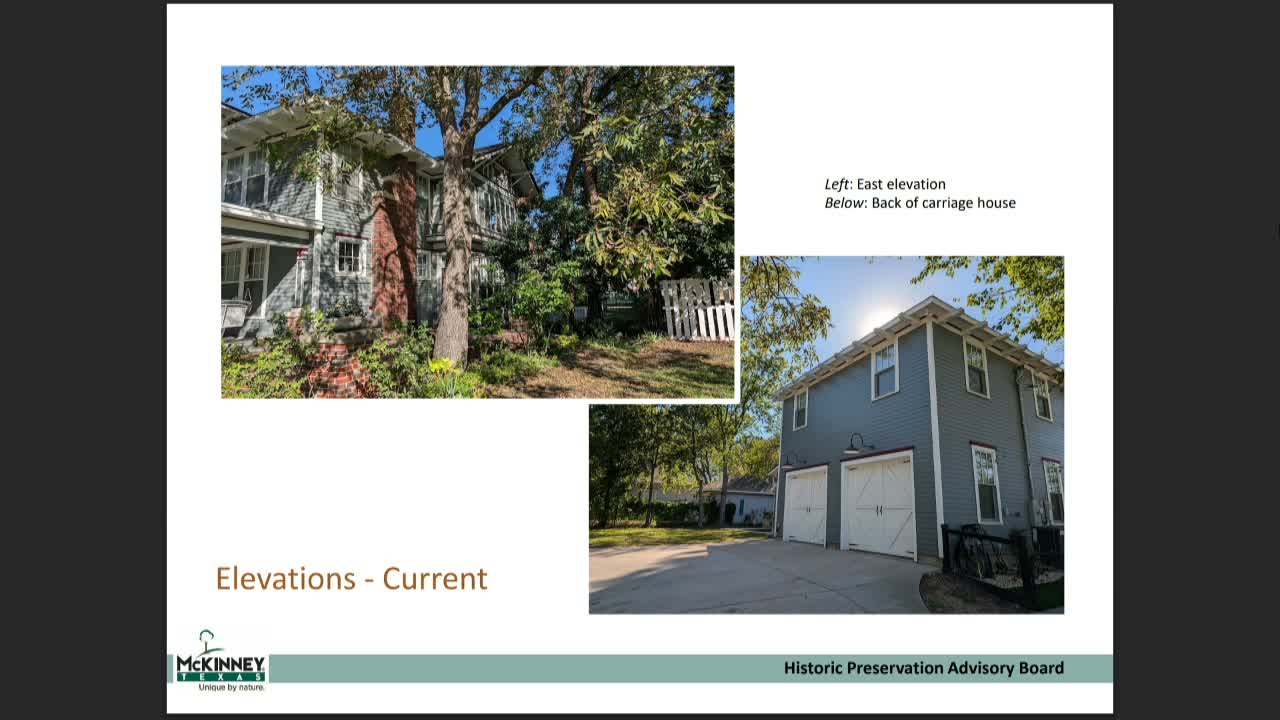
The board heard from a homeowner who said, “We’ve actually owned the house since 2012, and it’s been under continual renovation,” and described a carriage house added in 2019 that the applicants said they restored to match the property’s original character. A neighbor provided historical context about early resident Joe Barnes and the site’s local significance. After staff recommended approval, the board’s chair moved to approve the historic-marker request; the motion was seconded and passed unanimously.
Why it matters: The actions preserve the board’s role in recognizing historically significant properties while authorizing relief for homeowners who invested in rehabilitation work. Staff noted that Level 2 exemptions require a minimum of $10,000 in eligible improvements and typically carry a 50% ad valorem tax exemption for 10 years.
Board actions at a glance: • Historic marker — Property associated with the Barnes and Largent families: motion to approve historic marker carried unanimously (motion made from the chair). • HP2025-0029 — 403 Tucker Street (Level 2 rehabilitation tax exemption): staff said the application met the $10,000 minimum; staff recommended a 50% exemption for 10 years. The motion to approve carried unanimously. Staff stated the program’s cumulative foregone ad valorem revenue is approximately $299,914. • HP2025-0059 — 501 Board Street (McCone Roberts House, Level 2): staff characterized the house as a high-priority resource and said eligible improvements exceeded $10,000; the motion to approve the Level 2 exemption carried unanimously. • HP2025-0091 — 408 Oak Street (certificate of appropriateness to demolish a detached shed): staff recommended approval, describing the shed as severely deteriorated and not character-defining; motion to approve carried unanimously. • HP2025-0097 — 1505 West Louisiana Street (certificate of appropriateness to demolish a detached garage): staff presented images showing bowed foundation and leaning walls, recommended approval; the board approved the demolition unanimously.
What staff said: The staff presenter repeatedly advised that accessory structures slated for demolition were not character-defining and that removal would not alter the priority rating of the main houses. On the process for rebuilding, staff said homeowners seeking to replace demolished structures must submit a separate certificate-of-appropriateness application; for residential projects staff typically has up to 30 days to act after application submission, and pre-application meetings are common.
Community context and next steps: Board members emphasized homeowner involvement and approved the items with no recorded conditions, though the board discussed the option to impose a 90-day delay in some demolition cases. No recorded member votes were individually tallied in the transcript; minutes record each motion as carrying unanimously. The meeting adjourned at 6:09 p.m.