Get Full Government Meeting Transcripts, Videos, & Alerts Forever!
Get email alerts on the Streets Trees topic
No spam. Unsubscribe anytime.
Council hears how McKinney balances street reconstruction with preserving mature trees
Summary
City engineers outlined the CIP street-reconstruction process and the limits that can force removal of mature trees, while council members pressed staff for options to replace larger trees and speed up reconstruction of substandard streets.
Tracy Lund, assistant director of engineering, told the City Council that McKinney’s street reconstruction work includes pavement, sidewalks, curbs, driveway and utility improvements and often requires tradeoffs that can threaten mature trees in downtown and historic neighborhoods. "We will consult with our in house arborist to determine the survivability of the tree," Lund said, describing the department’s process for assessing critical root zones and whether a tree can survive excavation and trenching.
Lund said the council previously directed staff in 2023 to add sidewalks where streets lack them, and noted that many downtown blocks have limited right-of-way, steep grade differences and franchise utility conflicts that reduce design flexibility. She explained the city’s standard street section—26 feet curb to curb—and the practical 24-foot minimum used to preserve a 10-foot clear lane for emergency vehicles when on-street parking is present. "Going less than that compromises emergency access," Lund said, citing public safety as the primary constraint.
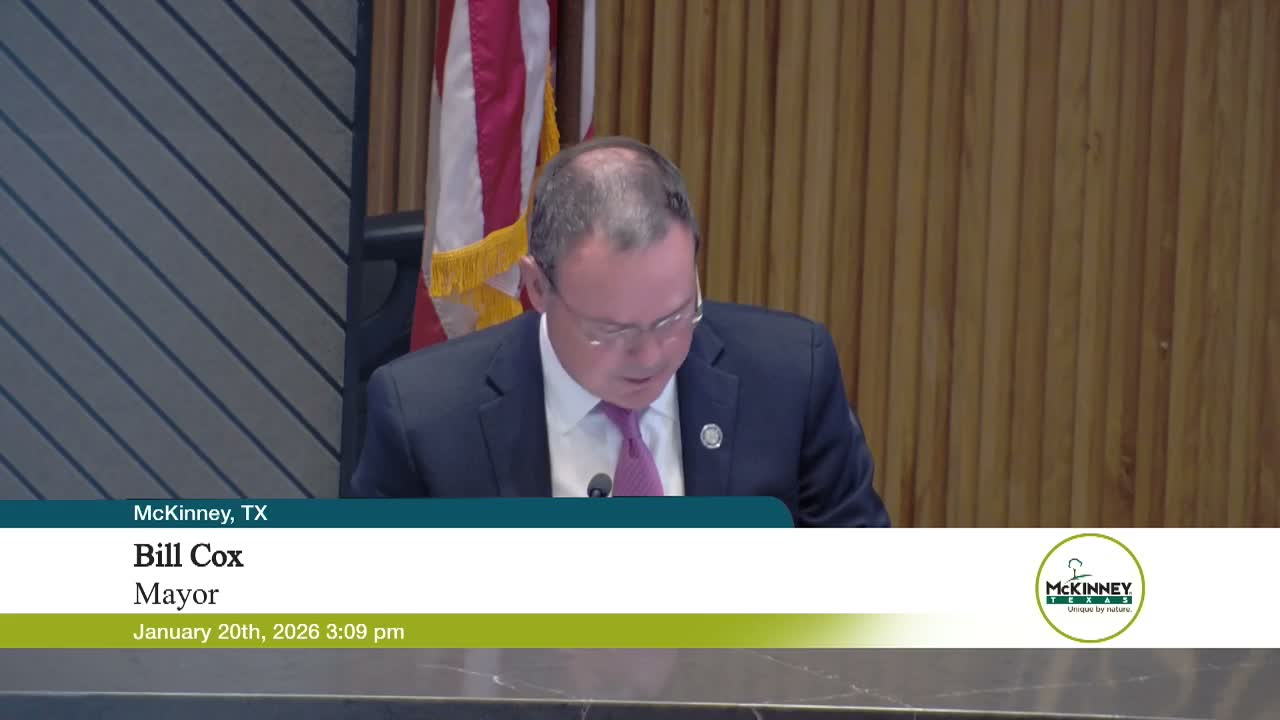
Council members who represent downtown neighborhoods pressed staff on two related issues: the pace of reconstruction for substandard 18‑foot streets, and replacement of large canopy trees lost during projects. One councilmember warned that residents expect replacement trees that mature into substantial canopy species rather than smaller ornamentals. "I hope we're not replacing oak trees with crepe myrtles," the mayor observed; another councilmember added bluntly, "We are," reflecting the current limits of right-of-way planting and species selection.
Lund and other staff said planting larger trees on private property with CIP funds is restricted by current funding rules, but planning staff are exploring alternatives — including whether reforestation funds or other programs could support larger private plantings. Councilmembers suggested better outreach around existing options (Arbor Day giveaways, a $500 private-planting grant mentioned in the meeting) and asked staff to return with concrete program proposals and timelines for accelerating reconstruction in priority neighborhoods.
Next steps: engineering staff will continue to apply case-by-case accommodations (sidewalk alignment changes, meandering sidewalks, root‑zone bridging and evaluating reduced street widths only where absolutely necessary) and report back to council on potential funding and program options to help residents replace mature trees lost to reconstruction.