Get Full Government Meeting Transcripts, Videos, & Alerts Forever!
Get email alerts on the Animal Services topic
No spam. Unsubscribe anytime.
McKinney council leans toward allowing trap‑neuter‑return with minimal staff oversight
Summary
After a resident urged McKinney to permit trap‑neuter‑return (TNR), city staff outlined three options — minimal, moderate and high staff involvement — and council members expressed support for starting with a minimal approach while staff researches veterinarian pricing and resources.
A McKinney resident and animal‑welfare advocate urged the City Council on Dec. 2 to change local ordinances to allow trap‑neuter‑return (TNR) programs, and staff told councilors they can implement the change with little or no additional city workload.
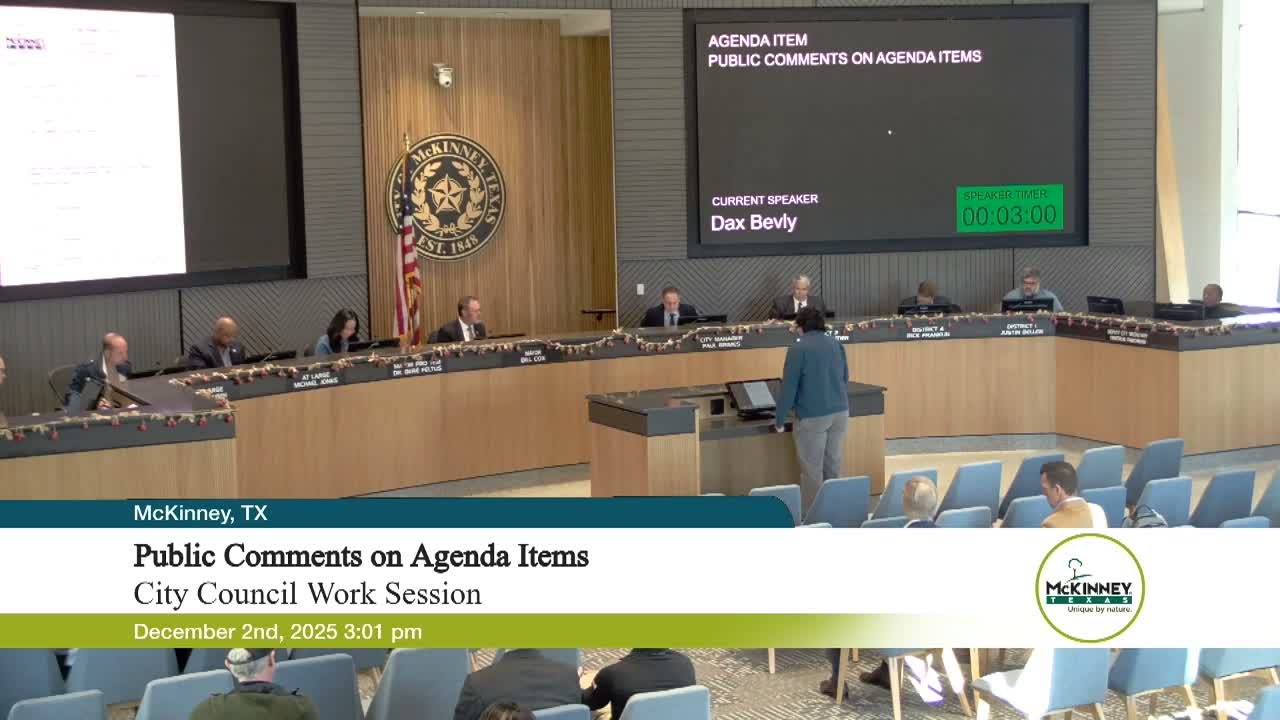
"I'm respectfully asking the council to amend the ordinances so that responsible humane TNR efforts are permitted in McKinney," resident Dex Beverly told the council during public comment, arguing that TNR is a cost‑effective, humane alternative to intake and euthanasia.
Phil Hubbard, director of Code Services, presented a sliding scale of options for permitting TNR. "At the minimum staff level, we would be able to amend our ordinances," Hubbard said. That option would remove the city prohibition on TNR without creating new paperwork or requiring additional staff time. A moderate option would add a registration requirement and a city point of contact; a high‑involvement model would include a sponsorship program, registration, data collection and potential basic services for caretakers.
Several council members said they favored the minimal‑involvement approach to allow residents to begin legal, volunteer‑led TNR efforts quickly while the city monitors outcomes. One councilor suggested staff contact local veterinarians to compile fixed‑price options or a list of accommodating clinics to post on the city's website; Hubbard said staff would look into providing that information online.
Supporters argued TNR reduces feral colony sizes over time and shifts the cost of sterilization away from the city. Critics raised concerns about monitoring colonies and handling complaints; staff and a resident speaker noted those challenges exist today under the current prohibition. Council members signaled willingness to revisit the program if operational concerns or budget considerations emerge during a future budget cycle.
Next steps: staff will proceed with drafting ordinance language to remove the prohibition and will gather information about local veterinary pricing and potential trap‑loan programs for council review. No formal vote was taken at the work session.