Get Full Government Meeting Transcripts, Videos, & Alerts Forever!
Get email alerts on the Population Projections topic
No spam. Unsubscribe anytime.
City staff says McKinney already has added much of its anticipated 10-year growth, urging planning adjustments
Summary
City staff presented population projections showing McKinney and its service area grew faster than expected, with staff advising the council to plan for denser development and to align impact-fee and infrastructure assumptions with a smaller water-service footprint.
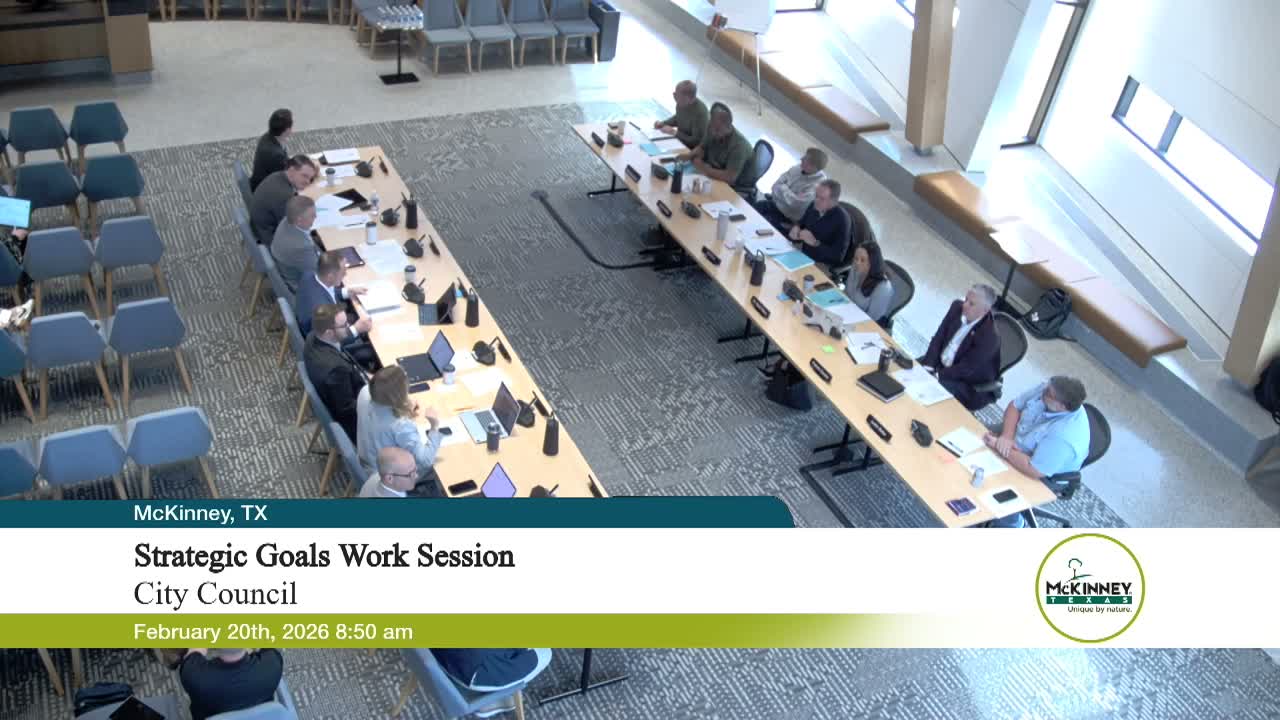
Lucas Raley, a city staff presenter, told council members at the Feb. 20 retreat that population projections made as of Jan. 1, 2024, show the McKinney planning area at roughly 237,000 residents and that the 10-year projection made in 2024 anticipated a growth of about 79,108 by 2034. "Two years in, we've already added 36,000 of that total," Raley said, noting the projection uses a Gompertz model and that the numbers apply separately to the full planning area and to a reduced water service area.
The presentation described a 2034 projection of about 316,000 for the full planning area and roughly 307,000 for the reduced water service footprint, with buildout estimates ranging from the high 300,000s up to the 480,000s depending on the area included. Raley said recent high-density projects that have broken ground, and multifamily proposals under review, account for a substantial share of the near-term increase. "Our annual average over a 10-year rolling period is over 7,000 people a year," he said, adding the city saw an estimated 11,000 new residents last year.
City Manager Grimes, who preceded the presentation with an organizational overview, framed the projections as a key input for strategic goal-setting and the budget process. Grimes reminded the council that the retreat's purpose is to surface priorities that staff will convert into SMART objectives for council review in May. He also pointed to recent state law changes that have reduced the city's annexation tools: staff emphasized the difference between the full planning area (including ETJ) and the reduced water service area the city now treats as its realistic near-term service footprint.
Council members asked how the smaller water-service area changed planning assumptions. Staff explained that many residents who will live outside the reduced service area will nonetheless use McKinney roads and services without generating property-tax revenue for the city. That gap, coupled with state restrictions on annexation and local funding pressures, prompted discussion about how the city evaluates voluntary annexations, the costs of serving noncontiguous parcels, and potential tools such as public improvement districts or municipal management districts.
The presentation and ensuing Q&A led council members to flag three planning implications: update impact-fee studies to reflect the revised service area, anticipate more dense development patterns (smaller lots and more multifamily), and consider fiscal strategies to preserve long-term infrastructure funding if tax bases slow. Staff committed to incorporate the projections into the impact-fee update and to return with objective metrics and budget alignments ahead of May.