Get Full Government Meeting Transcripts, Videos, & Alerts Forever!
Get email alerts on the Homeless Services topic
No spam. Unsubscribe anytime.
Council presses staff on low-barrier shelter outcomes and costs after budget presentation
Summary
Council members questioned the cost and outcomes of the city's low-barrier shelter, pressed for clearer metrics on exits to stable housing and long-term funding, and heard staff say STRAC and hospital partners are aiding operations and referrals.
Council members used the Feb. 18 budget briefing to press staff on the low-barrier shelter's cost, occupancy and outcomes, and to ask for a clearer business plan before committing general-fund support long term.
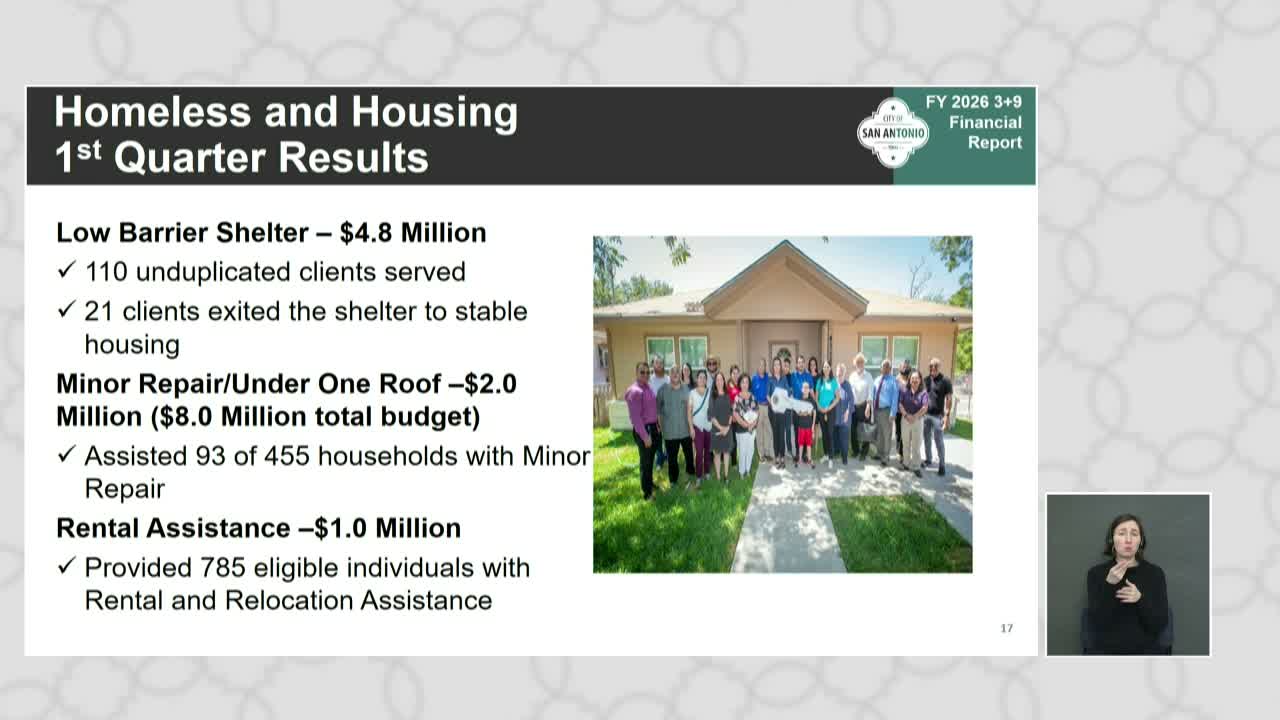
Freddy Martinez told the council the FY26 budget included $4.8 million to pay the lease for the low-barrier shelter; operations are funded via a partnership with SANs ministries and STRAC. The original FY26 goal was to serve 450 unduplicated clients with a target that 55% of exits would be to stable housing; through January staff initially reported 110 served but later corrected the figure.
Mark Carmona, director of the Homeless Services and Strategy Department, told the council the correct count was 183 people served through the shelter to date. "STRAC is identifying people that are homeless and mentally ill that were showing up in hospital systems. Now are going over to the shelter itself which frees up those beds in the hospital system," Carmona said, adding staff are analyzing engagement-to-exit timelines.
Council members expressed differing views about cost-effectiveness. Councilman Mark White calculated a per-person annualized cost under current tracking of roughly $10,909 per person and warned that if exit rates remained low the effective per-successful-exit cost would be much higher. "If we only have a 10% success ratio then it's $109,000 per person," White said, urging that the council define success metrics.
Several council members asked whether the low-barrier shelter should remain general-fund supported after initial ARPA funding, and staff said the program was initially ARPA-funded and is now in the general fund for FY26. Eric (staff) and Martinez said a business plan and goals will be presented as part of goal-setting materials.
What's next: staff committed to provide clearer data on shelter enrollment, exits to stable housing, and a proposed business plan for the shelter ahead of the May goal-setting session so the council can evaluate long-term funding options.