
Commission hears conceptual 'Tiny Village' redevelopment; designers told to refine pedestrian frontage and landscaping
Get AI-powered insights, summaries, and transcripts
Subscribe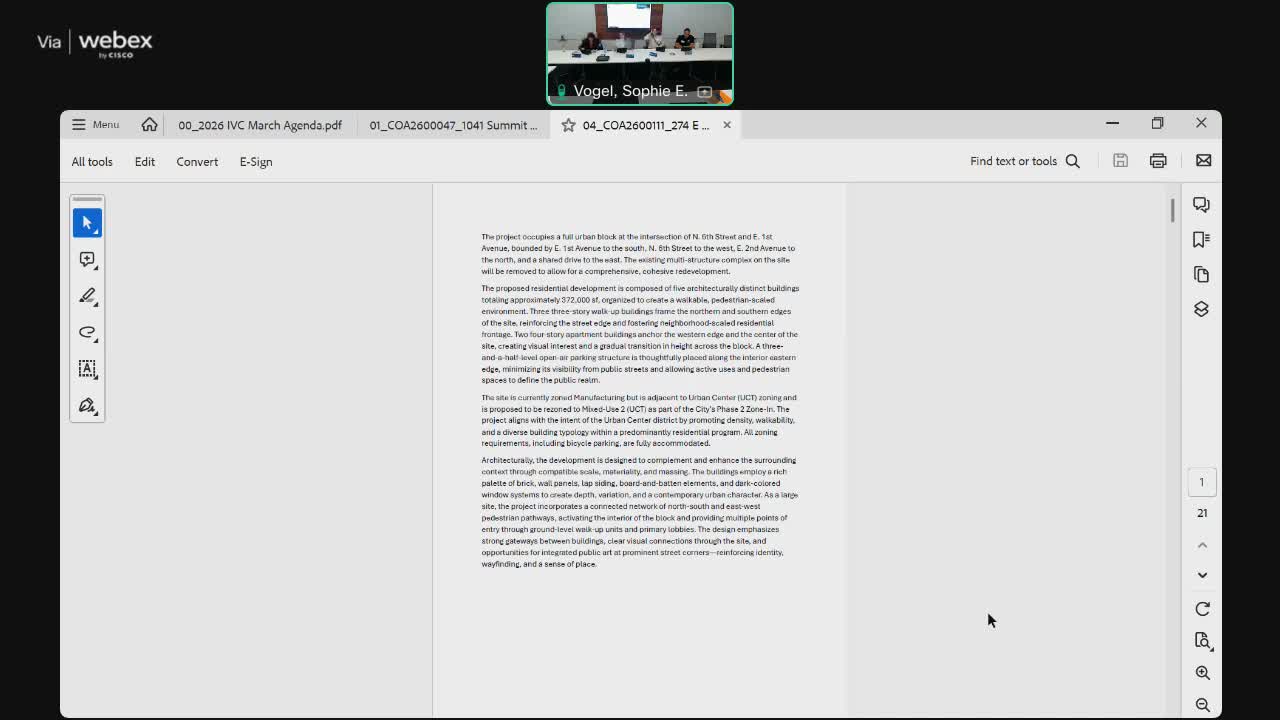
Summary
Developers presented a multi‑building residential proposal (COA 2600111274) for demolition and construction of five new buildings at 274 East Spencer Avenue. Commissioners praised elements of the design but asked for clearer sidewalk dimensions, more perimeter green space, trash/servicing plans, and options to reduce long corridors or increase internal green space.
Developers presented a conceptual review of COA 2600111274, a redevelopment proposal at 274 East Spencer Avenue that would demolish existing structures and construct five new residential buildings. Commissioners offered detailed feedback focused on pedestrian frontage, landscape buffering, building massing, and service logistics; no final action was taken because the review was conceptual.
Pat Byrne, identified as development director with Merus, said the team had submitted a site compliance package and a rezoning application and expected subsequent reviews. "We are thrilled about the opportunity," Byrne said, adding that the team would proceed through site compliance meetings and refine plans. Zoning counsel Eric Zartman explained the team sought to opt into an adjacent form‑based district created by a city ordinance last year and said the project aims to follow the city’s East Street District guidance.
The architect described two primary building typologies — 3‑story walk‑ups along First and Second Avenues and a 4‑story, double‑loaded corridor building — plus internal green space, a C‑shaped building and lobby connections to create visual corridors. Commissioners repeatedly encouraged more buffer between the buildings and the sidewalk, asked for a clearer trash/servicing strategy and requested drawings showing where trash compactors and service access would be located. Several commissioners said a narrow, long interior corridor would be unpleasant for pedestrians and asked the team to consider design options that break up long circulation runs.
A written public comment read into the record urged inclusion of retail (a corner shop or small cafe) and cautioned against removing existing businesses without replacement in this walkable, dense neighborhood. Commissioners discussed trade‑offs between added building height and more internal green space, with the developer noting financial and parking constraints that limit easy up‑zoning in the near term. The developer pledged to study opportunities to increase green space and refine unit layouts and said they would return with more detailed materials, elevation sections and landscape plans.
Because the hearing was a conceptual review, commissioners provided direction rather than a final vote and asked the applicant to return with detailed sections, landscape and pedestrian-frontage plans, materials samples, and the proposed trash/servicing plan.