Get Full Government Meeting Transcripts, Videos, & Alerts Forever!
Get email alerts on the Affordable Housing topic
No spam. Unsubscribe anytime.
Council backs resolution supporting 65‑unit affordable project amid neighborhood opposition
Summary
After public comment from nearby residents and developers, the San Antonio City Council voted to support a 9% housing tax credit application for a proposed 65‑unit affordable complex on the 9600 block of Gilboa Road; opponents raised traffic, parking and privacy concerns while supporters emphasized the city27s housing needs and negotiated design changes.
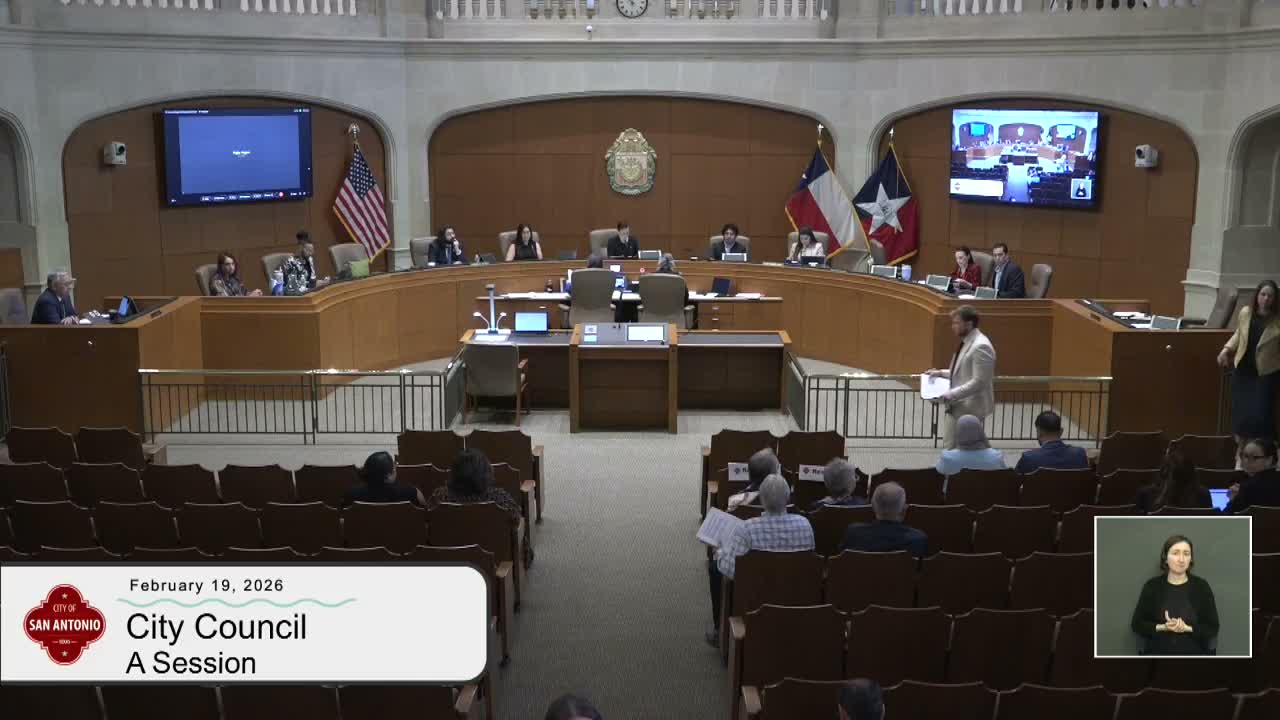
The San Antonio City Council voted Feb. 19 to adopt a resolution supporting VBGSA 26 LP27s application to the Texas Department of Housing and Community Affairs for 2026 competitive 9% housing tax credits to build Nuesto Tierra, a proposed 65‑unit affordable housing development on the 9600 block of Gilboa Road in District 7. The vote followed a lengthy public comment period and council debate.
Neighbors who spoke urged council members to withdraw support, saying the 2.34‑acre site is too small for the proposed density and warning of increased traffic, insufficient parking and a loss of privacy for adjacent homeowners. Jeanette McCart, president of the Brown Station West Association, said the neighborhood had collected over 900 signatures opposing the plan and highlighted limited parking (about 1.5 spaces per unit) and only five accessible spaces as inadequate.
Val De Leon, director of development for the Bassino Group, told the council the project meets the city27s scoring threshold and is zoned for multifamily. De Leon said the developer has revised the design to respond to neighborhood feedback: lowering the height nearest homes to two stories, eliminating many third‑ and fourth‑floor windows that would face backyards, and removing several on‑site amenities such as the previously proposed pool and dog park. De Leon said the property is “a four‑minute walk” to New Territories Park and that the team is open to additional landscaping, fencing or mature trees to improve screening.
Council member Aldrete Gavito, whose district includes the site, said she supports affordable housing generally but opposed this location, citing traffic congestion on Gilboa Road, lack of bus service, proximity to a school and loss of privacy for nearby residents. "This project does not meet the same standards as others in District 7," she said, and announced she would vote against the resolution and write a letter of opposition to TDHCA.
Several council members, including McKee Rodriguez, emphasized that the parcel is already zoned for multifamily uses and that without a negotiated, funded affordable project the site could be developed by-right in ways that offer the city less leverage to require community benefits. McKee Rodriguez said the developer27s concessions — reduced height adjacent to homes, removal of windows and added landscaping — show a willingness to negotiate and encouraged continued community engagement.
City staff advised the council that the property is zoned C-3 and, under recent state law changes, can accommodate multifamily development by right. Staff also noted the project scored highly on criteria such as developer experience, resident services and proximity to jobs and services; the developer received top points for several scoring categories in the city27s application review.
After discussion, the council approved the resolution of support. Council members who opposed the site based on neighborhood impacts still stressed the need to expand affordable and workforce housing across the city and encouraged the developer and neighborhood to continue negotiations. The resolution authorizes city staff to provide a letter of support to TDHCA for the project27s tax credit application but does not by itself grant funding or zoning changes.
Next steps: If the project becomes competitive for state tax credits, further conditions, funding requests or design reviews may come back to the city; opponents have said they will continue to engage with the state process and the developer.