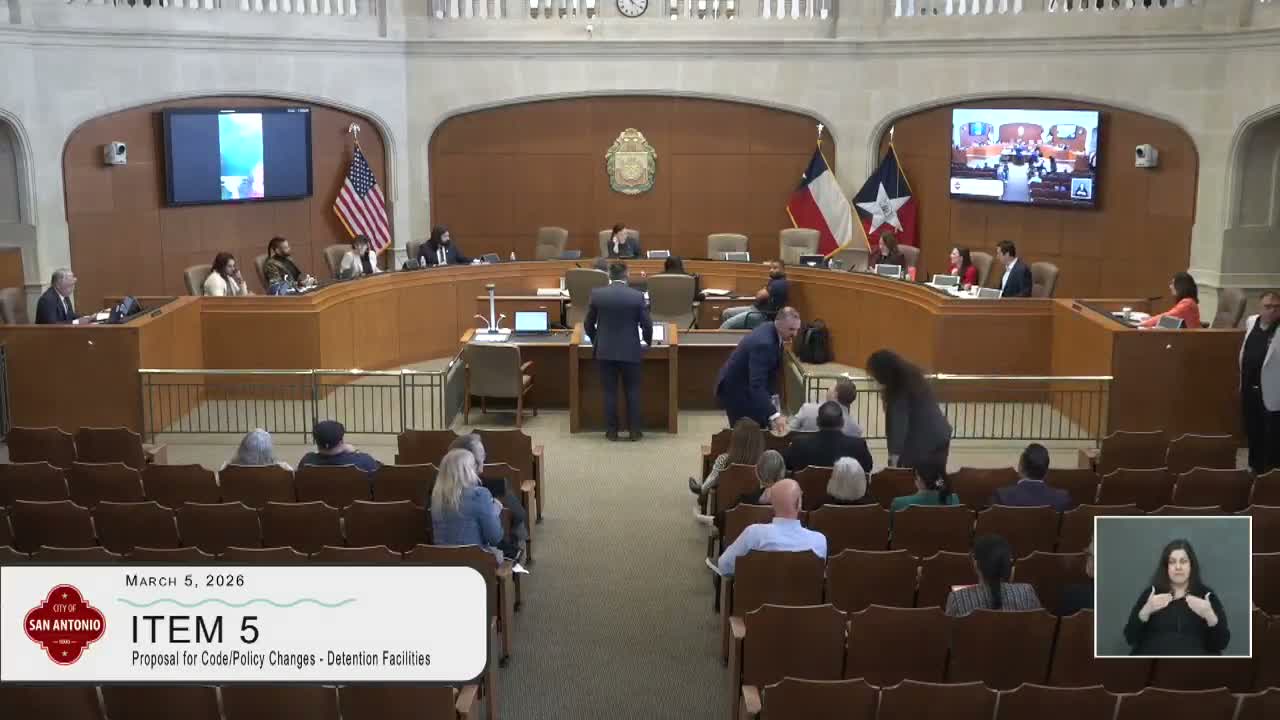
San Antonio council approves resolution to evaluate detention-facility rules and to pursue moratorium process
Loading...
Summary
The City Council voted to direct staff to evaluate code and policy changes for detention facilities and to initiate a moratorium process in parallel, while council members and residents warned the city’s authority is limited when federal facilities may override local rules.
San Antonio — The City Council on March 5 approved a resolution directing staff to evaluate potential amendments to the Unified Development Code and city policies related to the construction and operation of detention facilities and to pursue a moratorium process in parallel.
The resolution, advanced after extended public testimony and council debate, tasks Development Services and the City Attorney’s Office with studying options such as a dedicated zoning designation for detention centers, special‑use council authorization, and minimum buffer or spacing requirements. Councilman McKee Rodriguez moved an amendment to explicitly initiate the moratorium process; the amendment passed by voice vote and the motion as amended carried.
Why it matters: Residents and faith leaders described the human impact of immigration detention and urged the council to take every available step to prevent privately run or federally operated centers from becoming permanent fixtures. Hilda Santiago, who said her husband was detained earlier this year, told the council: "My husband was detained on a Wednesday morning ... The room was full of people who look like me who look like many of the people in San Antonio." Her testimony was among several personal accounts urging stronger action.
Limits of local authority: City staff and the city attorney repeatedly warned that city rules can be limited by federal law. City Attorney Andy (last name not specified in the transcript) told council members that if a facility is operated directly by the federal government, local requirements may be waived. Deputy City Manager Maria Villagomez briefed the council on the staff work program that will accompany the evaluation, including monthly reporting on any ICE requests and referrals.
How the city will proceed: Development Services Director Amin Thomas offered two timetables. Under a standard out‑of‑cycle Unified Development Code process, amendments typically take roughly five months with summer public hearings. Under an expedited process staff described, the zoning commission could meet as soon as April 7 with council consideration on April 16, roughly a 45‑day path to recommendations. Staff recommended council direction to study options rather than immediate code changes.
Moratorium mechanics: Council members discussed and then authorized staff to initiate the moratorium process in parallel with the UDC review. Staff and legal counsel cautioned that a moratorium under state law has procedural notice and hearing requirements and, even when adopted, is limited in duration (generally 90 days with a possible extension to 180 days in certain circumstances). The council directed staff to return with specific language, environmental and liability analyses, and further committee review.
Next steps: Council directed staff to pursue the expedited evaluation and to bring more detailed timelines, legal analysis on enforceability against federal facilities, and potential fiscal impacts back to council for review. The council also requested continued engagement with neighborhood associations and a clear communications plan so residents understand what the reporting mechanism will and will not accomplish.
Council action: Motion to approve the resolution as amended carried by voice vote. The amendment to initiate the moratorium process passed first, also by voice vote.
What the council did not do: The action does not by itself ban federal facilities or guarantee that privately owned sites could not be leased to federal authorities; staff repeatedly cautioned that federal entities retain discretion that may limit local regulatory reach. The council asked staff to identify the practical legal limits and to pursue legislative or intergovernmental options where feasible.
The council moved on to other business after the vote; staff will return with a detailed plan and timelines for the UDC amendment process and the moratorium procedural steps.