Get Full Government Meeting Transcripts, Videos, & Alerts Forever!
Get email alerts on the Education Lcap topic
No spam. Unsubscribe anytime.
Cajon Valley board hears mid‑year LCAP update; Bostonia charter reports gains in attendance and reading
Summary
District staff presented mid‑year LCAP data highlighting development of 'CV Essential Skills,' professional learning initiatives and preliminary assessment gains; Bostonia Global reported decreased suspensions, higher attendance and literacy progress among students, with trustees asking for site‑level breakdowns.
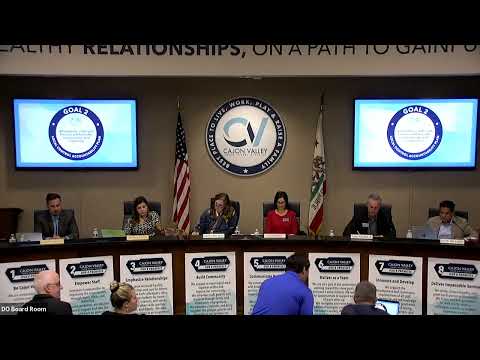
District leaders gave the Cajon Valley Union School District board a mid‑year look at progress on the Local Control and Accountability Plan (LCAP) and a separate presentation from Bostonia Global, an in‑district charter school, during the board's January meeting.
The board president opened the session and turned the floor over to district staff, who described work on Goal 1 — preparing students with “CV Essential Skills.” A new card‑deck teaching tool was introduced for classroom use and staff said more than 60 CV ambassadors are engaged in multi‑year lesson study work, reaching roughly 2,800 students this year. The district also reported a recent professional learning day and a staff survey showing teachers prioritized training such as Barton, OG and CGI math.
District staff described a district‑created “CV thought partner,” an instructional assistant built in Gemini that the presenters said is trained on curriculum materials the district uploads. A trustee questioned whether the tool has access to the district's adopted curriculum; presenters said the thought partner uses uploaded materials and the district is still negotiating access with publishers in future adoptions.
The presentation also addressed school climate and student supports. Staff reported modest declines in chronic absenteeism at several campuses and a district‑wide decrease in suspension rates. Presenters said they are expanding restorative practices and redesigning student response systems at multiple sites, and will pilot a digital referral system to replace paper referrals.
Bostonia Global, which the presenters described as an in‑district dependent charter, gave a separate mid‑year report aligned to the district's goals. Principal Johanna Simcoe highlighted high completion rates of RIASEC interest inventories and a 99% success rate for students experiencing work‑based learning activities. Bostonia leaders said they have decreased suspensions by 5 percentage points at TK–12 and reported attendance gains at elementary and high‑school levels.
Bostonia also highlighted gains for English learners and students with disabilities on state assessments, and principals said consistent long‑term enrollment correlated with higher achievement. Board members asked for site‑level data and raw incident counts so they can compare discipline declines with any changes in hands‑on interventions.
The presentations closed with trustees thanking staff for the team‑based approach. The district noted that several assessment windows remain open through February and described the data as preliminary.
The board moved on to a busy consent and action agenda after the presentations.