
Charleston County committee says resilience work must move from plans to on-the-ground action
Get AI-powered insights, summaries, and transcripts
Subscribe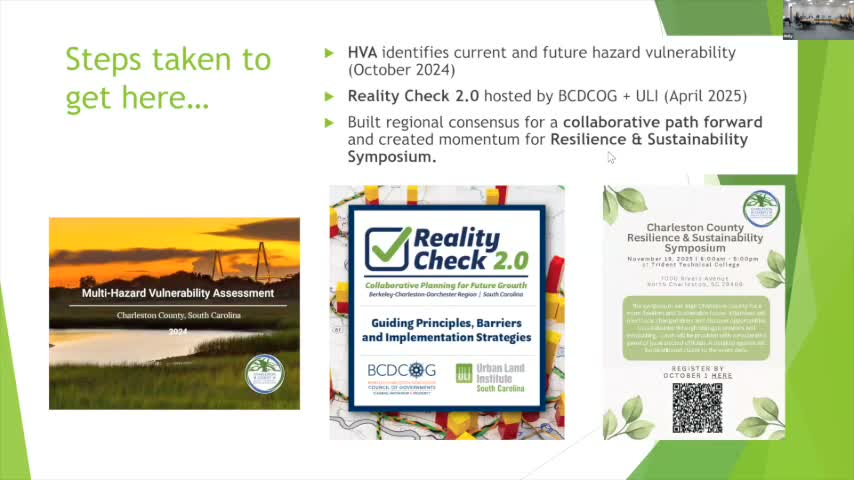
Summary
Committee members reviewed outcomes from a November symposium and a February accelerator workshop and identified coordination, data gaps and a "trust deficit" as barriers to implementing resilience plans; the collaborative will reconvene in May to train staff on vulnerability-assessment data and set measurable actions.
The Charleston County Resilience & Sustainability Committee spent much of its meeting reviewing steps meant to turn years of planning into tangible projects, emphasizing better coordination across jurisdictions and clearer public communication.
"It's easy to write a lot of plans and potentially not really... reckon with what it is to commit to what it takes to implement those plans," said the meeting facilitator (Staff member), summarizing a common workshop finding and why the county is prioritizing implementation over additional planning. The county produced a Hazard Vulnerability Assessment in October 2024 and convened a November symposium that drew roughly 180 attendees and about 60 organizations, followed by an "accelerator" workshop in February that included more than 40 local government representatives.
Workshop participants identified specific barriers to moving from plans into projects, including poor cross-jurisdiction coordination, outdated regulatory standards, critical data gaps and public resistance rooted in what the committee described as a "trust deficit". Committee members said those barriers contributed to delays so that, even when risks such as flood-prone areas are known, development or redevelopment decisions may already be locked in by older entitlements.
The committee said the collaborative has converted symposium findings into impact statements and action items that assign responsibilities to jurisdictions and partners with timelines and specific technical support. The county plans to convene the larger collaborative in May to share accelerator findings, offer trainings on the vulnerability-assessment data and Excel-based tools, and discuss common metrics for measuring resilience outcomes.
Speaker 1 urged the committee to prioritize public education about the work, noting that residents often do not understand why trade-offs are made in planning decisions. Staff member said the collaborative will provide trainings and make baseline data available so jurisdictions can make comparable and equity-driven decisions.
The meeting closed the resilience segment with a commitment to reconvene in May and to continue developing common measurement approaches that combine hazard layers with assessor data to make projected impacts and costs more tangible.