Get Full Government Meeting Transcripts, Videos, & Alerts Forever!
Get email alerts on the Energy Storage topic
No spam. Unsubscribe anytime.
Southampton County commissioners direct staff to study battery energy storage zoning and safety
Summary
After reviewing informational materials, the planning commission agreed to keep battery energy storage systems (BESS) on the agenda and asked staff to research existing local codes, safety concerns (including fire/rescue impacts) and examples from other localities, such as a project in Sussex County.
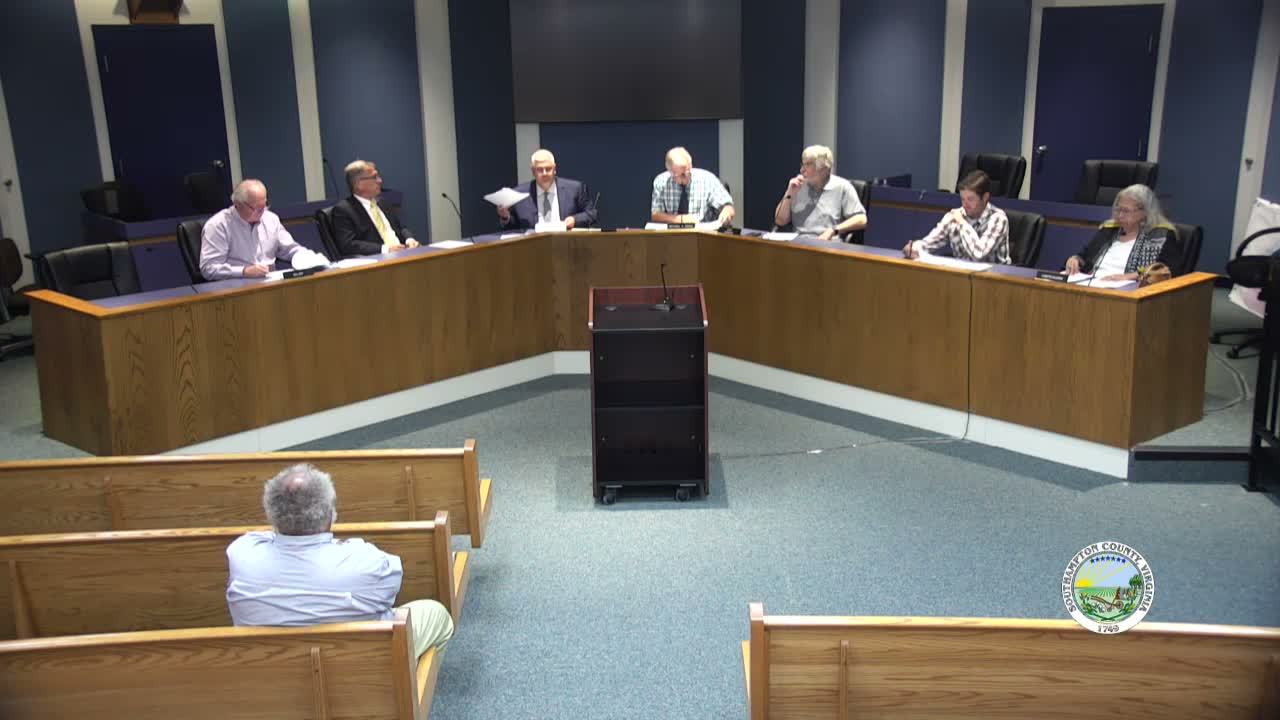
The Southampton County Planning Commission discussed stationary battery energy storage systems and directed staff to research zoning models, technical and safety guidance, and examples in other localities before proposing any changes to county code.
Chair introduced the item as unfinished business and said the materials provided were "purely file information" for now; commissioners asked whether battery systems would tie to solar projects or be standalone grid-charged facilities. Planning staff member Nuckols described a Sussex County example (the "Shands" project) that would draw energy off the grid at night, store it in batteries, and release it during daytime peak demand.
Commissioners raised practical concerns, including whether the county's solar ordinance currently addresses energy storage, the need for conditional-use permits for large facilities, and potential burdens on fire and rescue services. One commissioner noted that the zoning code likely allows conditional approvals (e.g., in M-1 or B-2 with conditions) and recommended proactively drafting standards rather than reacting to ad hoc applications.
Members asked staff to research whether other Virginia localities have ordinances addressing battery storage, to consult subject-matter resources (including the Berkeley Group), and to report findings at a future meeting. The commission agreed to keep the topic on upcoming agendas so it can be considered for incorporation under the solar ordinance or as a separate code section if appropriate.
No formal action to adopt regulations was taken; commissioners instead set direction to staff for research and follow-up.