Lifetime Citizen Portal Access — AI Briefings, Alerts & Unlimited Follows
Glenview trustees approve Sanders Corporate Park rezoning subject to ‘light and clean’ guardrails; 6B tax incentive deferred
Loading...
Summary
After hours of trustee questions and more than two hours of public comment, the Glenview Village Board approved rezoning and preliminary site approvals for the Sanders Corporate Park but instructed staff to add explicit definitions and restrictions for "light and clean" industrial uses; action on the developer's Cook County Class 6B tax incentive was continued to March 19 for further fiscal and ordinance work.
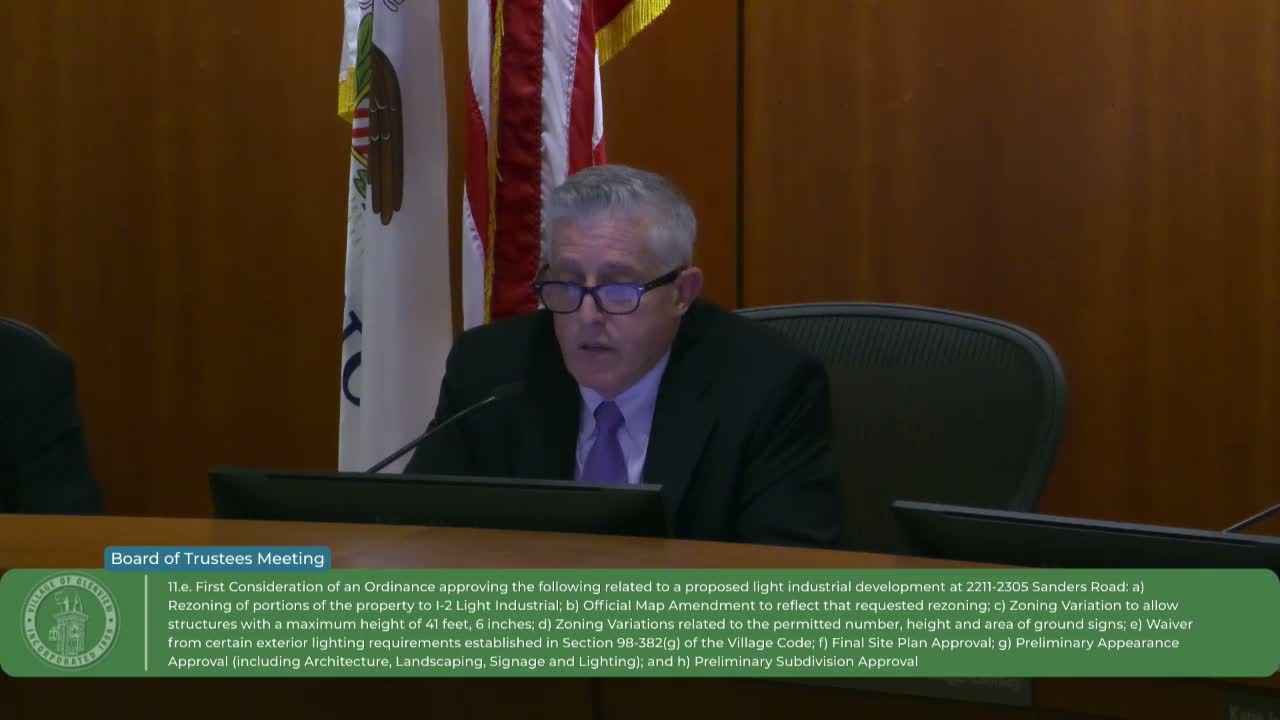
Glenview’s Village Board voted on Feb. 17 to advance a major rezoning and preliminary site plan for a proposed 29‑acre "Sanders Corporate Park," while postponing a decision on the developer’s request for a Cook County Class 6B property tax incentive so staff can record clearer limits on allowed uses.
The project, proposed for 2211–2305 Sanders Road, would demolish existing office buildings and construct four shallow‑bay light‑industrial buildings totaling roughly 380,000 square feet with about 392 parking spaces and up to 53 truck docks. The developer told the board the design intentionally favors smaller, high‑image tenants and excludes large trailer‑storage yards to limit heavy freight activity.
Board members and staff said the central question at the meeting was how to ensure the property remains limited to the low‑impact uses the village desires. Director Jeff Brady told the board that the Willow Road Corridor agreement and the village’s existing use table narrow the universe of permitted activity, but several trustees said the phrase "light and clean" needed a clear, written definition in the ordinance that will run with the property.
"We need guardrails so that when a new tenant comes in, staff and future boards know what 'light and clean' actually means," Trustee Sidoti said. Trustee DeBoni said she supported the proposal only if such definitions and recorded restrictions are included. The board directed staff to draft explicit language and record the zoning entitlement so the restrictions will be clear to future property owners.
The developer’s representative, Scott, said the campus is designed for "shallow bay" users—advanced manufacturing, showroom/fabrication, local service providers and light manufacturing—that use smaller trucks and do most work during daytime hours. He said the project is not designed for heavy distribution and that the buildings’ 32‑foot interior clear heights and 100–230 foot depths are economically and physically mismatched for large, high‑volume freight operators.
Residents and neighborhood advocates spoke at length. Speakers from Timberlane Estates, Mission Hills and adjacent neighborhoods described concerns about truck traffic at the Sanders/Willow intersection, school routes, overnight operations and property values. Several speakers asked the board to reject an I‑2 rezoning because, they said, the Willow Road Corridor agreement envisions office, commercial or residential uses in parts of the corridor. Other commenters with industrial real‑estate experience said the site is distressed and that shallow‑bay redevelopment would bring jobs and sales tax.
Trustees pressed the applicant on truck‑dock counts and tenant size. Trustee Doran asked whether the board could limit individual tenant size (for example, to 50,000 square feet) and require administrative review for larger uses; the applicant said hard limits would risk losing growing local firms, but agreed to work with staff on measurable conditions and to limit dedicated trailer storage. Village attorney Greg Jones told the board options include recording the ordinance against the property or adding a covenant; staff said either approach would put subsequent purchasers on notice.
On fiscal questions, staff said the applicant is seeking a Cook County Class 6B incentive (which reduces the assessment rate for a period) to make the deal feasible compared with neighboring counties. Trustees and residents asked for clearer fiscal modeling and for protections—such as a make‑whole provision and a requirement that the developer waive aggressive tax appeals—so that other taxing districts are not unfairly burdened. Director Brady summarized the developer’s fiscal projections and the mechanics of make‑whole payments to impacted districts.
The board voted to approve the rezoning and preliminary site items (11E) subject to staff incorporating the board’s feedback—including a definition of "light and clean," limits on operations and clarity about review procedures—and to record relevant restrictions. The separate resolutions and development agreement that would express the village’s support for the Cook County Class 6B incentive were continued to the board’s March 19 meeting, giving staff time to draft the ordinance language and to produce additional fiscal detail for the overlapping taxing districts.
The board’s action was procedural: second consideration and final approvals remain required for some of the individual entitlements, and conditional uses or tenant‑level approvals would still trigger administrative review and, where required, public hearings before commissions.
What’s next: staff will draft and circulate ordinance language that defines "light and clean" uses, propose enforceable conditions (including whether to limit tenant sizes or docks), and include recording steps so any restrictions run with the property. The 6B resolution will return for board consideration on March 19 with updated fiscal analyses and proposed protections for the village and overlapping taxing districts.