San Antonio council backs feasibility study and city–county ad hoc committee for diversion and recovery center
Loading...
Summary
Council members heard a staff‑led briefing on a CCR that asks the city to participate in an RFP and to form a joint city–county ad hoc committee to study a pre‑arrest diversion center and longer‑term recovery services; the Public Safety Committee recommended participation and the city expects to contribute toward a $100,000 feasibility study.
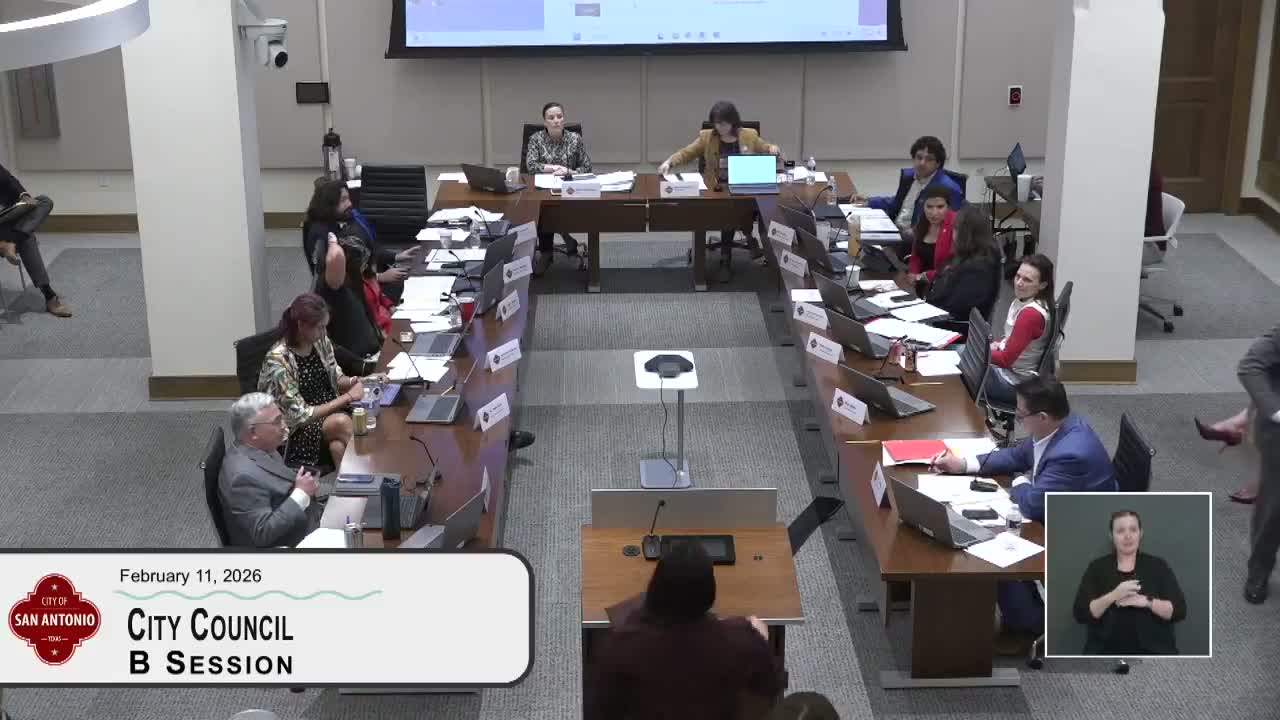
City staff and the local mental‑health authority on Wednesday briefed the City Council on a Council Consideration Request (CCR) to explore a centralized diversion and recovery system for individuals with mental‑health, intellectual or developmental disability, or substance‑use disorders — and the council voiced broad support for launching a feasibility study and a city–county ad hoc committee.
Maria Vargas, director of the Integrated Community Safety Office, summarized the CCR’s four requests: begin conversation on a diversion center alternative to incarceration; identify necessary infrastructure, staffing and procedural changes; review recommendations from Dr. Alexander Testa’s Bexar County Justice Intake and Assessment annex evaluation; and create a joint city–county ad hoc committee. The CCR proposes two related facility types: a pre‑arrest diversion site (short‑term intake, stabilization and referral) and a recovery center (longer‑term rehabilitation and case management).
Speakers cited outcomes in Texas counterparts. Harris County reported that between 2018 and 2023 the Judge Ed Emmett Diversion Center diverted thousands of people from jail and estimated $5.54 in criminal‑justice cost avoidance for every $1 invested. Dallas County’s Deflex effort increased referrals after deploying mobile crisis outreach and rapid‑response teams.
Jalene Jamieson, CEO of the Center for Healthcare Services (CHCS), said CHCS issued an RFP and selected Dr. Alexander Testa and a University of Texas–Houston team to complete a feasibility study and evaluation; staff reported the study cost is roughly $100,000 and that the city was asked to contribute $30,000 toward it as part of the Public Safety Committee action. The selected study team will validate community need, determine eligible population and operational workflows, recommend governance, and estimate capital and operational costs.
Presenters and council members emphasized that a successful program requires three elements: inpatient psychiatric bed capacity, a diversion and deflection center for short stays and stabilization (the "front door" for eligible law‑enforcement encounters), and robust wraparound supports, including transitional and permanent supportive housing and 90‑day aftercare planning. Multiple council members pressed for equitable stakeholder representation on any ad hoc committee, for closer coordination with hospitals and University Health, and for clear metrics to measure reductions in bookings and improved outcomes.
Council members expressed support for the ad hoc committee and the feasibility work; several volunteered to participate or to serve as council liaisons. The council did not vote during B session on a funding appropriation; staff said the Public Safety Committee had already recommended the city participate in the RFP and proposed the $30,000 study contribution.
The council recessed for 10 minutes during the discussion and reconvened; the meeting adjourned later in the evening.