Get Full Government Meeting Transcripts, Videos, & Alerts Forever!
Get email alerts on the Transit Via topic
No spam. Unsubscribe anytime.
VIA tells San Antonio council its transit overhaul is ‘an inflection point’; council seeks fare-free pilot and telecom-tax analysis
Summary
VIA Metropolitan Transit told the City Council it has accelerated service changes and secured major federal grant eligibility for the Green and Silver ART lines, while council members pressed the agency for data, sought a memo on a six‑month fare‑free pilot for top routes and questioned how a telecom‑tax shift would change local funding.
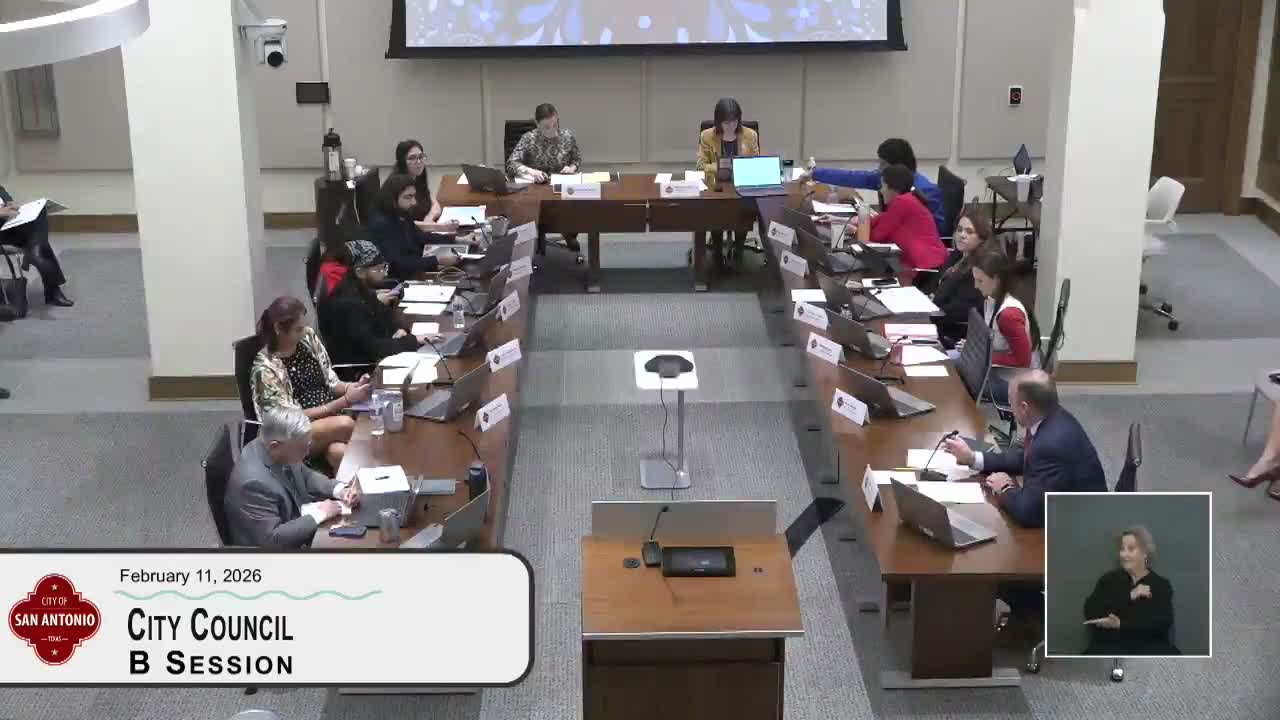
VIA Metropolitan Transit on Wednesday described a rapid transformation of San Antonio’s bus system — citing service redesigns, ridership gains and a multi‑hundred‑million‑dollar federal funding effort for two Advanced Rapid Transit (ART) lines — while City Council members pressed the agency for clearer revenue and fare options.
Laura Cabanilla, chair of the VIA board, told the council the agency is undergoing “not incremental” change but “a generational shift” focused on reliability, safety and connections to jobs. VIA said last year it delivered 31.6 million passenger trips and achieved a top customer‑satisfaction rating in the transit industry.
John Gary Herrera, VIA president and CEO, and Rod Sanchez, VIA director of planning, outlined the Keep San Antonio Moving investments: the Green Line (10.3 miles, 25 stations, 10‑minute target frequency, a $480 million project with a major federal share cited) and the Silver Line (7.3 miles, 18 stations, a $322 million budget and a $150 million federal ask currently in the federal process). VIA also reported strong growth on ViaLink (an on‑demand zone service) and said changes to 65% of the network under the Better Bus plan are complete or planned in an accelerated timeline.
Council members focused questions on funding and outcomes. Herrera clarified that VIA’s operating revenue comes primarily from sales tax and fares, and that a recent transfer of the 1/8‑cent sales tax to VIA does not include some telecom receipts — reducing an earlier $54 million estimate of available local revenue to an expected $47–48 million figure “now that telecom is no longer being assessed,” he said. City legal staff said any change to which entities collect that telecom component would require municipal ordinance action.
Discussion turned to fares and equity. Several council members urged a serious evaluation of fare‑free service pilots; Mayor Jones asked VIA to deliver a written memo laying out what it would take to run a six‑month, fare‑free pilot on VIA’s top five routes (about 24% of riders), identify the program’s top concerns and mitigation steps, and model how a partial funding offset (for example, via telecom tax receipts) would change the fiscal picture. Herrera and staff said farebox revenue is a modest portion of VIA’s budget and that nonprofits currently underwrite many discounted or free passes for vulnerable riders.
Council members also pressed VIA for operational detail: per‑ride cost and efficiency metrics, route‑level ridership changes following frequency improvements (VIA reported many improved routes saw 15–20% increases), the timeframe for construction and utility work along ART corridors, and how VIA will use ViaLink zones and park‑and‑ride capacity to connect riders to ART stations.
On environmental and fleet questions, VIA said its bus fleet largely runs on compressed natural gas (CNG) and that electric‑vehicle technology is still limited for heavy service; VIA reported a small number of electric buses in testing and said CNG remains more operationally reliable today.
The council asked for follow‑up data and public‑facing materials including route‑level metrics, a clearer construction timeline with sidewalk and drainage work call‑outs, and the requested memo on the fare‑free pilot and telecom‑tax offsets. VIA agreed to provide additional data and to return with details for council review.