Get Full Government Meeting Transcripts, Videos, & Alerts Forever!
Get email alerts on the Urban Renewal topic
No spam. Unsubscribe anytime.
Idaho Falls council approves Riverside Urban Renewal Plan and intergovernmental agreement with Bonneville County
Summary
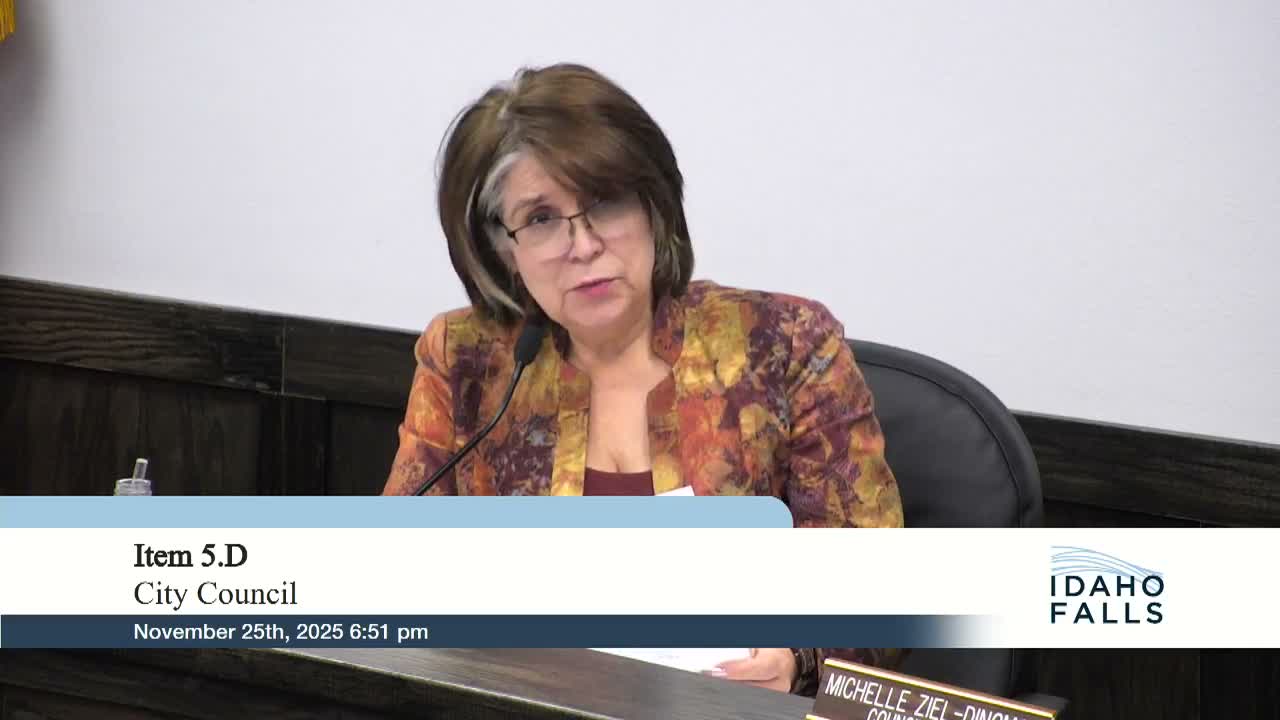
The Idaho Falls City Council voted Nov. 24 to adopt the Riverside Urban Renewal Plan and authorize an intergovernmental agreement with Bonneville County, creating a 20-year revenue allocation area that consultants say could support hundreds of millions of dollars of private investment and pay-as-you-go public projects.
The Idaho Falls City Council on Nov. 24 approved an ordinance adopting the Riverside Urban Renewal Plan and a resolution authorizing an intergovernmental agreement with Bonneville County to create a multi-jurisdictional revenue-allocation area (a tax-increment financing district) with a 20-year term.
Megan Conrad, the redevelopment agency’s legal representative, told council members the proposed district covers roughly 215 acres along the Snake River and includes parcels inside city limits and in unincorporated Bonneville County. She said the agency followed statutory notice requirements and that some parcels classified as agricultural were excluded when owner consent was not obtained.
Greg Kramer of Perspective Planning presented an economic feasibility study that the agency used to support the plan. Kramer said the study identifies about $600 million in anticipated private investment over 20 years and roughly $663.3 million in eligible public costs for infrastructure, remediation and related projects. He described two revenue scenarios — a conservative projection and a moderate-growth projection — and said both indicate the OPAs (owner participation areas) would generate sufficient tax increment to reimburse developers’ eligible costs and still leave carryover funds for additional public projects later in the district’s life.
Mr. Sanner, speaking on behalf of the Idaho Falls Redevelopment Agency, summarized the agency’s prior actions: the agency adopted the plan on Sept. 18 and sent required materials to Bonneville County and overlapping taxing districts. He noted state law limits the district to a 20-year plan and that some taxing districts (ambulance and fire) must consent by resolution to be included in the financing provisions; if those levies do not consent, their levies will not generate revenue for the district.
Council discussion touched on river-corridor protections, remediation needs and the scale of the project. Councilors expressed support for protecting the Snake River corridor while allowing commercial and mixed-use development in line with the city’s future land-use goals. Kramer said some sites within the area will require significant cleanup and that revenues are expected to begin to provide carryover funds for other projects roughly a decade into the district.
Councilor [motion maker] moved to adopt the ordinance under suspension of the rules and to approve the intergovernmental agreement; a second was heard and the motions carried on recorded voice votes.
The ordinance requires publication by summary and authorizes the city clerk to transmit copies to county and state officials and affected taxing entities; the resolution authorizes the mayor and city clerk to execute the intergovernmental agreement with Bonneville County. The council closed the legislative hearing after taking no public testimony in the chambers.
Next steps: The clerk will publish the ordinance summary and transmit required materials to overlapping districts and state officials as prescribed by statute. Any future material amendments to the plan could trigger a base-reset analysis under state law.