Get Full Government Meeting Transcripts, Videos, & Alerts Forever!
Get email alerts on the Urban Renewal topic
No spam. Unsubscribe anytime.
Council adopts Riverwalk urban renewal plan to enable $40 million in private investment
Summary
The Idaho Falls City Council voted to adopt a 20-year Riverwalk Urban Renewal District covering roughly 10 acres. City and agency staff said tax-increment financing would support up to about $4.1 million in public infrastructure and remediation costs tied to private development.
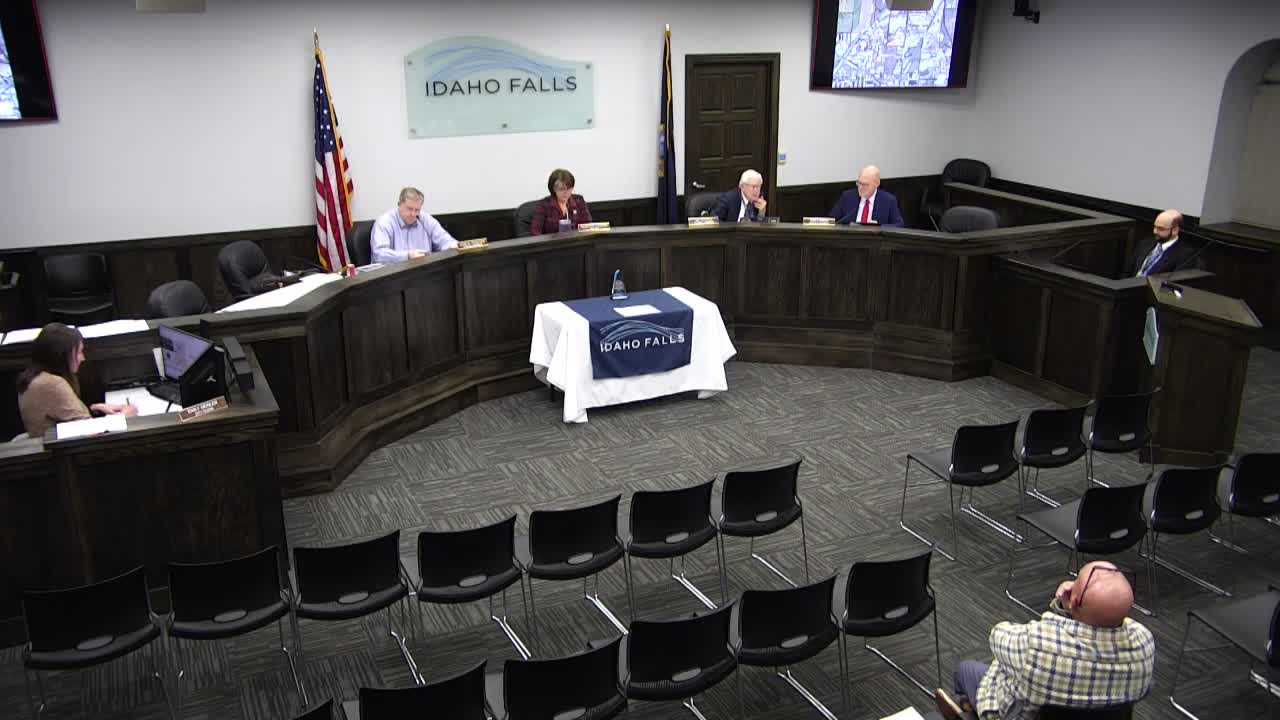
The Idaho Falls City Council on Dec. 2 adopted an ordinance creating the Riverwalk Urban Renewal District, a roughly 10-acre, 20-year revenue-allocation plan city staff said will support private development estimated at about $40 million.
The plan, presented by Megan Conrad of Hillenburg and consultant Brad Kramer of Perspective Planning, outlines eligible public projects — most prominently rock blasting and fill remediation, a canal pathway and related infrastructure — and assumes developer owner participation agreements to reimburse eligible costs. Kramer summarized the economic-feasibility work, saying the district is "economically feasible with 75% OPA. I would say just feasible." (OPA = owner participation agreement.)
Why it matters: council and agency staff said the area was previously included in an earlier river-district plan but remained undeveloped; the new district is intended to unlock mixed-use, office and hotel projects that, staff told the council, would put properties on the tax rolls and create revenue streams to repay public investments.
What the plan would fund: staff identified roughly $4.1 million in potential public costs across three primary development sites. The largest single line in the budget is rock blasting and fill remediation on Site 3, which staff said accounts for the most expensive eligible construction. Kramer said revenue projections used conservative and moderate scenarios and noted that timing matters: the hotel project, already in review, is expected to accelerate tax-increment receipts.
Public comment and deliberation were brief: one member of the public asked for clarification about parcel boundaries and notification; staff confirmed affected taxing districts had been notified and that Bonneville County Road and Bridge was included in the mailing. Council members discussed how owner participation agreements and bids factor into reimbursement timing.
The vote and next steps: Councilor Larson moved to adopt the ordinance by suspension of rules; the council approved the ordinance on a roll-call vote. The city clerk read the ordinance title into the record, and staff will transmit required documents to county and state officials and affected taxing entities as required by Idaho statute. The ordinance becomes effective after publication by summary.