
Boston council committee hears officials’ warnings on contractor, cryptocurrency and AI-driven scams targeting seniors
Get AI-powered insights, summaries, and transcripts
Subscribe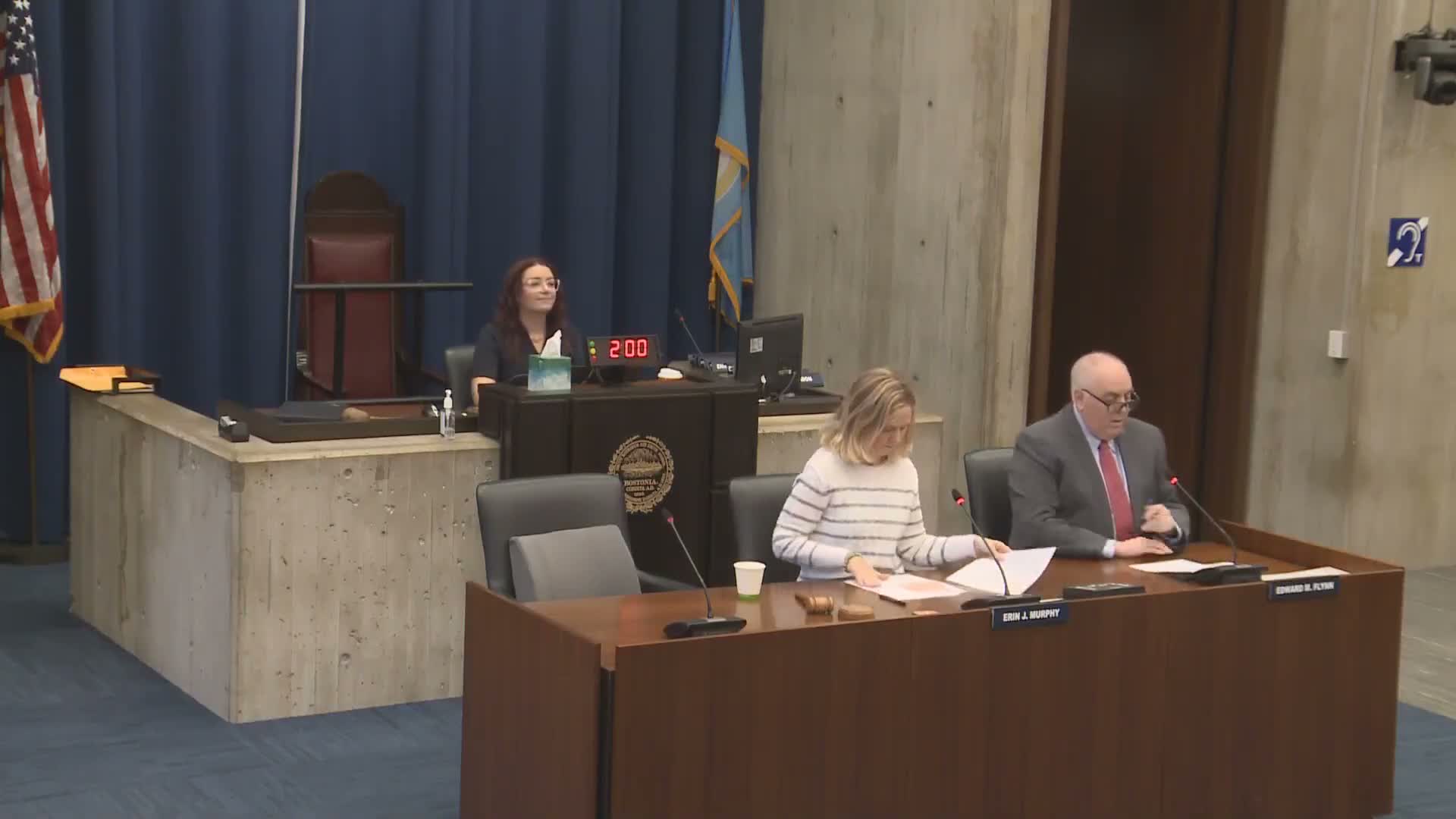
Summary
Boston City Council’s Committee on Human Services on March 9, 2026, heard from Age Strong, the Office of Consumer Affairs and Licensing, and Boston Police about rising scams that target older residents — from contractor fraud to crypto ATM schemes and AI-enabled impersonation — and a victim’s account of $10,000 identity theft.
Boston City Council’s Committee on Human Services convened March 9, 2026, to examine elder scamming and fraud prevention, hearing testimony from Age Strong, the Mayor’s Office of Consumer Affairs and Licensing, and the Boston Police Department about outreach, casework and emerging threats.
In opening remarks, Councilor Erin Murphy (chair) said the hearing was intended to “prevent, educate residents, and respond to these crimes,” and she asked city agencies about ways to strengthen coordination and outreach to protect older Bostonians.
Councilor Michael Flynn said the Boston Police issued a community alert in September 2025 about home-improvement fraud and that some seniors have paid “upwards of $20,000 to $30,000” for work that left them worse off. He cited a federal estimate of more than $3,000,000,000 in losses to seniors nationwide.
Emily Shea, commissioner of the Age Strong Commission, described education programs and partnerships the city uses to reach older residents: community presentations with BPD, a monthly Age Strong magazine (translated into Spanish for selected articles), the Money Smarts curriculum delivered by AmeriCorps RSVP volunteers, and partnerships with the Attorney General’s Office, AARP and community organizations. “Every day, more and more older Bostonians are falling victim to scams, and scammers are becoming increasingly creative and bold in their tactics,” Shea said.
Kathleen Joyce, executive director of the Mayor’s Office of Consumer Affairs and Licensing, said the office closed over 1,000 consumer cases last fiscal year and helped recover more than $264,000 across all cases handled by the office. She described a recent case in which a Quincy resident lost $70,000 and, through coordinated work with the FBI and the postal inspector, recovered the funds.
Gerald Cahill, deputy superintendent with the Boston Regional Intelligence Center (Boston Police), described information‑sharing and community outreach by the Bureau of Community Engagement and said strengthening interagency communication is key to identifying scam trends. Cahill warned that many incidents are underreported and said Boston law enforcement recorded roughly $7,200,000 in fraud reported by elders last year, while noting that figure likely understates the true scope.
Committee members pressed the panel on language access and caretaker exploitation. Councilor Flynn and others noted that immigrant seniors who speak Cantonese or other languages may be especially vulnerable; officials said community service officers who speak multiple languages conduct presentations in neighborhoods and that printed materials and translated content are used to reach seniors who are not online.
Officials also discussed cryptocurrency ATM (kiosk) scams. Cahill and James Chin, superintendent in the Bureau of Community Engagement, said some crypto kiosks exist in Boston and that money moved into cryptocurrency can be difficult to recover. Cahill said detectives have had specialized training and that the department has considered targeted signage at kiosks to warn users. “When you’re working with crypto, it is very tough to get money back,” he said.
The committee heard a two‑minute public comment from Paul White, who said someone used his Social Security information to open a Discover card and charged $10,000 at a Downtown Crossing store called T Luxury; he told the council Discover declined to treat the activity as fraud and that a police report did not reflect the detail he provided. Cahill asked whether White had filed a police report; White said he had and offered to provide it to the council staff for follow-up.
Lawmakers and agency officials emphasized education and early intervention as the primary tools to prevent victimization, and urged residents who suspect fraud to contact consumer affairs or police rather than responding immediately to demands for payment. The committee adjourned without formal votes; staff follow-up was offered for individual cases raised during testimony.