Get Full Government Meeting Transcripts, Videos, & Alerts Forever!
Get email alerts on the Zoning Planned Development topic
No spam. Unsubscribe anytime.
Consultant warns DeSoto commissioners that Planned Developments can be overused; staff urged to improve notice and code alignment
Summary
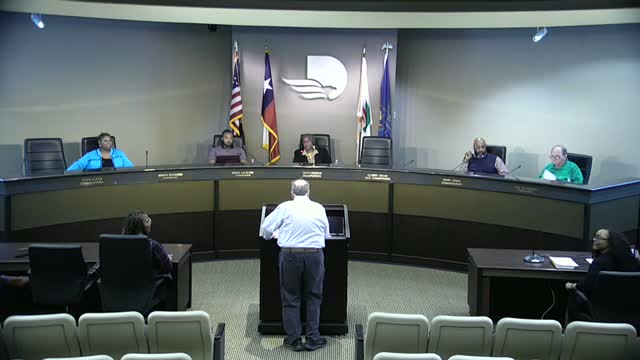
At a Feb. 12 Planning and Zoning Commission training, consultant David Kossel cautioned that Planned Developments (PDs) are intended for large or unique sites but are often applied to small, site-specific issues; commissioners pressed staff on community notice, and staff said the city will compile an exact inventory of PDs.
A consultant told the DeSoto Planning and Zoning Commission on Feb. 12 that Planned Developments, or PDs, are intended for larger or unique sites but are frequently used to resolve small, site-specific issues, prompting commissioners to press staff for clearer notice and a citywide inventory of PD ordinances.
"PDs frequently end up being used for smaller developments just to accommodate problems," said David Kossel, the consultant leading the session, in a training the commission scheduled to review PD processes and approval criteria. Kossel said the PD enabling language in the DeSoto ordinance envisions mixed-use or unique-site developments but that the tool can be misapplied when the underlying zoning code needs updating.
The commission asked how many PDs exist in DeSoto. Kossel estimated "about 200" based on his review; Planning Manager Cambria Jordan said staff is working with the city secretary—s office to compile an authoritative list and will report back to the commission.
Commissioners focused on two recurring concerns: transparency to adjacent communities and potential inconsistency across similar parcels. Kossel described PDs as a flexible tool that can list a base zoning district and call out a small set of exceptions, but he warned that flexibility can lead to unpredictable outcomes for neighbors and additional administrative burdens for staff.
A commissioner raised the example of a proposed PD near the Crystal Creek neighborhood and asked whether future residents or adjacent communities receive notice. "Adjacent property owners within 200 feet would all receive notice and DeSoto has expanded that to 400 feet as well," Kossel said, and Jordan confirmed that only those within the 200-foot radius may formally file support or opposition on the mailed notice.
Kossel listed typical review materials the commission and staff should expect for PDs: a statement of purpose, conceptual plan showing natural features and projected street grids, a table of development standards (setbacks, FAR, lot size), and later a development plan for ministerial staff review. He said PDs are most effective for larger master-planned sites, projects with transit opportunities, or environmentally sensitive land, but less appropriate when used only to tweak a single technical standard.
Commissioner Jones cautioned against a blanket prohibition: "There are times where PDs are very important," Jones said, urging that the commission and staff balance appropriate use with safeguards to avoid ad-hoc benefits for a single developer.
Staff suggested practical follow-ups: assemble the PD ordinance inventory, consider better outreach tools (website notices, clear flyers), and flag when a PD request effectively seeks only minor technical relief that might be achieved through other approval paths.
The training closed with the commission thanking Kossel; no formal policy changes or votes were taken on PD rules during the meeting. The commission asked staff to return with the PD inventory and any recommended procedural changes.