Get Full Government Meeting Transcripts, Videos, & Alerts Forever!
Get email alerts on the Impact Fees topic
No spam. Unsubscribe anytime.
Idaho Falls council tables update to development impact fees after heated public hearing
Summary
After more than two hours of testimony and debate, the Idaho Falls City Council voted to table a proposed update to the city's development impact fee study, citing unresolved questions about methodology (square-foot vs. housing type), whether to include unfinished basements, affordable-housing waivers and commercial fee impacts.
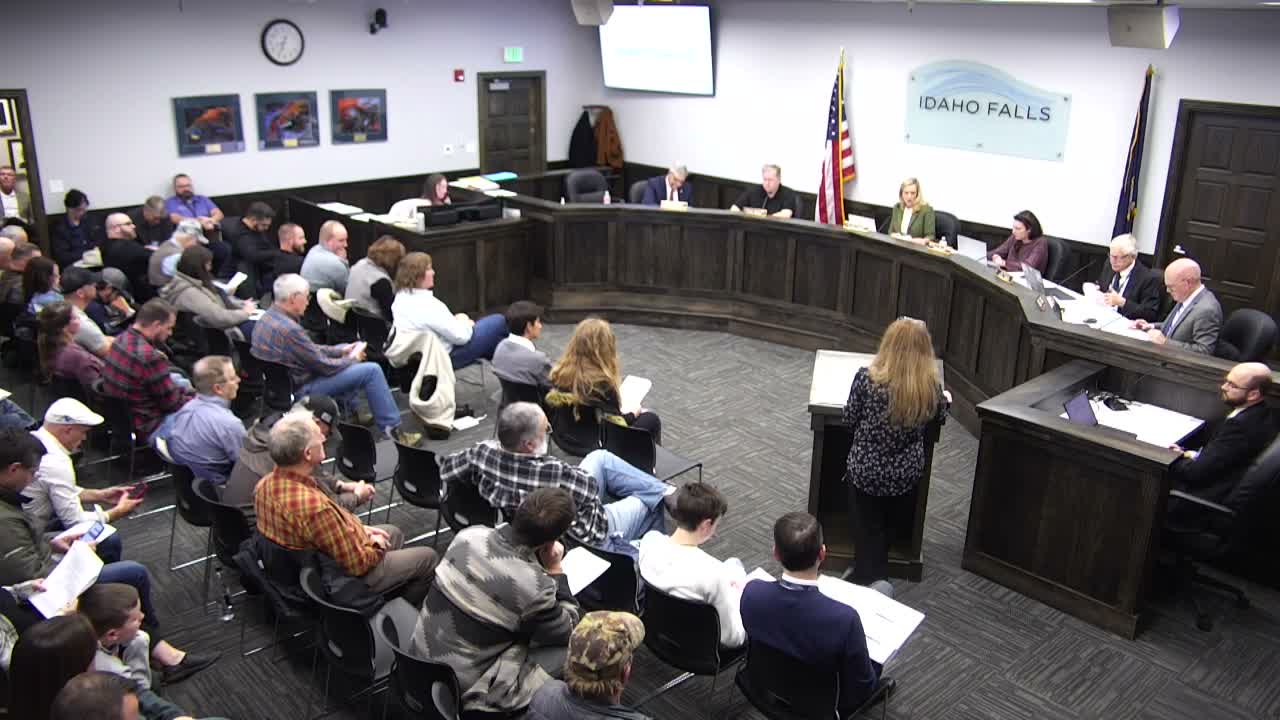
The Idaho Falls City Council on Nov. 25 postponed action on a major update to the city's development impact fee study and related ordinance after an extended public hearing and wide-ranging testimony from residents, developers and advisory committee members.
The hearing, led by Director of Parks & Recreation and impact fee administrator PJ Alexander, and consultant Colin McAlweeney of TishlerBise, presented a proposed methodology shift: assessing residential fees by square footage rather than the current housing-type categories, increasing several fee elements to the maximum supportable level and recalibrating credits and project lists in the capital improvement plan (CIP). The staff-recommended design keeps transportation at 100% of maximum support and other services (fire, police, parks) at 75%.
Why it mattered: city staff said the update reflects rising construction and infrastructure costs since the 2021 study, and completing the update positions the city to finance anticipated growth-related projects without shifting those costs to existing taxpayers. Consultant Colin McAlweeney told council that square-footage-based fees can better tie likely demand for services to dwelling size and that local census and housing data show smaller homes generally have fewer occupants and lower per-unit infrastructure demand.
But the advisory committee and multiple public speakers pushed back on several points. Richard Stewart, chair of the Impact Fee Advisory Committee, said committee members had not reached a final consensus on including unfinished basements in the square-foot calculation and warned that treating unfinished basements as finished space can sharply increase fees for starter homes. An advisory committee member and developer, who testified he participated in the process from May onward, said the committee had expected more time to review the October revisions and opposed the rushed timeline.
Developers and engineers warned the council that high commercial fees can push large retailers and industrial users outside city limits, shifting growth and some infrastructure burden to the county. A former planning director and current county official said examples in the record show that once proposed fees push development outside the city, the city can lose opportunities for annexation and growth even though regional roads and utilities still face impacts.
Council members raised practical concerns about enforcement and measurement: how the city would define and track "habitable" square footage, whether a homeowner who finishes a basement without a permit would escape a fee, and how to ensure affordable-housing waivers are enforced over time. Director Alexander said staff had drafted a definition (habitable space with electrical and HVAC) but acknowledged the definition and enforcement steps need clearer language.
The council's decision: After deliberation that included requests for more analysis from staff and the advisory committee, Councilor Lee Radford moved to table the proposed CIP, the impact-fee study update and the ordinance amendments to Title 10, Chapter 8. The motion carried on a roll-call vote; the council left timing for further work to staff and the advisory committee.
What comes next: Council members asked staff to return with focused follow-up on at least four issues: (1) unfinished-basement treatment and clear, implementable definitions of habitable or climate-controlled space; (2) enforcement mechanisms and placement of any affordable-housing waiver program; (3) commercial fee comparisons with Bonneville County to avoid unintended relocation of large projects; and (4) clarification of the CIP project locations and the nexus between projects and anticipated development. Staff and the advisory committee will reconvene; no new adoption timetable was set in the meeting record.
The hearing underscored the trade-offs cities face between generating up-front funding to build capacity and ensuring fees do not unintentionally slow affordable housing or drive development outside municipal boundaries. The council's tabling preserves time to address technical definitions, enforcement questions and outreach to the development community before any final adoption.