Get Full Government Meeting Transcripts, Videos, & Alerts Forever!
Get email alerts on the Housing Lihtc topic
No spam. Unsubscribe anytime.
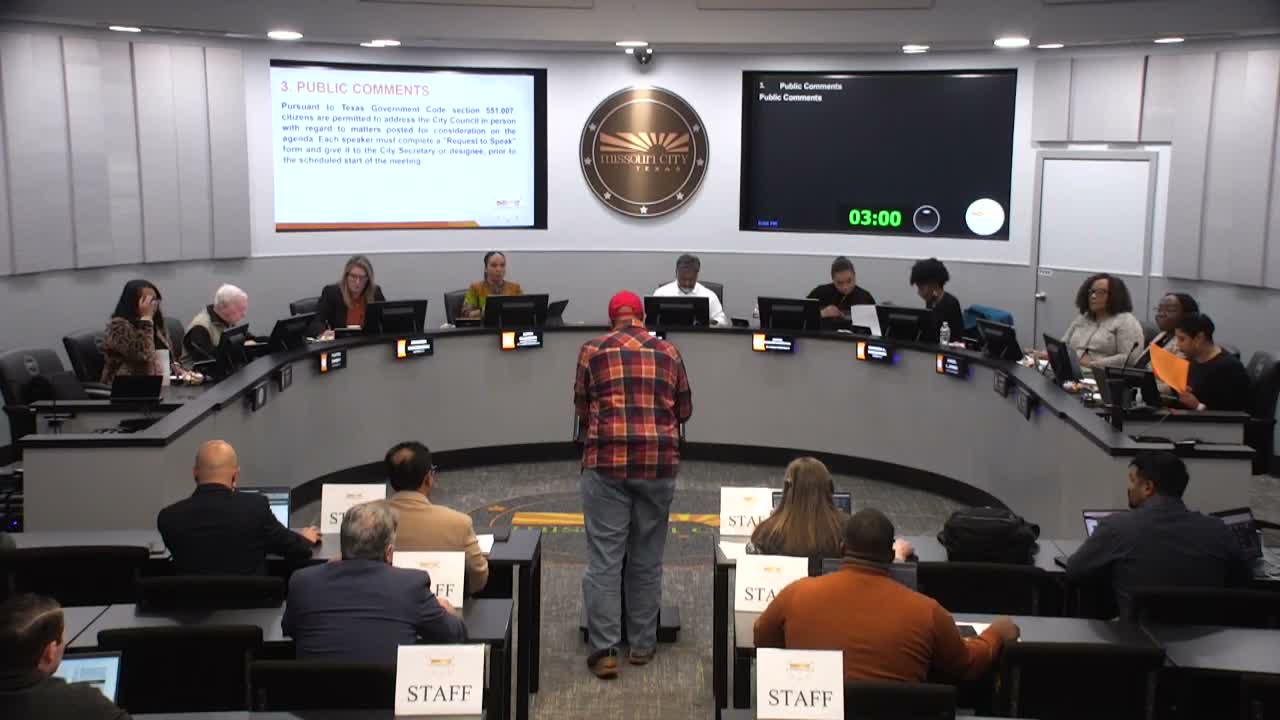
Missouri City council unanimously denies resolution to support 9% tax-credit housing application after heated public comment
Summary
After an hours-long public comment period with residents split over a proposed 68-unit workforce housing project near Scanlon, the Missouri City Council voted unanimously to deny a resolution of support that would have helped the developer apply for 9% Low Income Housing Tax Credits.
The Missouri City Council voted unanimously Feb. 23 to deny a request for a letter of support that would have helped a developer apply for the Texas Department of Housing and Community Affairs's competitive 9% Low Income Housing Tax Credit program for a proposed workforce housing project on Scanlon.
The vote followed more than an hour of public comment in which neighborhood residents, HOAs and business owners sharply questioned the choice of site, citing traffic, drainage, public-safety and property-value concerns. Several residents said the area has been "dumped on" with warehouses and that public services and infrastructure are already stressed. "We don't want something that's going to bring value down," resident Manuel Cortez said during the public-comment period.
Supporters of the proposal, including Shad Boggan, president of the Fort Bend Housing Finance Corporation, and Logan Hampton, senior director of development with Blue Ridge Cascade, said the project is designed to serve workers earning up to 60% of area median income and would preserve quality through tax-credit program oversight. "This is not public housing and it's not Section 8," Hampton said in his presentation, noting the resolution being requested would allow the applicant to apply for the state tax credits but would not approve zoning, site plans or construction. Hampton told the council the state application deadline was Feb. 27 and that a resolution of support gives the application additional points in the competitive cycle.
Council discussion focused on process as much as on policy. Several councilmembers said they were concerned that the applicant sought a support letter before completing local zoning review and public vetting. "When it's put before us in the way that it is now it takes away our opportunity to fully vet the product," Councilmember Lynn Clauser said. Councilmember Sonia Brown Marshall and others urged innovation and mixed-use approaches to reduce footprint and add ground-floor retail, but Councilmember Moriah moved to accept staff's recommendation to deny the request, which the council approved unanimously.
Staff had recommended denial in part because the property remains zoned LC1 (local retail) and would need rezoning and planning approvals before any construction. Jason Mangum, an assistant city manager presenting the item, told council the application as proposed would be for 68 multifamily units serving households at under 60% AMI and that rents were projected in the applicant's packet at a range presented there. He reiterated that a resolution of support would not preempt zoning or permitting.
The council's denial means the applicant cannot include a local resolution of support on this year's LIHTC application; Hampton said missing the state funding cycle could mean losing the opportunity for an award in this round. Councilmembers and staff encouraged developers and applicants to pursue zoning and planning review with public notice and community engagement prior to requesting support letters or other points that aid state applications.