
West Palm Beach commissioners review 2019 fire-assessment study and weigh fee update ahead of March 23 decision
Get AI-powered insights, summaries, and transcripts
Subscribe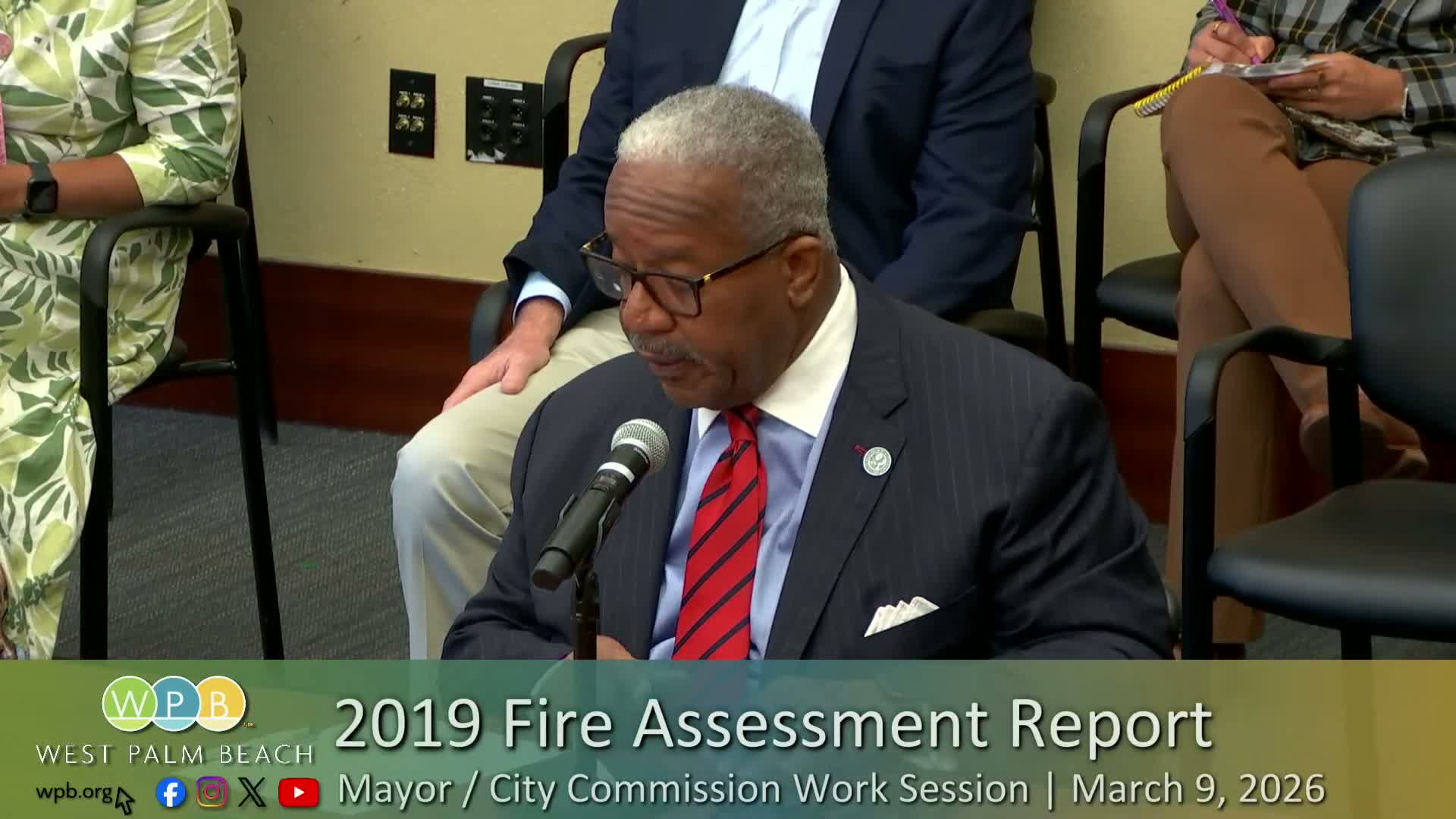
Summary
City finance staff and a consultant reviewed the 2019 fire-assessment study, showing the city could legally raise residential assessments from the current $100 toward a $231 maximum; commissioners requested more data and will decide whether to raise the fee and whether to commission a full study update at a March 23 workshop.
At a West Palm Beach City Commission workshop, Chief Financial Officer Bridget Souffrant and consultant Sandy Newbarth of Accenture reviewed the city’s 2019 fire-assessment study and laid out options for raising the residential assessment from the current $100 per dwelling unit.
The presentation explained the assessment is a property charge used to fund fire-protection services only; Newbarth said, “A Fire Assessment is a charge imposed against property to pay for Fire Protection Services,” and noted that EMS costs must be excluded under the controlling case law. The consultants told commissioners the study uses a court-tested “historical demand” methodology that apportions costs by where calls for service occurred and that the Desiderio v. Boynton Beach decision in the Fourth District upheld similar methods.
Why it matters: the commission must decide how to cover rapidly rising fire-suppression costs. The city’s five-year average assessable budget used in 2019 was about $20.5 million; Souffrant said the current fire-suppression budget is roughly $54 million, and the assessment presently funds about 13%–43% of assessable fire-protection costs depending on the funding level the commission approves. Under the 2019 study’s formulas, Newbarth showed a maximum residential rate of $231 per dwelling unit; the commission has kept the rate at $100 since 2019, which the consultant said funds approximately 43% of what could be funded under the study’s assumptions.
The presentation and discussion Newbarth walked commissioners through the study components: (1) identifying service delivery and removing EMS costs, (2) splitting the department budget between fire and EMS using a five-year average, (3) deriving a historical-demand apportionment (residential 54.21%, commercial 26.32%, institutional 11.98%, industrial 2.79%, nursing homes 4.7%), and (4) selecting billing units (residential by dwelling unit; nonresidential by square footage). Using the 2019 assessable budget example, she computed scenario results showing $100 per dwelling would produce about $8.6 million for fire protection; raising the residential fee to $125 would correspond to funding roughly 54% and $150 would shift assessment funding to about 19% of suppression costs in the fiscal-26 snapshot and yield an estimated $3.1 million additional revenue for that year. Newbarth cautioned that while the city could move toward the study’s maximums, any increase must preserve the same proportions across categories to remain legally defensible.
Commissioner questions and concerns Commissioners pressed for clarity about who pays and who is exempt. The 2019 program includes a 100% exemption for government properties (which Souffrant noted raises collection challenges) and an 80% buy-down for tax-exempt nonprofits so they effectively pay 20% of their assessed share. Commissioner Peduzzi said, “The problem I have with it is they're already tax exempt... and they're essentially paying nothing,” arguing nonprofits can impose material demand on fire services even while receiving a buy-down. Newbarth agreed to provide a breakdown of what the nonprofit buy-down currently costs the city.
Several commissioners also flagged political and timing risks. Commissioner Fox asked how a potential November ballot measure to change property taxes would interact with assessment revenue; Souffrant answered that a voter-approved state change would affect the city’s fiscal 2028 budget and urged more lead time to adjust special assessments if needed. Souffrant told the commission the fee is a “special assessment” rather than a tax and warned there could be state-level limits on imposing new assessments though existing assessments may be grandfathered.
Next steps and staff requests Souffrant asked the commission whether it wanted staff to pursue a full study update (work would need to start in October) and reminded commissioners the next workshop on March 23 is when she needs a clear signal on whether to increase the fee and by how much. Commissioners did not set a new rate at the workshop; they requested additional data on what drove the department’s budget growth since 2019, a breakdown of the nonprofit buy-down cost, and public-education talking points that would explain how assessment revenue would be used and address concerns that taxpayers could be “double-paying.”
The workshop ended with no formal vote; the commission is scheduled to revisit the issue at the March 23 meeting, where any decision on a rate change and whether to fund a new study will be considered.