
Residents press Richardson council on Amazon drone noise, privacy after low-altitude flights
Get AI-powered insights, summaries, and transcripts
Subscribe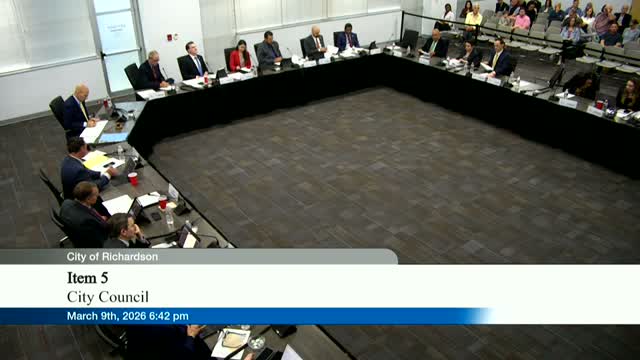
Summary
Residents told the Richardson City Council that frequent Amazon Prime Air flights from the STX-8 facility are creating a persistent noise and privacy burden in nearby neighborhoods; Amazon representatives described changes already made and committed to more community outreach and testing.
Residents packed the Richardson City Council chamber on March 9 to press elected officials and Amazon for answers about frequent drone overflights, noise and privacy concerns stemming from Prime Air operations at the STX-8 facility.
Community members said flights are frequent, loud and sometimes appear at low altitude. "I regularly hear those drones at a distance of 300 to 500 feet while inside my home," Brian Rowe, Sharps Farm HOA president, told the council. Christie Graham said she counted 19 drones over her house in 90 minutes on a Sunday morning. Neighbors raised similar complaints about disruptions in yards and parks, possible property-value impacts and uncertainty about how telemetry and imagery from the drones is stored and used.
Amazon senior manager Sam Bailey replied that Prime Air operates within the hours the council approved (7 a.m. to 8 p.m.), has delivered more than 13,000 customer orders from STX-8 and is testing changes to reduce community impacts. "We have committed to flying at that higher altitude with an average minimum of 225 feet," Bailey said, and the company reported redirecting some outbound flights to travel over commercial areas before entering residential neighborhoods. He described the Feb. 4 incident at Spring Hill Apartments in which a drone struck a gutter during ascent, and said Richardson Fire Department inspected the device and Amazon filed an incident report with the Federal Aviation Administration.
Residents and several council members urged Amazon and staff to gather independent noise data, disperse concentrated flight paths and make blurring or opt-out options more accessible. Councilmember Corcoran recommended engaging local researchers: "I'd like you all to consider utilizing UTD" to conduct a decibel study at varying heights, he said. Nick Zogakis, a neighborhood resident with technical background, proposed crowdsourced noise data and routing algorithms that distribute flights to avoid repeatedly overflying the same houses.
Bailey said Prime Air has instituted additional operational safeguards after the February incident, including removing larger multifamily developments from eligible delivery addresses pending further FAA review and increasing rooftop and crane surveys for hazards in the service area. He also described steps taken in other markets after earlier incidents: rooftop scans, daily checks of FAA portals and dynamic no-fly additions where cranes or construction appear.
On the regulatory front, city staff reminded the council that many controls over altitude, speed and airspace rest with the FAA. Staff also cautioned that the facility's land-use approval vests certain rights and that drastically changing those approvals could raise legal issues. Council members nonetheless pressed for feasible city actions and for Amazon to provide regular follow-up. Bailey offered to summarize feedback from the open-house meeting scheduled the next morning and to return with a progress report within two weeks.
No formal enforcement action or ordinance was adopted at the meeting. Council members and neighbors said they expect continued meetings, independent noise monitoring and further technical engagement to determine whether adjustments materially reduce the impacts residents reported.
The council moved on after roughly three hours of discussion; Prime Air said it will continue community outreach and engineering reviews with the FAA and city staff.