
Staff outlines downtown and Mohawk Climate Friendly Areas overlay and schedule for joint Glenwood planning
Get AI-powered insights, summaries, and transcripts
Subscribe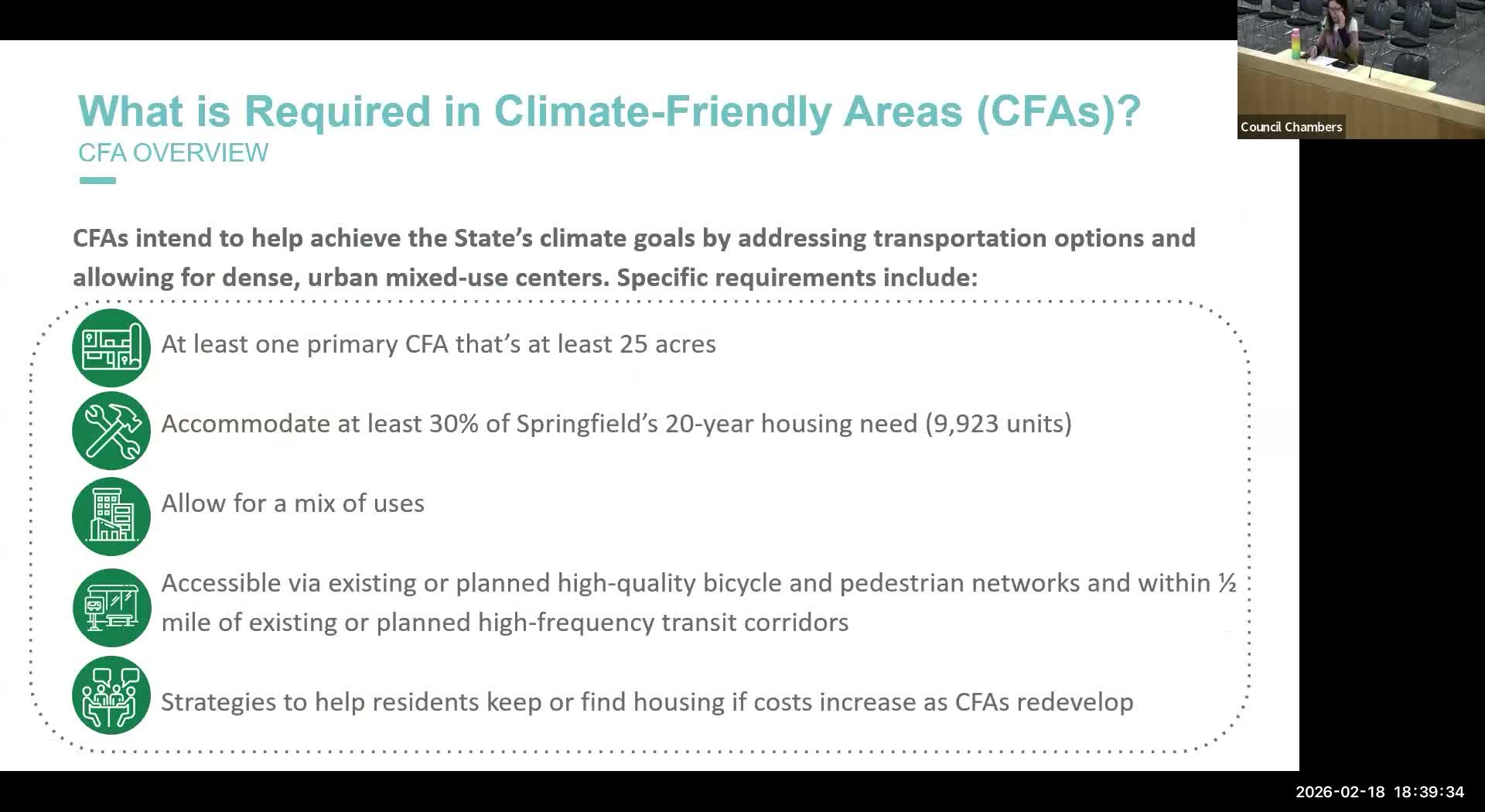
Summary
Senior planner Chelsea Hartman described how the CFA overlay will implement state CFEC rules in downtown and Mohawk (secondary CFAs), noted Glenwood Riverfront as primary CFA, explained density and height standards, and outlined March joint meeting with Lane County and a year‑end adoption deadline.
Senior planner Chelsea Hartman presented the proposed Climate Friendly Areas overlay district for Springfield’s downtown and Mohawk areas, explaining how local code amendments implement Oregon’s Climate Friendly and Equitable Communities (CFEC) rules.
Hartman told commissioners the CFEC rules require jurisdictions to designate at least one primary CFA of 25 acres or more and ensure CFAs accommodate at least 30% of the city’s 20‑year housing need. “For Springfield, that includes a little less than 10,000 housing units,” Hartman said, describing the target the CFAs must help meet. She said the Glenwood Riverfront was designated by council as the primary CFA and that downtown and Mohawk would be secondary CFAs.
Key points in the overlay - Relationship to base districts: the CFA overlay mostly relies on standards in the base mixed‑use districts (density, design and development standards) but adds CFA‑specific rules on block length, walkability and allowable uses. - Heights and densities: primary CFAs allow higher heights and densities (Glenwood already has no maximum heights and a 50‑unit minimum density per net acre); secondary CFAs must allow at least 50‑ft building heights and a 15‑unit minimum density per net acre, which generally aligns with Springfield’s downtown and Mohawk existing standards. - Auto‑dependent uses: the overlay will continue to prohibit new auto‑dependent uses (vehicle repair, gas stations, car washes, standalone auto sales) consistent with the nodal overlay it replaces; staff said existing auto‑dependent uses may continue or expand but new ones are restricted. Staff noted a limited allowance for auto‑oriented uses such as drive‑thrus that include indoor seating; staff explained purely drive‑through facilities with no indoor seating would be considered auto‑dependent and would not be allowed as new uses. - Local rezones and maps: downtown revisions would rezone some R‑2 and R‑3 parcels to mixed‑use residential, convert some community commercial to mixed‑use commercial, and replace the nodal overlay in downtown with the CFA overlay; Mohawk changes are largely cleanup rezones for consistency.
Coordination and schedule Hartman said Glenwood requires co‑adoption with Lane County because it extends outside city limits; staff will hold a joint Springfield–Lane County planning commission work session on March 17 to focus on Glenwood CFA planning code amendments. Hartman reminded commissioners the project deadline to adopt CFAs is the state deadline of year‑end.
Commissioner questions and staff responses Commissioners asked how much of Springfield’s housing need CFAs might accommodate and whether that would mean concentrating most housing in CFAs. Hartman said that while the primary CFA has fewer height limits and could host tall buildings, downtown and Mohawk have lower secondary CFA limits and the city will run a separate housing capacity analysis to identify where different housing types should be allowed across the city. On drive‑thru uses, Hartman said drive‑thrus with indoor seating could be allowed as auto‑oriented uses, while standalone drive‑through only facilities would be treated as auto‑dependent and not allowed as new uses.
Staffing note During later business, staff announced Hartman will move to a new position in the city manager’s office as a legislative and economic liaison; she will remain a city employee and help transition the CFA project to new staff before leaving the project lead role.
Next steps The commission offered feedback and staff said they will bring refined code language and maps to future hearings, including the March 17 joint session for the Glenwood CFA, followed by formal council designation and code adoption steps to meet the state timeline.
Attribution: Chelsea Hartman (senior planner and project manager) led this presentation and answered commissioner questions.